

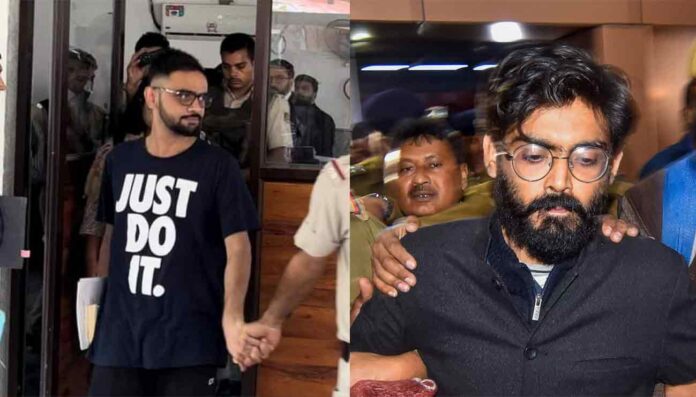
A Delhi court today rejected the fresh bail applications filed by Umar Khalid and Sharjeel Imam in the larger conspiracy case linked to the 2020 Anti-Hindu Delhi riots. Additional Sessions Judge Sameer Bajpai of the Karkardooma Court passed the order on Saturday, turning down the pleas for regular bail.
The court earlier in the day had reserved the verdict after hearing arguments from the petitioners and the prosecution. On the afternoon, the court pronounced the judgment, rejecting the plea for bail.
The two accused had approached the trial court last month seeking bail, primarily on the grounds of prolonged incarceration and lack of progress in the trial. Their applications came after a coordinate bench of the Supreme Court expressed reservations about the interpretation adopted by another bench while denying them bail on January 5, 2026. In that earlier order, the apex court had denied bail to Khalid and Imam while granting relief to five other co-accused in the same case.
#Breaking
— Bar and Bench (@barandbench) July 4, 2026
Delhi court rejects fresh bail applications filed by Umar Khalid and Sharjeel Imam.
They had filed for bail after Supreme Court bench raised objections to coordinate bench order denying them bail. #SharjeelImam #UmarKhalid pic.twitter.com/glRHQ0i2yQ
The fresh pleas highlighted that nearly six years have passed since their arrest in September 2020, with arguments on framing of charges still pending and little headway in the proceedings despite the passage of time.
Umar Khalid and Sharjeel Imam contended that the statutory bar under Section 43D(5) of the Unlawful Activities (Prevention) Act cannot justify indefinite detention when the trial is not likely to conclude soon. They relied on the Supreme Court’s observations in the K.A. Najeeb case, which recognised that prolonged incarceration without a reasonable prospect of early trial can warrant the grant of bail even in stringent cases under special laws, keeping in view the constitutional guarantee of personal liberty under Article 21.
However, the court rejected their arguments and refused to grant bail, citing Supreme Court orders in related matters. The Court held that the fresh bail applications filed by Umar Khalid and Sharjeel Imam were not maintainable. It observed that the Supreme Court, while dismissing their bail pleas on 05.01.2026 in the Gulfisha Fatima case, had expressly directed that the applicants would be at liberty to renew their prayer for bail only upon completion of the examination of the protected witnesses relied upon by the prosecution, or upon the expiry of one year from the date of that order, whichever occurs earlier.
The Court further noted that although the applicants argued changed circumstances on the basis of a subsequent Supreme Court judgment in Syed Iftikhar Andrabi, which had expressed reservations about the manner in which the K.A. Najeeb precedent was applied in the Gulfisha Fatima case, the issue of divergence between these two judgments has already been referred to a larger bench of the Supreme Court. Until that larger bench settles the legal position, the trial court cannot independently examine or act upon the plea of changed circumstances, the judgement stated.
Accordingly, the Court held that it had no option but to follow the binding directions contained in the Supreme Court’s 05.01.2026 order and dismissed both applications as not maintainable. The court said, “Thus, following the said order of the Hon’ble Supreme Court, this Court cannot entertain the applications and grant bail to the applicants. Infact the applications are not maintainable and they are hereby dismissed.”
The case arises from an FIR registered at the Karkardooma police station. It alleges a larger conspiracy behind the February 2020 communal violence in North East Delhi, which resulted in 53 deaths and injuries to over 700 people. The prosecution claims that activists and students, including the two accused, planned and coordinated anti-Citizenship Amendment Act protests in a manner that deliberately escalated into riots through meetings, speeches, formation of WhatsApp groups, chakka jams (road blockades), and mobilisation of crowds towards sensitive areas.
Umar Khalid faces charges under various sections of the Indian Penal Code, including those relating to rioting, unlawful assembly, murder, attempt to murder, sedition and promoting enmity between groups, besides provisions of the UAPA dealing with unlawful activities, terrorist acts and conspiracy, as well as the Arms Act. The prosecution attributes to him a central role in the alleged conspiracy, including participation in planning meetings and issuing directions for protest activities that allegedly created conditions for violence.
Sharjeel Imam is charged mainly under UAPA provisions for alleged involvement in unlawful and terrorist activities and conspiracy. The charge sheet alleges that he played a role in creating WhatsApp groups and articulating strategies for escalation of protests at the instance of others in the alleged conspiracy.
Both accused have consistently denied the charges, maintaining that they were engaged only in peaceful democratic protests against the CAA and had no role in any violence.
