

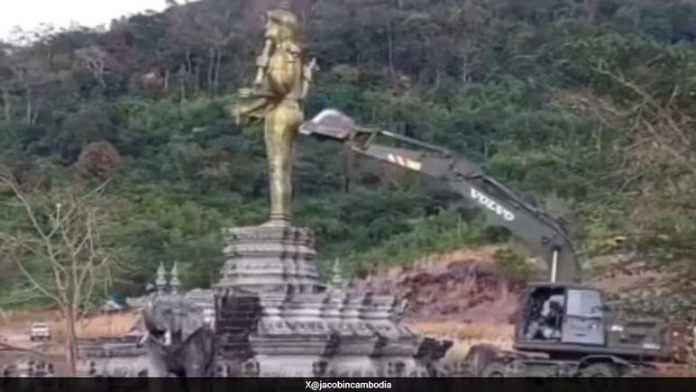
As tensions continue to simmer along the volatile Thailand–Cambodia border, the demolition of a towering statue of Lord Vishnu has added a sharp cultural and diplomatic edge to an already combustible dispute. After India and Cambodia condemned Thailand for demolishing the statue, Bangkok has issued a statement, claiming that the idol was razed for “security purposes” and not to hurt Hindu sentiments.
The incident, captured on video and widely circulated online, shows Thai military engineers using heavy machinery to bring down the Hindu deity’s statue in a contested border zone, triggering outrage in Cambodia and drawing a strong rebuke from India.
The nearly nine-metre-tall statue, erected in 2014, stood in the An Ses area of Cambodia’s Preah Vihear province, close to the Thai border. Cambodian authorities maintain that the structure was located well within their territory. Government spokesperson Kim Chanpanha said the site lay between 100 and 400 metres inside Cambodia and described the demolition as an attack on religious heritage revered by both Hindu and Buddhist communities.
“We condemn the destruction of temples and statues worshipped by Buddhist and Hindu followers,” Chanpanha said, stressing that the statue was not merely a symbolic structure but an active religious site.
Thailand, however, has pushed back against accusations of religious desecration. While Bangkok has not issued a detailed official statement, Thai military-linked sources and the Thai–Cambodian border press centre have claimed that the statue was built illegally in a disputed area at Chong An Ma.
According to Thailand, Cambodian forces erected the statue as a strategic move to assert sovereignty over land claimed by Thailand. Thai authorities have insisted that the demolition was carried out strictly for area management and security purposes after Thai forces regained control of the zone, and that it was not intended to disrespect religious beliefs.
“The removal was undertaken solely for security and area management reasons and was not intended to disrespect any religion or belief,” the statement said.
In a separate clarification, Bangkok added that the statue was neither registered nor officially recognised as a religious site. The Thai government also expressed “sincere regret for any discomfort caused by misunderstandings” arising from the circulation of images of the demolition.
The episode has unfolded against the backdrop of renewed military hostilities between the two Southeast Asian neighbours. Border clashes reignited in early December 2025 after a fragile ceasefire, brokered earlier by US President Donald Trump, had collapsed. Fighting has centred on long-contested stretches of the 800-kilometre border, including regions near culturally and historically sensitive sites such as the UNESCO-listed Preah Vihear Temple, which international court rulings awarded to Cambodia in 1962 and reaffirmed in 2013.
Since the latest escalation, both sides have accused each other of ceasefire violations. Thailand has carried out air operations using American F-16 and South Korean T-50 fighter jets, striking targets inside Cambodian territory. Cambodia has labelled these actions “armed aggression,” while Thailand maintains that its strikes are limited to military assets and are a response to Cambodian provocations. The renewed conflict has reportedly resulted in dozens of military and civilian casualties, large-scale displacement, and damage to infrastructure and cultural sites.
Against this backdrop, India stepped in with a firm but measured condemnation. On December 24, the Ministry of External Affairs expressed deep concern over the demolition of the Hindu deity’s statue, calling the act “disrespectful” and harmful to the sentiments of devotees worldwide. MEA spokesperson Randhir Jaiswal noted that Hindu and Buddhist deities are part of a shared civilisational heritage across the region and emphasised that such acts should not occur, regardless of territorial disputes.
“Notwithstanding territorial claims, such disrespectful acts hurt the sentiments of followers around the world,” the MEA said, urging Thailand and Cambodia to return to dialogue and diplomacy to restore peace and prevent further loss of life and damage to heritage.
The Vishnu statue controversy has thus become more than a localised border incident, it now symbolises how territorial disputes, military escalation, and cultural sensitivities can intersect, turning a geopolitical conflict into a matter of global religious and diplomatic concern.
