

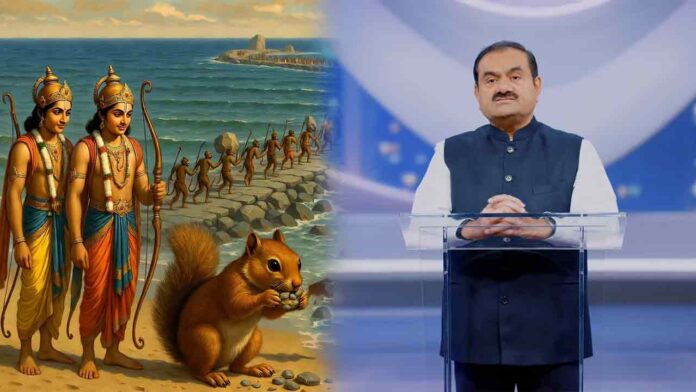
On the occasion of International Labour Day, Gautam Adani, Chairman of the Adani Group, delivered a heartfelt and motivational speech to the company’s over 400,000 employees, framing the day as a celebration of hard work, national contribution, and collective nation-building. He also elevated their role from workers to nation-builders and launched a new era of open dialogue within the Group. The address coincided with Adani’s personal milestone, the 40th anniversary of his marriage to Priti Adani.
In the address, Adani announced the launch of a new dialogue series titled “Apni Baat, Apno ke Saath” (Our Thoughts, With Our Own), aimed at fostering open communication, sharing learnings, and empowering employees across the conglomerate. He emphasised that life is a continuous journey of learning from the past, understanding the present, and shaping the future, a philosophy that has guided the Adani Group’s growth.
Adani began the day with a spiritual visit to Kedarnath Dham along with his wife Priti, where they sought blessings from Lord Shiva (Mahadev). He expressed gratitude for his life, the opportunity to serve India, and the trust placed in him by his colleagues, while praying for the nation’s endless progress and the well-being of all Adani employees.
Drawing from the Ramayana, Adani recounted the story of the tiny squirrel that contributed grains of sand to Lord Ram’s bridge to Lanka. He narrated that when the squirrel was asked what difference he could make by carrying tiny amounts of sand and pebbles to the sea, the squirrel had said, “what matters is that when history is written, it cannot be said that I did not make my contribution.”
As per the epic, when the vanars working on the bridge had mocked the squirrel, Lord Ram had scolded them, and told them that there were gaps in the big boulders used in the bridge, and the sand and pebbles carried by the squirrel and other such small animals were filling those gaps, making the bridge strong. Ram said that however small, every task is equally important.
Gautam Adani used this story to underscore that every contribution, big or small, matters in nation-building. He urged employees not to view their work merely as a job, but as an integral part of India’s development, directly linking it to Prime Minister Narendra Modi’s vision of a Viksit Bharat by 2047.
Highlighting flagship projects as symbols of national progress, Adani spoke about Mundra, which has transformed from barren land into India’s largest port; the Vizhinjam Port in Kerala, which will position India as a major global transshipment hub; the world’s largest green energy project at Khavda in Kutch, laying the foundation for a clean energy future; the Navi Mumbai International Airport, described as a symbol of India’s growing strength; and the recently inaugurated Ganga Expressway in Uttar Pradesh, which will connect 12 districts and over 500 villages, reducing travel time from Meerut to Prayagraj from 10–11 hours to just 5–6 hours.
He also spoke passionately about the redevelopment of Dharavi in Mumbai, calling it perhaps the world’s largest and most challenging endeavour in human transformation. Adani said the project was not undertaken for profit, but to provide the hardworking residents with the dignified life they deserve.
Adani then outlined three major organisational transformations, which he described as the three pillars for the Group’s future growth. The first is the 3-Layer Model, designed to flatten the organisation, accelerate decision-making, increase speed, and provide faster growth opportunities to young talent.
The second is the Partnership Model, which aims to work with a select group of strong, reliable partners who will take end-to-end responsibility for projects, fostering entrepreneurship and simplifying coordination. He illustrated this with the inspiring story of partner Hadhubhai Rabari, who rose from a camel-herding background to owning a major contracting business.
The third pillar is Learning and Development, including the establishment of the Adani Training Academy, to create clear skill progression pathways so that every employee can advance from unskilled to skilled roles and eventually to leadership positions.
He further outlined five foundational principles, which he called the Panchtatva (five elements) of the organisation. These include prioritising local hiring, continuous skill development and training, clear career progression with a focus on homegrown talent, fair and competitive salaries paid on time, and ensuring life with dignity through quality accommodation and nutrition.
Gautam Adani also announced the construction of air-conditioned housing for 50,000 colleagues and a massive cloud kitchen in Mundra capable of serving one lakh nutritious meals daily. “This is not a privilege. It is a necessity. Every worker has the right to live and work with dignity,” Gautam Adani said.
Concluding his address, Adani saluted the workforce and delivered the speech’s most powerful message: “You are not merely labourers. You are not merely employees. You are not merely officers. You are nation-builders.” He called upon them to take a pledge to view their work not just as a job, but as a contribution to nation-building.
आज का दिन मेरे लिए विशेष है, एक ओर विश्व श्रमिक दिवस है और दूसरी ओर मेरे विवाह की 40वीं वर्षगांठ।
— Gautam Adani (@gautam_adani) May 1, 2026
इस पावन अवसर की शुरुआत मैंने अपनी जीवनसंगिनी प्रीति के साथ केदारनाथ धाम में भगवान महादेव के दर्शन और आशीर्वाद से की।
चार दशकों की इस यात्रा में, प्रीति का साथ मेरे लिए केवल जीवन… pic.twitter.com/J3yW5tsK1d
Complementing the speech, Gautam Adani shared a post on X on May 1, 2026. He wrote in Hindi, “Today is a special day for me — on one hand it is International Labour Day, and on the other, it marks the 40th anniversary of my marriage. I began this sacred occasion with my life partner Priti by seeking the blessings of Lord Mahadev at Kedarnath Dham… Today, on the occasion of International Labour Day, I am launching a new initiative ‘Apni Baat, Apno ke Saath’ to connect with my more than 400,000 colleagues in the Adani family… It is my firm belief that when millions of members of the Adani family come together as collaborators with the resolve of nation-building, we will not only build projects but also make a humble contribution towards realising the dream of a developed India. Jai Shram Shakti, Jai Rashtra Shakti.”
