

An Indian soldier went missing in the death zone of Mount Everest 30 years ago, during one of the most disastrous trips in the country’s climbing record, reported The Tribune. Now, the government is currently organising a historic mission to return his mortal remains to his family. Lance Naik Dorje Morup had perished during an expedition in 1996, which met a tragic end due to the Mount Everest disaster that year.
The Indo-Tibetan Border Police (ITBP) has begun the process of recovering the remains in a unique and extremely complicated operation. Mountaineering experts termed this as one of the most difficult body retrieval missions India has ever attempted. ITBP has put out a tender to recruit a high-altitude recovery agency capable of accomplishing the task.
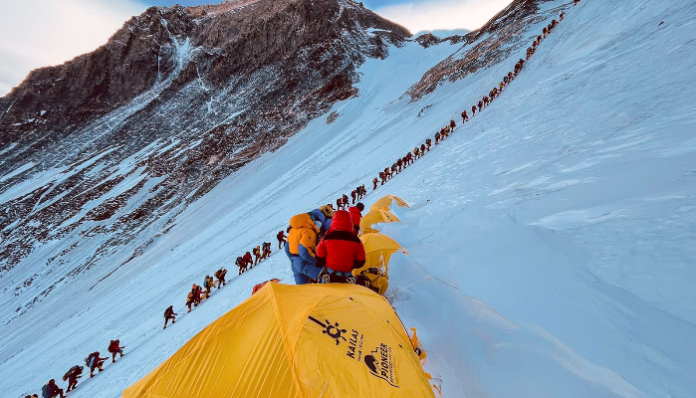
Morup’s remains are considered to be located deep within Everest’s infamous “death zone,” where oxygen levels are too low to support human life for extended periods of time, at an elevation of about 27,700 feet on the mountain’s northern, Tibet-facing slope. The planned operation is set for June through September. A team of professional Sherpas would ascend beyond 8,000 metres to find the body and convey it down the mountain before bringing the mortal remains to India via Nepal.
The tender document stated that at least 6 exceptionally skilled Nepali Sherpas, ideally Everest summiters with knowledge of technical retrieval operations above 8000 meters, would be needed for the mission. The chosen agency will also have to arrange transportation across the Tibet-Nepal border, obtain authorisations from the Chinese authorities in Tibet, satisfy the legal requirements for repatriation and guarantee the preservation of the remains, which have been subjected to below-freezing temperatures for nearly 30 years. The mission must be carried out completely in accordance with cultural and religious customs.
Marup and 2 others disappeared during one of the deadliest seasons in Everest’s history. The group was trying to reach the summit from the Tibetan mountain’s North Face. On 10th May 1996, three members of their six-person summit team withdrew due to severe weather. However, Subedar Tsewang Samanla, Lance Naik Dorje Morup and Head Constable Tsewang Paljor continued their journey. Later, an intense snowstorm covered the mountain, and they could not make it back to the camp.
The corpse of a climber close to a cave on the Northeast Ridge trail became a tragic symbol for mountaineers over time, earning the nickname “Green Boots” due to the characteristic green Koflach mountaineering boots evident on the body. Some experts and mountaineers believe it belongs to Paljor, while others speculate that it might be of Morup. However, “Green Boots” is listed next to Morup’s name in the ITBP tender form, suggesting that the force considers that the body is that of the latter.
In mountaineering, recovering bodies from the death zone is one of the riskiest operations. Rescuers face serious risks from avalanches, storms, falls, and oxygen deprivation. Furthermore, carrying even a dead climber a short distance at such a high altitude may require multiple Sherpas. The procedure was still in its early stages, and its completion would mostly depend on the weather in the upcoming months.
