

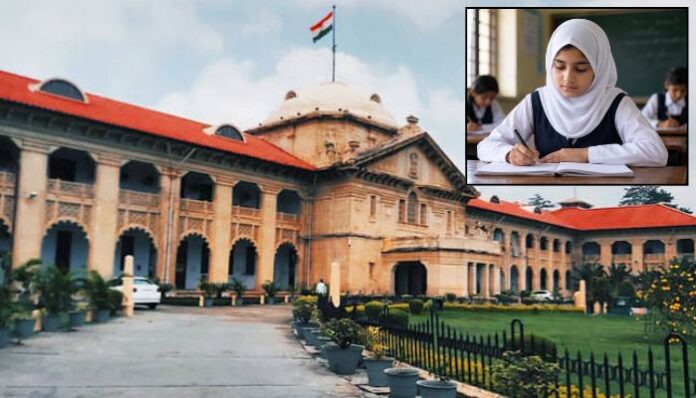
The Allahabad High Court has dismissed a plea filed on behalf of a minor Muslim student who wanted permission to wear a hijab along with her prescribed school uniform. The Court said a student cannot demand a change or exception to a dress code if the uniform policy is applied equally, fairly and without discrimination.
A Division Bench of Justice JJ Munir and Justice Indrajeet Shukla also said the petitioner had not placed enough material before the Court to show that wearing a hijab is an essential religious practice in Islam.
School uniform policy cannot be changed on individual demand
The case was filed by Sukaina Rizvi, a minor student of Tagore Public School in Attarsuiya, Prayagraj, through her mother. The private, unaided CBSE-affiliated school had taught her from Class VI to Class X, and she had passed Class X from there.
She sought admission to Class XI and wanted to continue wearing a hijab in addition to the school-prescribed uniform. She sought a direction to the school authorities to allow her to do so.
The student said she had worn a hijab during her earlier years in school without any objection. However, the High Court said the school’s earlier decision not to object did not create a legal right for her to continue wearing it.
The Bench said the school may have earlier failed to strictly enforce its uniform policy for several reasons, including inaction, courtesy or hesitation. But this could not prevent the school from later enforcing the same dress code.
The Court also noted that the school had not changed its uniform policy. The dispute arose because the student wanted to add a hijab to the prescribed uniform.
Court cites discipline, equality and institutional identity
The school said its dress code applied to all students and that other girls from the same religious community were following it. The principal also said that granting an individual exemption could affect discipline and school administration.
The State’s counsel supported the school, saying that deciding a uniform policy was mainly the responsibility of the school administration and was meant to maintain uniformity among students.
Agreeing with this view, the High Court said a uniform helps maintain discipline, equality and institutional identity. It also helps avoid visible differences among students and promotes a religion-neutral atmosphere in the classroom.
The Bench said allowing individual students to move away from the prescribed dress code on personal grounds could weaken the very idea of a uniform and shift the authority over school discipline from the institution to individual students.
No final Supreme Court ruling on hijab issue
The petitioner had argued that wearing a hijab was an essential religious practice and that stopping her from doing so violated her fundamental rights under Articles 14 and 19(1)(a) of the Constitution.
However, the Court found this to be only a bare claim. It said there was no sufficient pleading or authoritative religious material to show that wearing a hijab inside the classroom was compulsory or that not wearing it would affect the fundamental character of her faith.
The Bench referred to earlier rulings of the Kerala High Court in Fathima Thasneem (Minor) v. State of Kerala and the Bombay High Court in Fathema Hussain Sayed v. Bharat Education Society. It also examined the Karnataka High Court’s 2022 Full Bench judgment in Resham v. State of Karnataka, which held that wearing hijab is not an essential religious practice.
The Allahabad High Court said it had no reason to take a different view and described the Karnataka judgment as “persuasive authority of great value”.
It noted that the Supreme Court later gave a split verdict in Aishat Shifa (Hijab Case-2 J.) v. State of Karnataka. Since no final authoritative Supreme Court ruling has yet settled the issue, the High Court said the Karnataka ruling could still carry persuasive value.
The Bench also referred to the 2024 Bombay High Court decision in Zainab Abdul Qayyum Choudhary & Ors. v. Chembur Trombay Education Society’s NG Acharya and DK Marathe College and Ors. Though the Supreme Court later stayed the clause banning hijab, cap or badge in that case, the Allahabad High Court said an interim order without reasons is provisional and not a binding precedent.
The Court further noted that photographs on record showed that no other girl student, including those from the same religious community, was wearing a hijab. It ultimately dismissed the writ petition.
