

The National Eligibility cum Entrance Test Undergraduate (NEET-UG) paper leak sent shockwaves through the Indian education system, after which the Modi government decided to implement rigorous measures aimed at addressing the sensitive matter and holding those involved accountable.
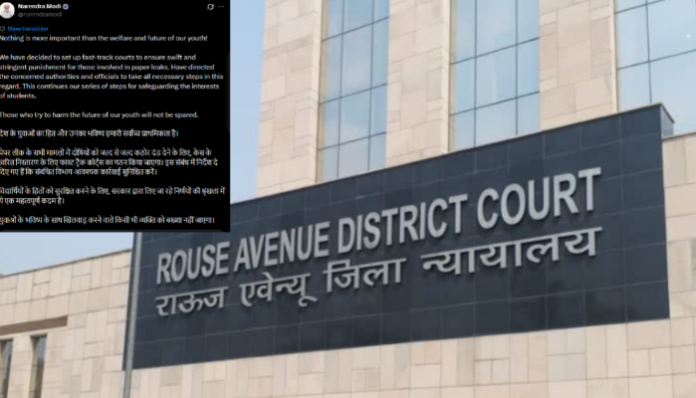
Hence, on 23rd July, Prime Minister Narendra Modi informed about the establishment of fast-track courts to guarantee prompt and severe punishment for individuals engaged in examination fraud. Delhi’s Rouse Avenue Court serves as an one such venue where Ajay Gupta presides as a Fast Track Special Court Judge, reported The Indian Express. He has been investigating the matter for more than 40 days at a rate that has afforded minimal scope for postponement.
Judge Gupta is scrutinising the case pertaining to the 13 defendants in this year’s NEET-UG paper leak, which has followed a series of interim applications, preliminary arguments and monitoring of the chargesheet. He has even frequently urged the lawyers to show up on time.
On 14th September (Monday), he even received a request to postpone arguments because the probe was underway. However, he told the defence, “Time is very precious. We can continue the hearing all day if necessary.” The nearly two-hour-long hearing provided a glimpse into the urgency with which he has approached the issue since taking over on 4th August.
Shivraj Raghunath Motegaonkar, the accused in the NEET-UG case, filed a motion asking the judge to postpone “arguments on charge” because further inquiry continued to be in progress. The trial commences after the arguments on charge, during which the agency must provide a “prima facie case.” This comes when the chargesheet is filed, acknowledged, and the materials are evaluated.
The first week of September saw the start of the arguments on charge, amid a two week period, document inspection was accelerated. The Central Bureau of Investigation (CBI) concluded its arguments on 6th September, while six of the 13 accused submitted their arguments on 8th September. The remaining arguments took place over the next two days.
Judge Gupta noted that the “arguments on the point of charge on behalf of CBI as well as all accused persons except A-5 have already been addressed at length and heard.” The observation was made in an order which was produced on Monday. Motegaonkar, the owner of Renukai Chemistry Classes (RCC) in Maharashtra’s Latur, is accused number 5.
He contended that the arguments need to be put on hold till the supplemental chargesheet was submitted. On the other hand, the CBI highlighted that a phone which was taken from him contained 136 handwritten questions, 111 of which matched the NTA’s (National Testing Agency) master question sets. It emphasised that hearing arguments on charges prior to the filing of a supplemental chargesheet was not legally prohibited.
Judge Gupta stated, “I have to look at other cases as well. Some other (Delhi High Court) notification has come,” as the verdict will be delivered on 18th September (Friday).
He has already advocated for the case to be expedited. He reprimanded defence counsel for being late during the first few days of his tenure. He expressed, “Understand my anxiety please. Every minute here is important, you all should be there at 10 am sharp. It can’t go on like this. Please be here at 10 everyday.”
Within days of their submission, Judge Gupta has also rendered decisions on a number of other applications, including those for a lie detector test, sacred texts and glasses in custody, virtual family meetings and further time for document inspection.
He recently rejected an accused’s request for more time to submit an application for release and mentioned that “this court is of the view that the accused already had sufficient time at her disposal and therefore, in case, accused was actually willing, she should have got her discharge application filed by today. It seems that the present application has been filed in order to drag/ delay the trial of the present case.”
Furthermore, he pointed out that arguments on the charge might have started on 13th August, the day after the charge sheet was cognisant, but they were delayed because several of the accused had put forward applications regarding vetting of document.
Additionally, Judge Gupta has been assigned to hear additional paper-leak cases that are pending in Delhi’s district courts under the Public Examinations (Prevention of Unfair Means) Act. He now has four of these cases, including two from Karkardooma Court and one from Dwarka, that is about to follow shortly. These cases concern recruitment tests for Lower Division Clerks and school employees that are conducted in Delhi.
On 28th July, the CBI presented its chargesheet which listed 13 individuals. On 12th August, Judge Gupta reviewed the submission and request for authorisation to conduct further probe was granted two days later. The CBI asserted that three NTA panel members and translators were the first to leak the NEET-UG material. According to its investigation, different hotel locations were utilised in April to “facilitate access” to the hacked documents, which were then shared on Telegram.
The case is developing at a rapid pace against the backdrop of national fury over examination paper leaks, which was sparked by the NEET-UG breach four months ago. NTA cancelled the 3rd May exam, which had almost 22 lakh applicants, nine days after the leak was discovered after which 21st June was selected as the date for another test.
PM Modi had assured, “Nothing is more important than the welfare and future of our youth,” in the aftermath of the issue. He announced, “We have decided to set up fast-track courts to ensure swift and stringent punishment for those involved in paper leaks. Have directed the concerned authorities and officials to take all necessary steps in this regard. This continues our series of steps for safeguarding the interests of students.” The prime minister added, “Those who try to harm the future of our youth will not be spared.”
Nothing is more important than the welfare and future of our youth!
— Narendra Modi (@narendramodi) July 23, 2026
We have decided to set up fast-track courts to ensure swift and stringent punishment for those involved in paper leaks. Have directed the concerned authorities and officials to take all necessary steps in this…
Under anti-paper-leak statutes, specialised fast-track courts expedite criminal prosecutions, ensure prompt accountability, reducing trial delays and legally defend constitutional right of students to take part in transparent public assessments.
