

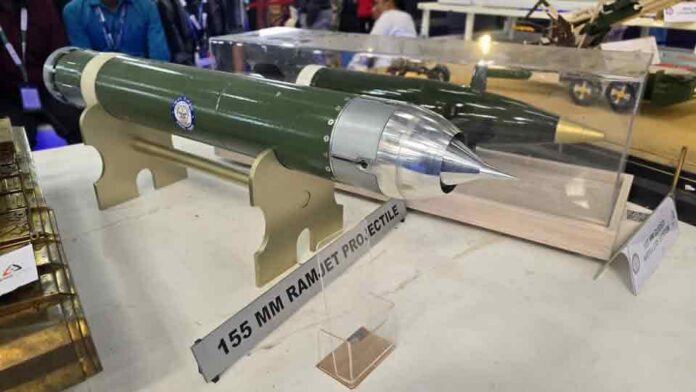
In a landmark achievement underscoring India’s push for self-reliance in defence technology, the Indian Army is on track to become the world’s first military force to operationally deploy ramjet-powered 155 mm artillery shells. This innovative development, a collaboration between the Indian Institute of Technology (IIT) Madras and the army, promises to revolutionise battlefield capabilities with unprecedented range and speed.
The ramjet shell increases the strike range of standard ammunition by 30–50%. While traditional artillery shells can reach roughly 40-50 km, the ramjet variant can strike targets up to 80 km away, that too with a much faster speed. The shells are also being equipped with Precision Guidance Kit (PGK), utilising India’s indigenous NavIC satellite system, to maintain accuracy at extended distances.
The project, part of the ‘Atmanirbharta’ initiative, has progressed through developmental trials, with the shells capable of reaching Mach 3 speeds, over three times the speed of sound. As per reports, the shells have demonstrated encouraging performance during live trials held at Rajasthan’s Pokharan Field Firing Range. The new shell is currently undergoing structured developmental trials at IIT Madras.
Professor P.A. Ramakrishna from the Department of Aerospace Engineering, IIT Madras, said that once the shell is fully developed, the Indian Army will be able to use it with any gun capable of firing 155 mm artillery shells. He added that it can also be retrofitted onto existing 155 mm artillery shells. This means the shell will be compatible with the wide range of Indian artillery guns, including the Dhanush, K9 Vajra-T, and M777 howitzer.
The ramjet-powered shells are estimated to be inducted into the army by this year or next year. The project has been approved by the Army Technology Board, and Munitions India Limited (MIL) is designated to handle large-scale production, once final validation is completed.
The ramjet engine, at the heart of this advancement, is a type of air-breathing jet propulsion system that relies on the projectile’s forward motion to compress incoming air for combustion, eliminating the need for complex rotating compressors or turbines. Unlike traditional turbojet engines, ramjets have no moving parts in the compression stage, instead, they “ram” air into the combustor at high speeds, mixing it with fuel to generate thrust. This design makes them highly efficient for sustained supersonic flight but requires an initial boost to reach operational speeds, typically above Mach 2.
Ramjets perform best in thin, high-altitude air and are ineffective at low speeds or standstill, which is why they are often paired with rocket boosters for launch. In the case of artillery shells, the initial boost will be provided by the gun.
Ramjet technology has long been a staple in missile systems, where it enables extended ranges and high velocities. India’s own BrahMos supersonic cruise missile also uses ramjet propulsion for speeds up to Mach 3 and ranges exceeding 290 km. Most other major defence powers have ramjet powered missiles, but ramjet powered shell is new development.
Applying ramjet propulsion to artillery shells marks a novel adaptation, where the shell is initially fired from a standard 155 mm howitzer like the indigenous Advanced Towed Artillery Gun System (ATAGS). Once airborne, the ramjet engine activates, providing additional thrust to propel the munition far beyond conventional limits. Traditional artillery shells rely solely on the explosive force from the gun’s chamber and gravity, typically achieving ranges of 30-50 km. In contrast, these ramjet-assisted rounds could extend effective strike distances up to 80 km or more, while achieving hypersonic speeds that enhance kinetic impact and reduce time-to-target.
This enhancement will significantly boost India’s artillery capacities, offering strategic advantages in modern warfare. Longer ranges allow armed forces to engage targets from safer positions, minimising exposure to counter-battery fire. Higher speeds make the shells harder to detect and intercept by enemy air defences, increasing survivability and lethality.
Additionally, the integration with precision guidance systems ensures pinpoint accuracy, transforming artillery into a more versatile tool for conflicts. This could also trigger global interest, potentially leading to exports and further innovations in extended-range munitions.
