

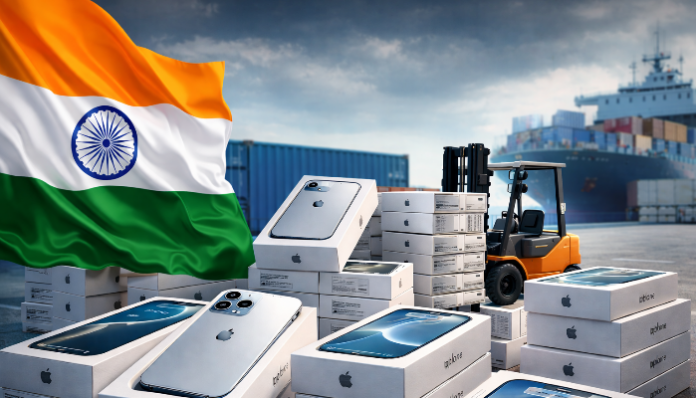
Apple Inc. exported an unprecedented $50 billion in iPhones through its Indian dealers up to last December, reported The Economic Times. The tech giant is the second-largest corporation in the world by market value. In FY22, it joined the smartphone production-linked incentive (PLI) program. With three months left in the company’s five-year PLI scheme tenure, the export total would increase substantially.
An official mentioned, “In the first nine months of FY26 alone, Apple has already exported nearly $16 billion, taking the cumulative iPhone exports past $50 billion within the PLI period.” During that specific five-year period, from FY21 to FY25, Samsung, the other mobile phone exporter and one of Apple’s largest international competitors, shipped out approximately $17 billion worth of handsets.
Currently, a supply chain of around 45 businesses, including several MSMEs, is anchored by five iPhone factories, three run by Tata and two under Foxconn, that produce parts for Apple’s worldwide and local supply chains. The category is now India’s top export line item in FY25, up from 167 in 2015, owing to exports of iPhones, which account for 75% of all smartphone sales.
Even though the smartphone PLI will expire in March of next year, the government aims to keep helping the sector in some form. A plan to offer incentives that support manufacturing will be developed in agreement with the industry. An official disclosed, “We agree that there is still a disability with Indian manufacturers when compared with countries like China and Vietnam, and we will continue to offer support to the industry.”
Even before the PLI system, there were some recorded mobile phone exports. However, after its launch, Apple decided to move its suppliers to India, which is the only nation other than China where iPhones can be manufactured. PLI’s launch has been the main driver behind the incredible outcome.
Out of the ten beneficiaries, Samsung was the only one to terminate the program in FY25. The company was able to meet output requirements in FY21, the inaugural year of the initiative, because of its already functioning manufacturing unit.
Due to the epidemic and strained India-China ties, Apple, in addition to others like Dixon, failed to reach the first year’s targets while establishing new plants. As a result, the government prolonged the program by one year. Samsung benefited from the incentives for FY21 to FY25, and all other firms took advantage of them for FY22 to FY26, as the condition was that businesses might access the perks for any successive five years of the six years.
Samsung and Apple’s suppliers have been chosen for the electronics component production program to maintain the momentum. Samsung plans to create 300 new jobs by manufacturing a display module sub-assembly. However, with five of the company’s partners approved under the second tranche of the program, the Apple ecosystem has once again reached maximum capacity.
Apple vendors would provide more than 60% of the investments and employment opportunities. The major suppliers are Motherson, Tata Electronics and Foxconn, who will produce iPhone enclosures. ATL will produce Li-ion cells, and Hindalco is set to handle aluminium extrusion.
India is also beginning to export electrical components to China and Vietnam for the first time to manufacture Apple products, including MacBooks, AirPods, Watches, Pencils and iPhones.
Ashwini Vaishnaw lauds “Make in India”
Minister of Electronics and Information Technology, Ashwini Vaishnaw, hailed the major development and credited Prime Minister Narendra Modi’s ambitious “Make in India” for the same.
He remarked, “Electronics production has increased 6 times in the last 11 years. And electronics exports have grown 8 times under PM Modi’s focused leadership. This progress has propelled electronics products among the top 3 exported items.” He stated that the producers of laptops, servers, and headphones, together with 46 component manufacturing projects, are contributing to the ecosystem and making the production of electronics an essential component of the manufacturing sector.
In a major milestone for PM @narendramodi Ji’s 'Make in India' and our quest to become a producer economy, Apple ships $50 billion worth mobile phones in 2025.
— Ashwini Vaishnaw (@AshwiniVaishnaw) January 5, 2026
Electronics production has increased 6 times in last 11 years. And electronics exports have grown 8 times under PM…
Vaishnaw added that this year, four semiconductor facilities will begin commercial production. “Total jobs in electronics manufacturing are now 25 lakh, with many factories employing more than 5,000 employees in a single location. Some plants employ as many as 40,000 employees in a single location,” he conveyed.
The minister further declared, “This is just the beginning. Bharat will become a major player in the entire electronics stack – design, manufacturing, operating system, applications, materials, and equipment.”
