

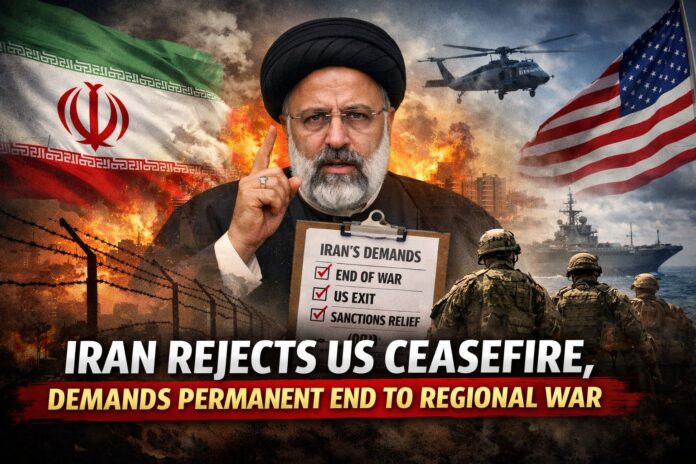
Iran has turned down a US-backed ceasefire proposal and instead routed its counter-position through Pakistan, which has been acting as an intermediary in the ongoing backchannel talks, according to state-run IRNA.
Tehran’s message is blunt: a short-term pause won’t cut it. Any deal, it insists, must guarantee a decisive and permanent end to hostilities, while safeguarding Iran’s strategic and economic interests. While the specifics of the American proposal remain undisclosed, Iran’s rejection signals a widening gap between Washington’s tactical pause and Tehran’s demand for a structural reset of the conflict.
Behind the scenes, Iran has reportedly laid out a maximalist framework. It is pushing for a region-wide cessation of conflict, not just within its borders, but across flashpoints like Lebanon and Gaza, backed by enforceable guarantees. More significantly, Tehran is said to be demanding the withdrawal of US military presence from the Persian Gulf, a condition that strikes at the core of Washington’s regional security architecture.
Control over the Strait of Hormuz has also emerged as a central lever. Iran is seeking formal recognition of its authority over the critical energy corridor, along with the right to regulate transit and impose tolls, an ask that could fundamentally alter global energy logistics. Alongside this, Tehran wants sanctions relief, acknowledgement of its nuclear rights under the NPT, and financial reparations for wartime losses.
This comes even as the White House acknowledges that a 45-day ceasefire plan is on the table, though not yet approved by President Donald Trump. US officials have described it as one of several options under consideration, even as military operations under “Operation Epic Fury” continue unabated.
Trump, in characteristic fashion, escalated rhetoric over the weekend, warning Iran of direct strikes if it continues to restrict movement through Hormuz. His blunt messaging underscores the high-stakes nature of the standoff, where economic chokepoints and military escalation are tightly intertwined.
Despite diplomatic flurries involving regional players like Egypt, Iran has publicly maintained that it is not engaged in direct negotiations with either the United States or Israel, reinforcing the opacity surrounding the talks.
The conflict, which erupted on February 28 following US-Israeli strikes that killed Iran’s Supreme Leader, has since spiralled into a broader regional crisis. Its ripple effects are already visible, with energy markets rattled, shipping routes disrupted, and geopolitical fault lines hardening.
