

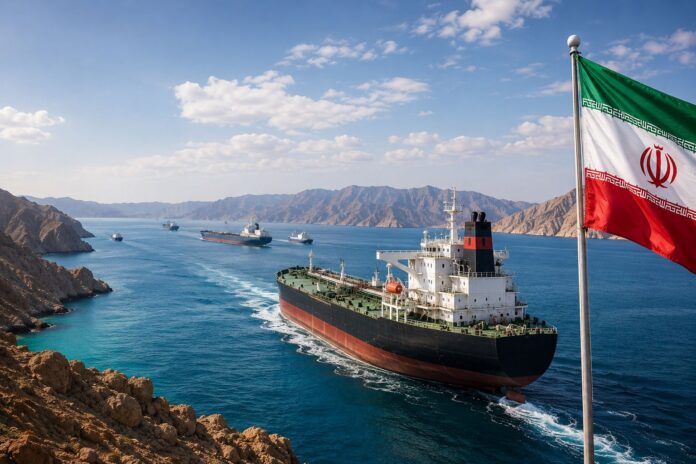
Iran on Monday announced that vessels passing through the strategically vital Strait of Hormuz will be required to pay a “maritime service fee,” even as Tehran reiterated its deep distrust of the United States despite reaching a framework agreement aimed at ending the months-long conflict.
BREAKING: Iran says the US has agreed to permanently hand over the Strait of Hormuz to Iran under their full sovereign authority, with Iran collecting tolls called "service fees" from all commercial ships after a 60-day waiver period. The opening is planned for Friday, after the…
— The Hormuz Letter (@HormuzLetter) June 15, 2026
Addressing reporters, Iranian Foreign Ministry spokesperson Esmail Baghaei clarified that Iran was not imposing a transit toll on ships using the waterway. Instead, vessels would be charged for services such as navigation assistance, environmental protection measures, insurance coverage, and other maritime support operations.
“We have never sought to levy transit tolls,” Baghaei said. “However, charges for navigation services, environmental safeguards, ship insurance, and other essential services will be collected.”
While welcoming the newly signed memorandum of understanding with Washington as a step towards de-escalation, Baghaei stressed that Tehran’s scepticism towards the US remains unchanged.
“Iran’s deep mistrust of the United States is rooted in a long history of American actions against our nation,” he said. “Washington still has a considerable distance to travel before it can regain the trust of the Iranian people.”
Baghaei described the agreement as “only an initial step” towards ending the conflict that erupted on February 28, when joint US-Israeli strikes on Iran triggered a devastating war and resulted in the death of Iran’s then Supreme Leader, Ayatollah Ali Khamenei.
He added that a key component of the understanding involves the release of Iran’s frozen overseas assets and compensation for war-related damages, commitments Tehran considers essential for the deal’s success.
The spokesperson also called on Washington to ensure that Israel adheres to its obligations under the broader regional framework. “The United States must honour its commitments and ensure that the Zionist regime does the same, including with respect to Lebanon,” he said.
The comments came just hours after Iran and the US agreed on a framework to halt hostilities, a conflict that rattled global markets and sent energy prices soaring after disruptions in the Strait of Hormuz, one of the world’s most critical oil and natural gas shipping routes.
Although the full details of the agreement have not yet been made public, mediator Pakistan indicated that a formal signing ceremony is expected in Geneva on Friday. Even if maritime traffic through the Strait resumes normally, analysts caution that it could take months for global energy markets to recover from the shock caused by the waterway’s disruption.
