

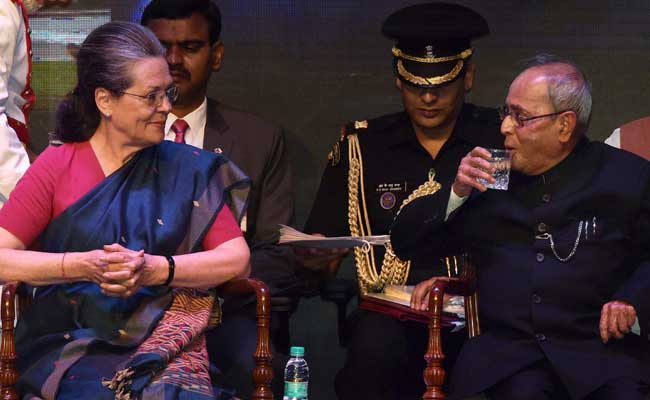
A fresh political controversy has erupted following revelations in Congress leader Sonia Gandhi’s memoir about former President Pranab Mukherjee’s Prime Ministerial ambitions. Mukherjee’s daughter, Sharmistha Mukherjee, has now hit back at Gandhi, questioning why her father’s desire to occupy the country’s highest political office should have come as a surprise.
In a strongly worded post on X (formerly Twitter), Sharmistha defended her father’s ambition, arguing that it was backed by decades of political and administrative experience, hard work and intellectual ability. She also recalled asking her father whether he wanted to become Prime Minister, to which he replied that “any politician worth his salt has this ambition”.
“What’s there to get ‘shocked’ about? Is it a crime to be ambitious, especially when that ‘ambition’ was supported by decades of experience in politics and governance, hard work and a brilliant mind?” she wrote.
What’s there to get ‘shocked’ about? https://t.co/G176imSSfy
— Sharmistha Mukherjee (@Sharmistha_GK) November 10, 2026
Her response came after Sonia Gandhi, in her memoir Belonging: A Journey of Love, recounted a conversation with Pranab Mukherjee in 2010 that she interpreted as a subtle indication of his desire to become Prime Minister.
According to Gandhi’s account, Mukherjee had expressed his displeasure over differences with then Finance Minister P Chidambaram. During the conversation, he reportedly suggested that perhaps “it was time for a change at the top”.
Gandhi wrote that she understood the remark as a hint about Mukherjee’s long-standing Prime Ministerial ambitions. She said she chose to gently steer the conversation in another direction and added that Mukherjee never subsequently made her feel that he resented her response.
‘No one served him positions on a platter’: Sharmistha defends father
Taking issue with the apparent surprise surrounding her father’s ambitions, Sharmistha highlighted his humble beginnings and argued that he had earned every position through merit and hard work rather than political inheritance.
“My father came from a very humble background. Whatever he achieved in his life was through sheer merit and hard work. There was no one to serve him positions, including PM-ship, on a platter due to dynastic entitlements,” she wrote.
She then questioned whether Sonia Gandhi was uncomfortable with the possibility of someone outside the Gandhi-Nehru family aspiring to become Prime Minister and openly expressing such an ambition.
“If a well-deserving person harbours ambition to become Prime Minister, what’s wrong in that, unless Sonia ji was ‘shocked’ by the fact that anyone outside Gandhi-Nehru family could even dare to nurture such an ambition and furthermore dared to ‘hint’ it to her?” Sharmistha asked.
Her remarks brought the issue of political dynasties and meritocracy into the debate surrounding Sonia Gandhi’s memoir.
‘He did not hold it against her’: Daughter clarifies Pranab Mukherjee’s position
Sharmistha also addressed another aspect of Sonia Gandhi’s recollection, in which the Congress leader suggested that Pranab Mukherjee never held the episode against her.
Referring to her father’s diaries and personal conversations with him, Sharmistha sought to reassure Gandhi that her father did not harbour any resentment over the matter.
“In this same context, I read that she said she felt ‘he never held it against me’. From what I read in his diaries and whatever conversation he had with me, I would like to reassure her that he DID NOT hold it against her or anyone else,” she wrote.
Describing her father as a pragmatic and understanding individual, she added that he understood Sonia Gandhi’s reasons and recognised that human beings, irrespective of their positions, could be vulnerable to insecurities.
Pranab Mukherjee served as India’s 13th President from 2012 to 2017. Before assuming the constitutional office, he was among the most influential leaders in the Congress-led UPA governments, holding key portfolios such as Finance, Defence and External Affairs.
Despite his extensive experience and standing within the Congress, Mukherjee never became Prime Minister. His daughter’s response has now brought renewed attention to the political ambitions of one of the Congress party’s most experienced leaders and the power dynamics that shaped the party’s leadership.
