

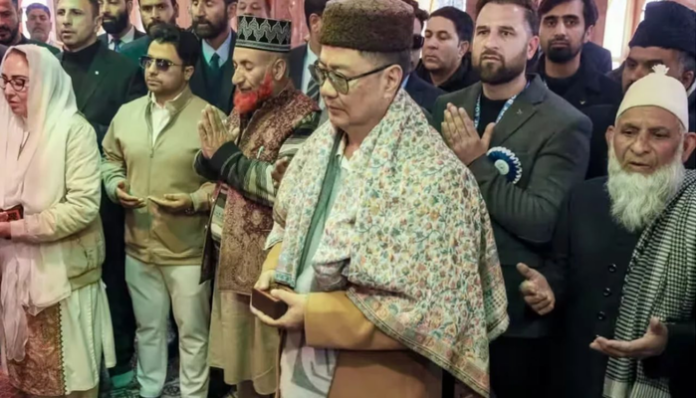
क्या वंदे मातरम BJP का गाना है? या पाकिस्तान का ? श्रीनगर में वक्फ कार्यक्रम के दौरान वंदे मातरम बज गया, तो कुछ मौलानाओं को दिक्कत हो गई. उन सभी मौलानाओं को माफी मांगनी पड़ी, जो जो इस गीत के दौरान खड़े हुए थे https://t.co/LU3KvU30C4
— Shalu Awasthi شالو اوستھی (@Shalu_official) November 26, 2026
Consequently, the Muslim clerics offered repentance prayers to Allah and recited the Qalma as reaffirmation of faith and sought forgiveness from Allah. The clerics issued a statement on Wednesday (November 25, 2026) apologising for hurting religious sentiments for attending the event where the national song was played.
“Since we attended the gathering, if our participation has hurt anyone’s religious sentiments, we sincerely repent before Allah and pray that He accepts our repentance,” the statement issued by the clerics said. Notably, Islamists oppose the Vande Mataram song and term it as un-Islamic for lyrics glorifying the motherland as divine.
Srinagar: Row erupts over Vande Mataram recitation at a Waqf event; Mutahida Majlis-e-Ulama to seek legal opinion over alleged imposition. India Today’s Sunil Bhat shares details #ITVideo #Srinagar #VandeMataram #MMU #KirenRijiju | @Sriya_Kundu @sunilJbhat https://t.co/WZWkWeTCeu
— IndiaToday (@IndiaToday) November 26, 2026
The event was organised by BJP leader and J&K Waqf Board chairperson Darakhshan Andrabi at the Sher-e-Kashmir University of Agricultural Sciences and Technology, Srinagar, on Monday (November 23, 2026). It was attended by Union Minister for Minority Affairs Kiren Rijiju.
The Muslim clerics present at the event included Mufti Syed Basharat, Mufti Farooq, Mufti Inayatullah Qasmi, Maulana Farooq, Maulana Basharat Sakafi, Pir Syed Ejaz, Maulana Zakir, Abdul Rashid Dawoodi and imams of the Dastigeer Sahib shrine and the Hazratbal shrine.
The act of repentance by the Muslim clerics was welcomed by their co-religionists, including Maulana Rahmatullah, the head of Kashmir’s biggest seminary, Darul Uloom Raheemiyyah. “I congratulate these religious leaders for their immediate repentance prayers and reciting the ‘kalima’ again for the mistake. Allah must be pleased with them,” said Rahmatullah.
Muslim organisations condemned playing of Vande Mataram
Several Muslim organisations, particularly Mutahida Majlis-e-Ulam (MMU), an umbrella of several religious and social organisations in Kashmir, strongly condemned the playing of Vande Mataram at the event. The organisation, headed by Kashmir’s chief cleric Mirwaiz Umar Farooq, asserted that there can be no compromise on the Tawheed (oneness of God) and religious freedom.
A statement released by the organisation clearly stated that attributing divinity to the motherland goes against the fundamental beliefs of Islam. “While Islam encourages love for one’s homeland, it draws a clear distinction between love for one’s homeland and its worship or deification. Any expression or practice that attributes divinity to the motherland is contrary to the fundamental Islamic belief of Tawheed and is, therefore, un-Islamic and impermissible for Muslims,” the statement said.
MMU Strongly Condemns Playing of Vande Mataram at Waqf Day Ceremony Raises Concern Over Its Growing Imposition in J&K To seek legal opinion and submit formal representation to authorities against its forcible imposition Reiterates that there can be no compromise on Tawheed and religious freedom Srinagar Nov 25, 2026: Mutahida Majlis-e-Ulama (MMU) Jammu and Kashmir, the representative amalgam of religious organisations and institutions across various schools of Islamic thought, has taken strong exception to the playing of Vande Mataram at the Waqf Day ceremony organised by the J&K Waqf Board in Srinagar. MMU stated that, as it has categorically made clear on several occasions in the past, the fundamental and non-negotiable principle of Tawheed in islam — the absolute Oneness of Allah. Islam strictly prohibits associating any partner with Allah or attributing divinity to any person, object, land or creation. While Islam encourages love for one’s homeland, it draws a clear distinction between love for one’s homeland and its worship or deification. Any expression or practice that attributes divinity to the motherland is contrary to the fundamental Islamic belief of Tawheed and is, therefore, un-Islamic and impermissible for Muslims. MMU pointed out that the All India Muslim Personal Law Board (AIMPLB) has also categorically clarified the Islamic position on Vande Mataram and strongly opposed its compulsory rendition on both religious and constitutional grounds. “It is highly regrettable and unacceptable that Vande Mataram was played at a function organised by the Waqf Board itself, an institution entrusted with safeguarding Muslim religious endowments and their sanctity. There was no legal obligation to play Vande Mataram simply because it was an official function, and playing it was optional . Yet the waqf board went ahead with it with utter disregard for the fundamental religious beliefs and sensitivities of Kashmiri Muslims, which has caused deep hurt and anguish among people MMU expresses grave concern over the increasingly routine inclusion of Vande Mataram at official government functions across Muslim-majority Jammu and Kashmir, despite the well-known religious reservations of Muslims. Such imposition disregards their religious convictions and constitutional rights and deepens distrust and alienation. In view of the growing seriousness of the issue, MMU is deliberating upon seeking legal opinion in this matter and will also submit a formal representation to the concerned authorities , seeking an immediate end to the forcible imposition of Vande Mataram at government functions, educational institutions and other public events in Jammu and Kashmir, urging respect for the constitutionally guaranteed freedom of faith and conscience. MMU also reminds Muslims, particularly those entrusted with religious responsibilities, of their obligation to uphold the fundamental principles of Islam, irrespective of any pressure, position or consideration. MMU once again makes it unequivocally clear that on matters of faith, particularly the cardinal principle of Tawheed, there can be neither ambiguity nor compromise.
— Mirwaiz Manzil-Office of Mirwaiz-e-Kashmir (@mirwaizmanzil) November 25, 2026
The MMU also urged Muslims, particularly those entrusted with religious responsibilities, “to uphold the fundamental principles of Islam, irrespective of any pressure, position or consideration”. The organisation said that it is considering “seeking legal opinion in this matter and will also submit a formal representation to the concerned authorities”.
Pertinently, the national song is played at specified official events in compliance with a January 28, 2026, order that mandates the playing of the full six-stanza Vande Mataram before the national anthem and also requires the audience to stand. Furthermore, the recent 2026 amendment to the Prevention of Insults to National Honour Act makes obstructing the singing of Vande Mataram punishable with up to three years in jail.
