

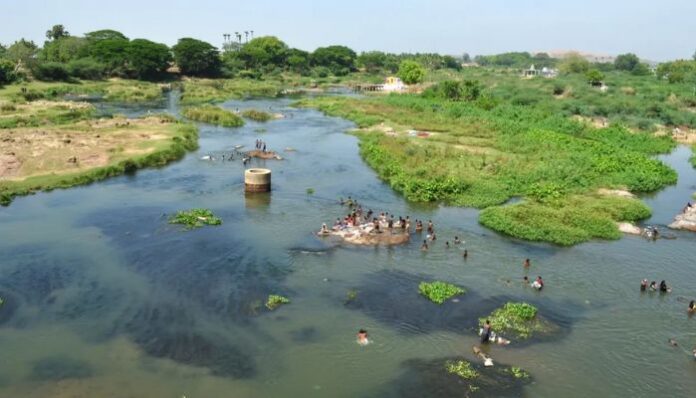
The Madras High Court has recognised the Thamirabarani River in Tamil Nadu as a juristic person for the limited purpose of protecting it from pollution. The Court said the river has been given this legal status because it is worshipped as a deity by Hindus and not merely because it is a river.
A Bench of Justices GR Swaminathan and B Pugalendhi passed the order while dismissing a petition filed by Sivanupandian, who had challenged his eviction from a 400-year-old mandapam at a bathing ghat in Papanasam.
The Court clarified that the declaration gives the river only one legal right not to be polluted. It said no other rights, duties or legal responsibilities arise from this recognition. The Bench observed that polluting the Thamirabarani would violate environmental laws, the fundamental right to life under Article 21 of the Constitution, and the rights of the river itself.
Pollution and court directions
During the hearing, the Court was informed about the growing pollution caused by ritual activities. An activist told the Bench that around one tonne of used clothes is thrown into the river every day. A booklet submitted before the Court showed that between 7th May and 28th May, cleaning drives removed 86 to 90 tonnes of clothes, 2.2 tonnes of holy ash, 1,385 kg of plastic waste, 220 kg of glass bottles, and 374 kg of sanitary napkins and diapers.
The Court said religious practices cannot be used to justify polluting a water body. It banned the dumping of clothes and other articles into the river and directed the Tirunelveli district administration to enforce the ban, spread awareness and involve civil society in keeping the river clean. Local bodies have also been asked to pass resolutions imposing fines on violators. The Bench warned that polluting the river could invite contempt of court proceedings, adding that its directions would continue as a continuing mandamus.
However, the Court allowed the immersion of ashes, considering its religious significance. It directed that ashes should be immersed only in unfired earthen pots that dissolve naturally in water.
Eviction upheld
The Court found that the land occupied by Sivanupandian was recorded as “river poramboke” and described as the Thamirabarani River in revenue records. It ruled that a riverbank cannot be separated from the river and must remain free from encroachments. The Bench also noted that the ancient stone mandapam had been altered beyond recognition by the construction of walls.
The Court ordered the Arulmighu Papanasa Swamy Temple to immediately take over the mandapam and restore it with the help of the Archaeological Survey of India.
Referring to the Valmiki Ramayana, the Mahabharata and Kalidasa’s Raghuvamsam, the Bench said the Thamirabarani holds deep religious significance. It also observed that under Hinduism, a deity need not be linked to a particular idol or shrine to be recognised in law.
Advocate S Ramasamy appeared for the petitioner, while Additional Advocate General B Saravanan, assisted by Government Advocate M Kannan, represented the district and temple authorities. Advocate VR Shanmuganathan appeared for the Hindu Religious and Charitable Endowments Department.
Thamirabarani River
The Thamirabarani River is a vital, perennial waterway that flows entirely within the southern Indian state of Tamil Nadu. Originating high in the sacred Pothigai Hills of the Western Ghats, the river travels roughly 128 kilometres through the vibrant districts of Tirunelveli and Thoothukudi before finally emptying into the Gulf of Mannar. Its mineral-rich waters carry a distinct, natural copper tinge, which gives the river its unique name, derived from the Tamil word Thamiram meaning copper. Serving as the primary agricultural and ecological lifeline for the southernmost region of India, it holds immense economic and cultural importance.
In Hinduism, the Thamirabarani River is deeply revered as a sacred, living deity, personified as Goddess Thamirabarani Devi. Hindu mythology associates its origin with the revered Vedic sage Agastya, who is said to have brought the river forth from his holy water pot on the peaks of Agastyarkoodam to bless the land. This spiritual legacy makes the river the absolute centrepiece of the Thamirabarani Pushkaram, a massive religious festival celebrated once every 12 years where millions of pilgrims gather to take a holy dip to cleanse their sins. Furthermore, the riverbanks are considered highly auspicious, lined with prominent holy shrines such as the Nava Kailasam temples dedicated to Lord Shiva and the Nava Tirupathi temples dedicated to Lord Vishnu.
