

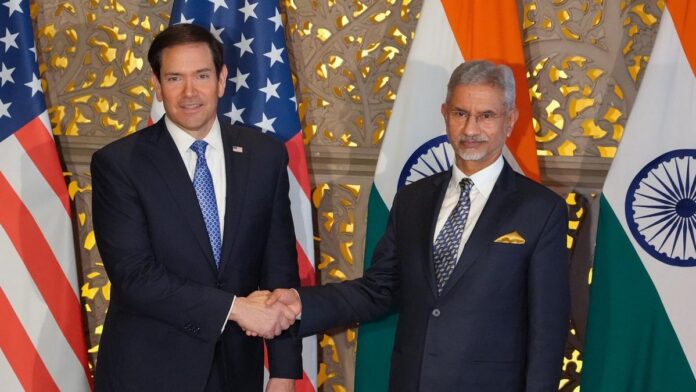
US Secretary of State Marco Rubio has dismissed the United Nations experts’ criticism of India’s handling of protests against the Election Commission, describing the term “UN experts” as an “oxymoron” and asserting that India’s domestic political matters should be left to Indians.
Speaking on Wednesday, October 21, Rubio was asked about protests involving opposition parties and students in India, as well as allegations by UN experts that authorities had cracked down on demonstrators.
Rubio made it clear that Washington would not comment on India’s internal political affairs, pointing to the country’s democratic system and electoral process.
“Well, the UN experts, my favourite. The UN experts are an oxymoron,” he remarked.
Asked whether the United States had concerns about the alleged crackdown, Rubio declined to offer an assessment of India’s handling of the protests.
“No, it’s a domestic political matter. This is a democracy; they have elections here. I am not going to opine on their political matters,” the US secretary of state said.
Rubio also distinguished peaceful demonstrations from violent unrest involving vandalism and the destruction of property. He said the freedom to express differing political opinions was an important feature of democratic societies, while making clear that he was not referring to riots involving the burning and destruction of buildings.
“I am not talking about the riots, what you see in Europe. They are vandalising and breaking and burning down buildings. I am not talking about that,” he added.
India pushes back against UN experts’ criticism.
Rubio’s remarks come amid a diplomatic exchange between India and UN experts over allegations concerning the treatment of protesters.
The UN experts had raised concerns about alleged restrictions on peaceful assembly, the excessive use of force against demonstrators and reports of enforced disappearances. Their criticism drew a strong response from New Delhi, which rejected what it described as attempts to portray India negatively using unverified allegations and incomplete statistics.
On Tuesday, Indian diplomat Barkha Tamrakar addressed the issue at the United Nations, defending India’s human rights framework and the constitutional protections available to its citizens.
Tamrakar emphasised that the Indian Constitution provides safeguards for individual rights and due process, citing Article 21, which protects the right to life and personal liberty.
“India firmly opposes any attempt to convert unverified allegations, incomplete statistics, or a report that contains no India-specific observation into a negative characterisation of the world’s largest democracy,” she said.
She also cautioned against the selective use of human rights concerns to exert pressure on particular countries.
“Human rights should not be used as an instrument of political pressure or selective country targeting,” Tamrakar added.
India called for human rights assessments to be impartial and grounded in evidence, arguing that countries should not be subjected to selective scrutiny based on allegations that have not been adequately substantiated.
Rubio refuses to weigh in on India’s domestic politics
Rubio’s response underscores Washington’s decision not to take a public position on the specific allegations surrounding the protests. Rather than endorse the UN experts’ assessment, the US secretary of state stressed that India has its own democratic institutions and electoral mechanisms through which domestic political questions should be addressed.
His dismissal of the term “UN experts” also delivered a pointed rebuke to the body’s critics of India, even as New Delhi challenged the factual basis and framing of their allegations.
The exchange comes amid a broader debate over the role of international bodies in assessing human rights practices within sovereign countries, with India insisting that such scrutiny must be evidence-based and free from political bias.
