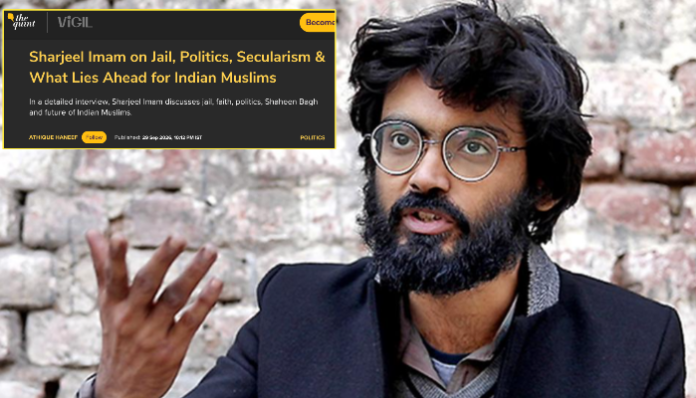
Sharjeel Imam, who shot to infamy for advocating the separation of the Siliguri Corridor (Chicken’s Neck) from the country and for his role in the anti-Hindu Delhi riots, has offered a peek into his troubling ideological convictions in a conversation with Athique Haneef for the propaganda website The Quint.
The interview titled “Sharjeel Imam on Jail, Politics, Secularism & What Lies Ahead for Indian Muslims,” was published on 29th September, outlining his disdain for democracy, the Constitution and the very idea of India as a secular entity. He even shared his disturbing vision of creating a separate Islamic state for Muslims, offering a window into the rabid mind of an Islamist whom the opposition ecosystem has hailed as a “liberal hero,” while he views them with the same contempt reserved for “Hindutva.”
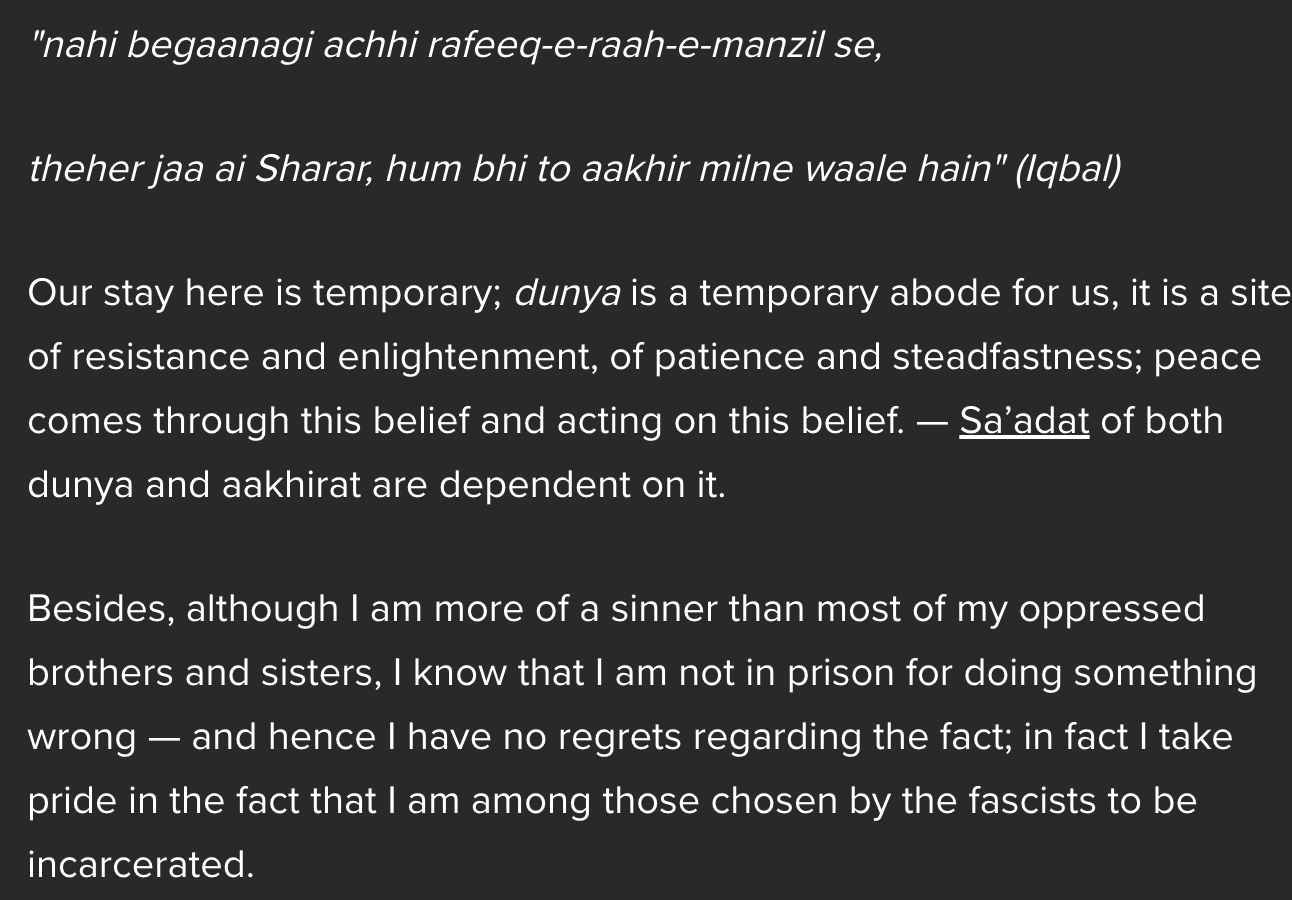
Imam, consistent with others of his extremist ilk, described the world as fundamentally a transit point, referring to it as a “temporary abode for Muslims” and designating it as “a site of resistance and enlightenment, of patience and steadfastness,” adding that he acts on this belief for peace. He quoted the Quran and Pakistan’s spiritual founder, Muhammad Iqbal, to support his statement.
Imam then dubbed himself a greater sinner than the “oppressed” members of his own community, as he claimed to be innocent, to cast himself as a martyr unjustly persecuted by the government rather than a prime accused facing charges under the Unlawful Activities Prevention Act (UAPA) for the part he played in the unrest in Delhi.
Imam declared that he had “no regrets” and, on the contrary, took “pride in the fact that I am among those chosen by the fascists to be incarcerated.” He also invoked “monotheist” Rabindranath Tagore to portray his unlawful activities as a positive contribution to future generations.
Imam, whose rhetoric seemed to be heavily influenced by Iqbal, repeatedly used his poetry to advance his narrative before bringing Palestine into the discussion. He urged not only Muslims but also Dalits and Adivasis to draw inspiration from the people of Gaza in their purported fight against Israel.
However, he conveniently overlooked the fact that Dalits and Adivasis do not follow Islam, even as he asked them to take lessons from the faith of Palestinians. This is a familiar tactic within the Islamo-leftist group, which actively drags caste to widen the rifts within the Hindu community but seldom extends the same scrutiny to the deep-seated sectarian conflicts within the Muslim world, which have persistently remained evident, especially in the Middle East, including the current violent clashes involving Sunni Saudi Arabia and the Shia Iran-backed Houthis.
Sharjeel Imam leans on Iqbal and Jinnah to attack Hinduism, secularism and nationhood
Imam, in a striking manifestation of his hatred for Hinduism, stated that “shirk” (polytheism or idolatry) is the source of oppression throughout human history, clubbing it with superstition, despotism, nationalism, materialism and casteism, as he lauded Iqbal, whom he reverentially called Allama, and credited his ideas with being of “central importance to my understanding” particularly in relation to the Muslims living in the Indian subcontinent.

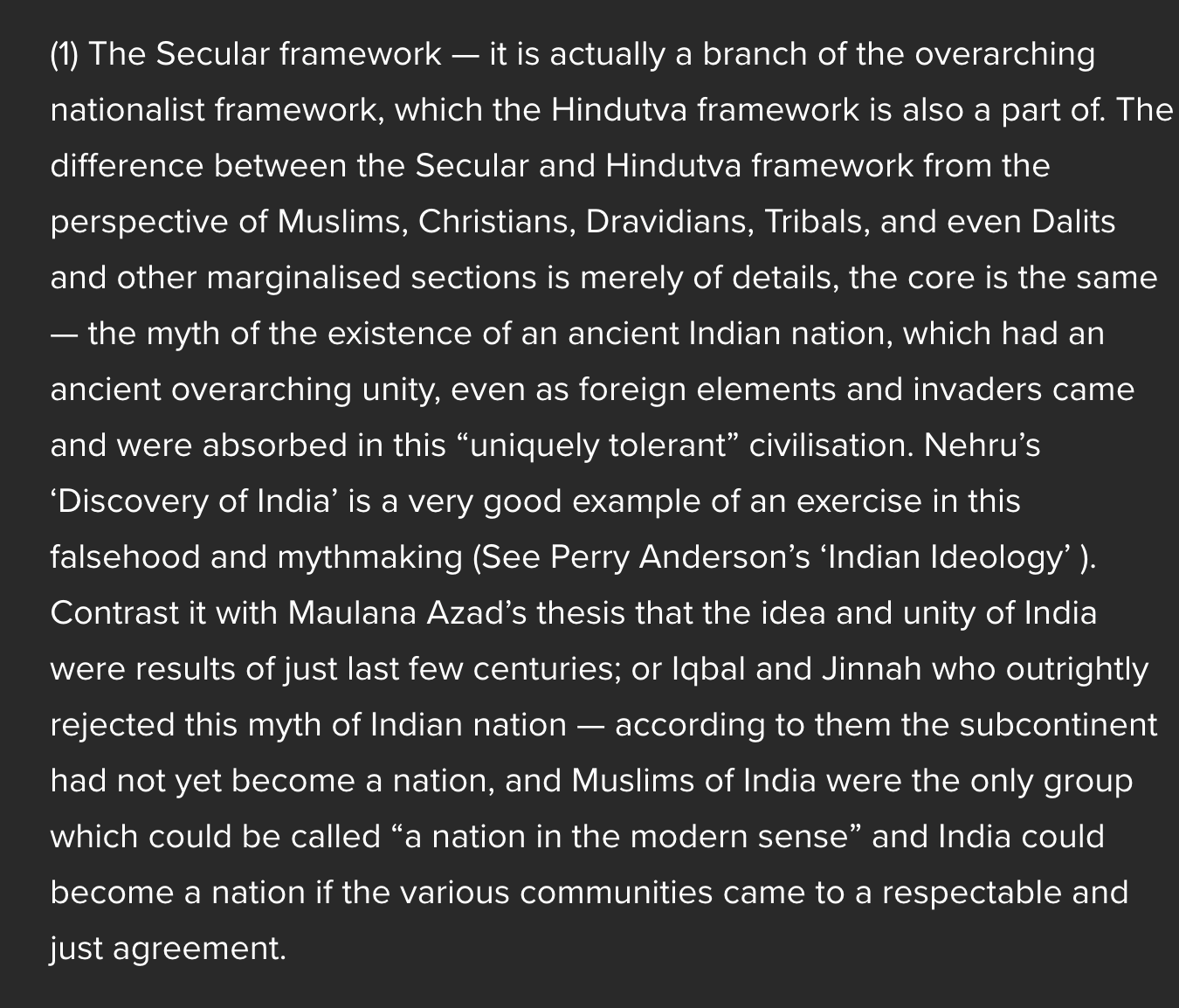
Imam also turned his ire towards the very values enshrined in the Indian Constitution, echoing the legacy of his favourite Pakistani figure. His first target was secularism, which he characterised as an offshoot of the broader nationalist paradigm, encompassing Hindutva.
He added, “The difference between the Secular and Hindutva framework from the perspective of Muslims, Christians, Dravidians, Tribals, and even Dalits and other marginalised sections is merely one of details” because “the core is the same – the myth of the existence of an ancient Indian nation, which had an ancient overarching unity, even as foreign elements and invaders came and were absorbed in this uniquely tolerant civilisation.”
Imam also took aim at Jawaharlal Nehru’s “The Discovery of India,” denouncing it as “a very good example of an exercise in this falsehood and mythmaking” and in the same breath eulogised the likes of Iqbal and Muhammad Ali Jinnah who betrayed India, legitimising their contentions which eventually paved the way for a separate Muslim state.
Interestingly, Jinnah or Iqbal, whose ideas underpin much of Imam’s argument, did not reject nationalism. Their objection was to a democratic system in which Hindus would have a prominent stake in the government and the power could not be seized by the Muslim community. They desired the return of Islamic rule and started a campaign for partition when their demands were not met.
After dismissing India’s thousands of years of history and ridiculing both secularism and nationhood, Imam remarked that “Muslims of India were the only group which could be called a nation in the modern sense and India could become a nation if the various communities came to a respectable and just agreement.”
Predictably, Imam also had an issue with the primacy of the Indian identity and resented that citizens are classified as Indians first, with their religion and other affiliations taking a secondary place, labelling this as a purported mechanism to subjugate minorities who are supposedly deemed “communal” and “divisive” when they demand autonomy or land rights.
India does not require its citizens to choose between their faith and their nation. Devout Hindus, Muslims, Christians and others can remain committed to their respective religions while embracing their country, which demands no religious uniformity, nor does it make adherence to a particular faith a condition of belonging.
The insubstantiality of his position is further exposed by the specific provisions available to Scheduled Castes, Scheduled Tribes and other backward classes, alongside special privileges extended to Muslims under the guise of their Sharia-compliant personal law after dividing the country, while the plight of religious minorities in Pakistan is before the eyes of the world.
Furthermore, Imam defined secularism as a conspiracy orchestrated by secular ideologues intent upon depriving minority communities of their rights, commending Iqbal for coining “Communal Oligarchy” to attack upper-caste Hindus for daring to form a government in their own country.
Meanwhile, India has witnessed multiple Muslim leaders occupying the nation’s highest offices, but Jogendra Nath Mandal, a Dalit who served as Pakistan’s first Law Minister, was forced to return to India as a refugee following his resignation in 1950 due to the severe atrocities against minorities in that country, an alarming trend that has remained consistent throughout subsequent decades.
Secularism has long been a one-way street in India, with the majority community required to shoulder the entire burden of upholding it. True to his aversion towards Hindus, which he couched in several ideological arguments, Imam blamed Brahminical forces within the Congress for the partition of India, rather than the Muslim League.
Sharjeel Imam’s crusade against the Constitution
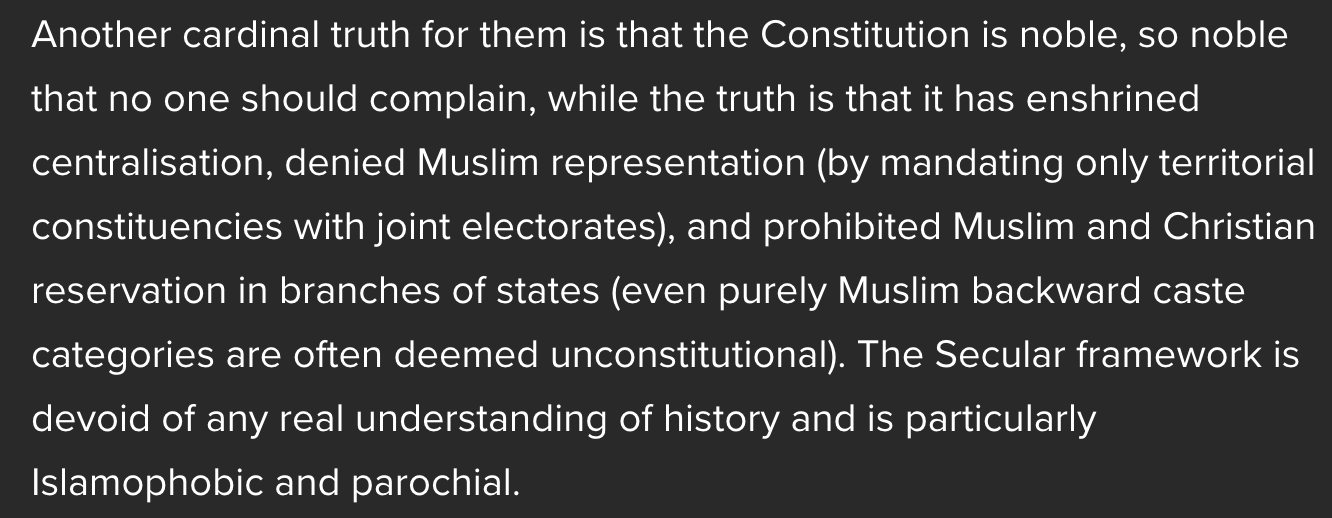
Imam continually reflected his abiding animus towards Hindus and India when he branded the “noble” Constitution as anti-Muslim because it abolished separate electorates for Muslims and did not allow reservations on religious grounds, stating, “The secular framework is devoid of any real understanding of history and is particularly Islamophobic and parochial.”
Imam also turned his ire towards his Marxist cheerleaders, whom he faulted for rejecting religion and failing to grasp the Muslim victimhood narrative that drives his interpretation of history, which presents partition as a positive outcome.
Imam continued his tirade against India and the Brahmins, a term often wielded by those sharing his ideology to target the broader Hindu community. He also cited controversial hardliners such as Rashid Rida to strengthen his claims, before circling back to his glorification of Iqbal, championing Islamist causes and provoking Hinduphobic elements even in the South.
Imam reinforced the submission that “two nations never meant two geographical nations in these discussions, but two religious nations dispersed across South Asia for which a delicate constitutional arrangement was needed,” asserting that the two religions can never thrive alongside each other except through a tenuous alliance.
According to this premise, India is comprised of two nations and should therefore have two separate states, a proposition conspicuously absent from discourse about Pakistan and Bangladesh.
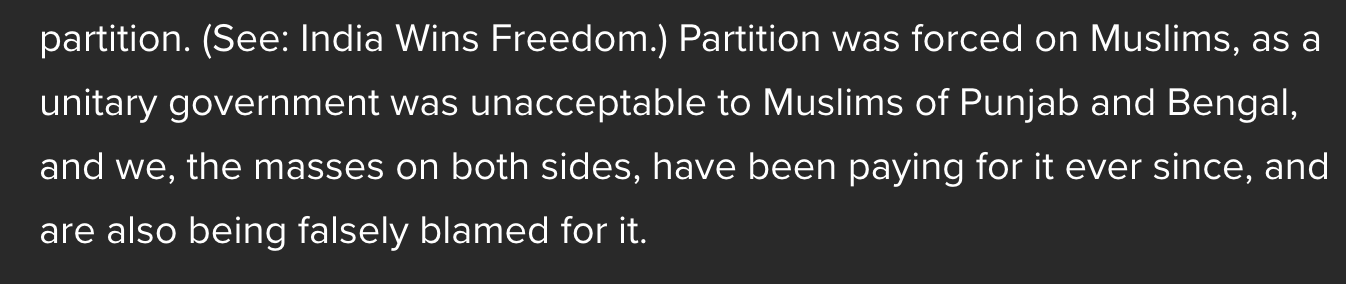
Imam attributed culpability to everyone from the Rashtriya Swayamsevak Sangh (RSS) and Hindu Mahasabha to the Congress and Brahminism, while absolving the Muslim League, Iqbal, Jinnah and his ideological allies of any responsibility for partition. He alleged, “Partition was forced on Muslims, as a unitary government was unacceptable to Muslims of Punjab and Bengal, and we, the masses on both sides, have been paying for it ever since, and are also being falsely blamed for it.”
He maintained that there would not have been partition had the Muslim League’s decentralisation program been approved without producing any such initiative, because the latter’s goals were to establish a majority in the legislature of provinces where the community barely exceeded Hindus and to award them an unfair advantage in regions where they were a minority, including Uttar Pradesh.
They were adamant about preserving their unjust and dominant control over authority. Otherwise, a similar plan would have unfolded upon Pakistan’s creation.
Imam also pointed to Maulana Azad’s “India Wins Freedom” article, which ascribed the division to the rejection of the Cabinet Mission Plan by Congress. However, Pakistan did not put it into practice and obtained the Muslim-majority areas, exposing the truth of this double standard.
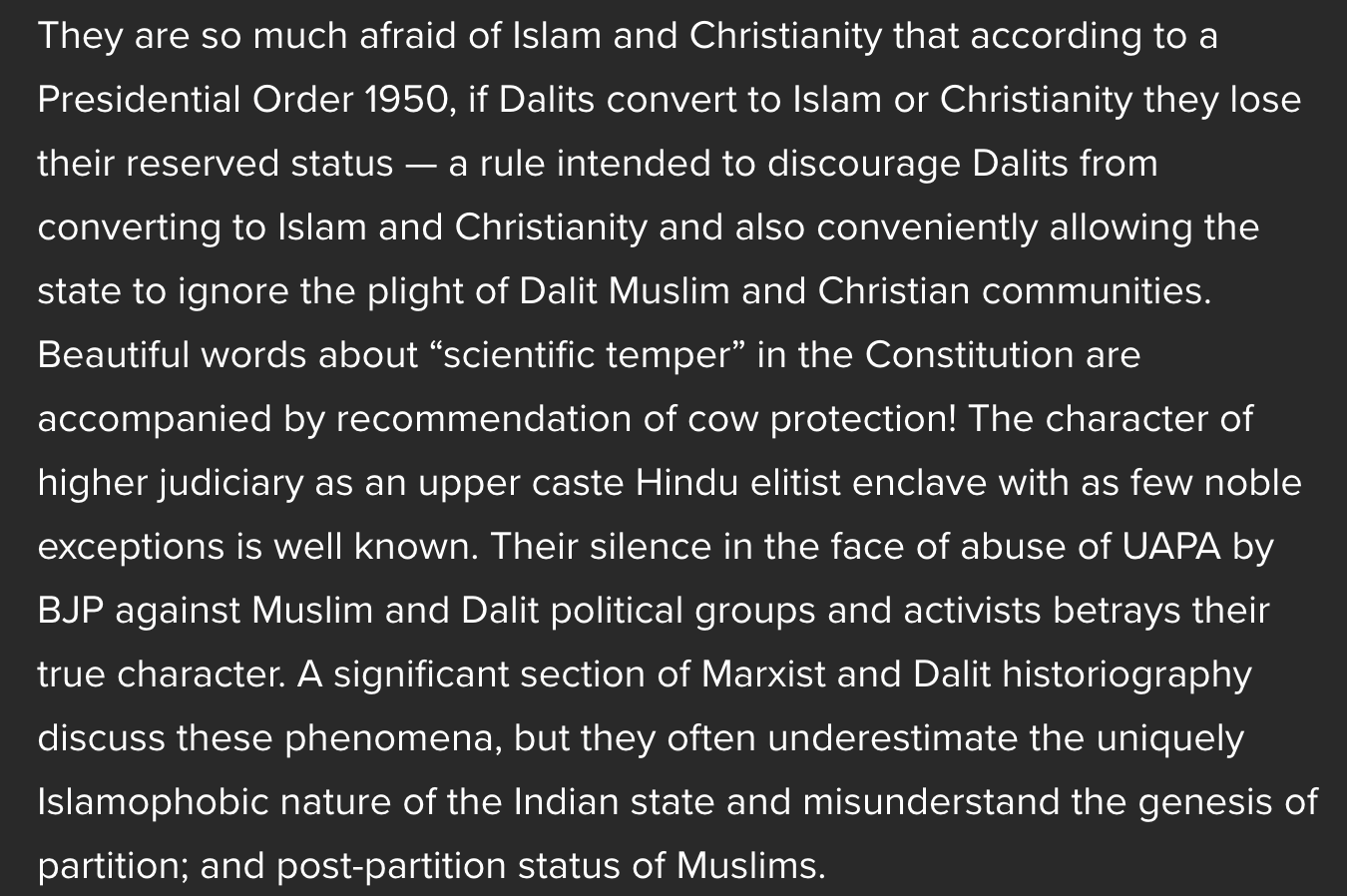
After emphasising that equality is a hallmark of Islam, Imam accused the Indian state of discrimination for not providing reservation benefits to Dalits who convert to Abrahamic religions, contradicting himself. He wanted compensation for an inequality his religion reportedly forbids, highlighting the inherent hypocrisy synonymous with his group.
Imam mocked the Constitution’s endorsement of “scientific temper” for recommending cow protection to suggest that the two could not coexist. This line of reasoning boiled down to why Hindu sentiments were not being trampled upon for “progress,” as though the community should continue to be relegated to the status of second-class citizens in their country.
He mirrored the aspiration of Jinnah and Iqbal, who pushed for partition upon realising that the days of Muhammad bin Qasim and other jihadi marauders were not going to return after the departure of the British imperialists.
Imam also criticised the higher judiciary for following the Constitution rather than conforming to the expectations of his extremist coterie.
Imam then fear-mongered about the RSS seeking to take control, casting Iqbal as a farsighted poet who had supposedly foreseen these developments centuries ago.
Imam also discredited the secular consensus as a lie and a trap, portraying it as a political ploy to secure Muslim votes. He ranked political parties according to the threat he believed they posed, placing the Bharatiya Janata Party at the top, followed by the Indian National Congress and then regional parties.
Notably, Imam appeared more favourably disposed towards the DMK, whose leaders want to eradicate Sanatan Dharma and abuse it regularly.
Hindus are communal, Iqbal was right: Sharjeel Imam
Imam hit out at the first-past-the-post (FPTP) electoral system, conveying, “We are already living under a permanent communal majority, or what Iqbal predicted would be a Communal Oligarchy, manufactured by consolidation of large parties under FPTP.”

He asked for proportional representation, opposing the concerns related to instability and ironically pointing to monarchies in the Gulf as examples of stable governance. He insisted that “FPTP silences even a 20 per cent vote share to zero seats,” as if Muslim candidates do not routinely win elections and hold public office in India under the ongoing electoral system.
Imam then proposed a united front of Muslims, Dalits, Sikhs, Christians and tribal communities, adding that the BJP could use the UAPA against such a coalition, as it did in the Bhima Koregaon case and the anti-CAA (Citizenship Amendment Act) protests, completely ignoring the severe allegations of planned violence and the serious law-and-order concerns that arose during these episodes.
Imam outlined a strategy of electoral coordination with Ambedkarite groups and other such communities, using tactical voting to force political parties to accept their demands and consolidate their influence while keeping the BJP out of power.
Sharjeel Imam defends his secessionist statement
Sharjeel Imam sought to defend himself by insisting that he had merely spoken about chakka jam as “an effective means of protest,” adding that he essentially meant obstructing a road. He was caught inciting his co-religionists to exploit their numerical strength to sever Assam and the Northeast from the rest of India, fully aware of the region’s sensitive geographical location and the strategic implications of disrupting access to it.
He has been named among the masterminds behind the riots that rocked the national capital under the guise of anti-CAA demonstrations and was also one of the key organisers of the Shaheen Bagh agitation.
Imam resumed his assault on the Constitution, dubbing it a “roadblock to the dignified existence of the Muslim community and other religious minorities in India.” He also claimed that Muslims had been disenfranchised, of course, without offering any proof for his sweeping accusations.
He then alleged that the protests led by the Islamo-leftists against the National Register of Citizens (NRC) had delayed its implementation, even though the unrest began before any nationwide NRC had been introduced.
“Our discourse critiquing secularism and the Constitution, and our questioning of Congress, Gandhi and Nehru etc. – this discourse has emerged as the real voice of anti-CAA-NRC protests, because apart from this discourse there were only boring, sterile and futile repetitions of self-congratulatory nationalist discourse pretending to be the solution for Muslim issues – the time for that lie is up,” he boasted.
He also loathed Gandhi, who wanted Hindus to accept their destruction at the hands of Muslims without harbouring any anger, only over his support for cow protection, again illustrating his intense Hinduphobia.
Imam demands preferential consideration for Muslims while simultaneously insulting Hinduism and its followers, in an abject embodiment of rank hypocrisy that only a jihadi could possess.
Conclusion
The entire piece is an exercise in peddling victimhood, showcasing everyone from the state and the majority community to the Constitution and democratic institutions as perpetual antagonists, while posing Muslims as the eternal victims of their actions. There is little introspection or willingness to look inward, and instead the blame is placed on all but the actual perpetrators masquerading in the cloak of vulnerability.
Imam need only look at Pakistan, whose founders fuel his ideology and vision, to see what state oppression looks like and how minorities bear its consequences. How many Muslims have faced a similar fate in India? On the contrary, their numbers are expanding at a much faster rate than those of the majority community.
In fact, such is the alleged mistreatment that Bangladeshi and Rohingya Muslims desperately seek to enter India, but how many Indian Muslims want to cross over to these countries?
However, if there is one thing Imam can be credited for, it is his unapologetic approach to the jihadi cause, unlike Arfa Khanum Sherwani, who wanted to change tactics to deceive the gullible minds into supporting them.
For those shocked by Imam’s statements, the joke is clearly on you. This cabal has never hidden its agenda, even when pretending otherwise. Its members have been vocal, both directly and indirectly, about their agenda, despite using different methods to mislead Hindus.
This might come as a rude awakening for people who have chosen to bury their heads in the sand, but for those who have been paying attention, none of this is particularly surprising. From the Popular Front of India (PFI) to Imam and even Umar Khalid, their actions have spoken far louder than their words for a long time, and to disregard this record is merely an arrogant denial of the truth, which only serves their nefarious interests.