

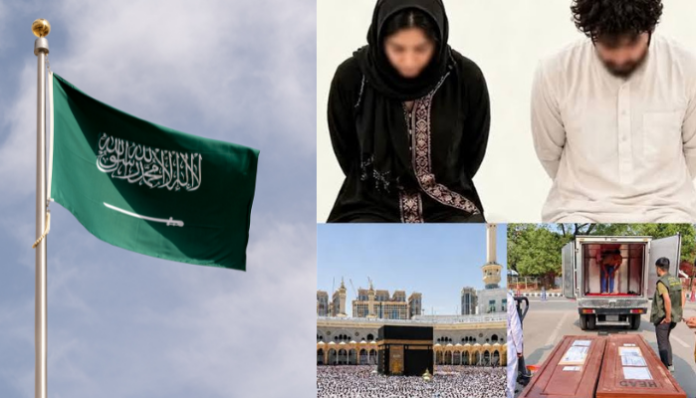
Let’s say the quiet part loudly. The Ummah’s so-called unity is not a brotherhood. It is a branding exercise. It is a slogan peddled at conferences, recycled in sermons and trotted out whenever someone needs to sound morally serious. This week, Saudi Arabia handed the world a case study in how hollow it all is.
Bangladesh says it was not informed before two of its citizens were executed in Mecca. Sri Lanka, by contrast, secured diplomatic engagement and a reprieve for Anojan Sivarasa, a Hindu migrant worker who faced the death penalty. If this is Islamic solidarity in practice, then what exactly does abandonment look like?
The uncomfortable question is not merely why Riyadh treated the two countries differently. It is why a country that constantly invokes religious ties and the solidarity of the Ummah could execute citizens of a Muslim-majority ally without even informing its government beforehand.
No call before the sword
On 14 October, Saudi Arabia executed two Bangladeshis identified as Nazrul Islam Abdul Basir and Siti Akhtar, after a Saudi court convicted them under ta’zir for what the Saudi Interior Ministry described as an “indecent act” inside a mosque in Mecca.
Bangladesh’s Consulate General in Jeddah said it received no prior notification of the arrests, trial or executions. Bangladesh’s foreign ministry has had to ask Riyadh for an explanation.
This is not a demand for special treatment. It is a demand for basic diplomatic courtesy and respect for the rights of foreign nationals facing criminal proceedings in another country.
Article 36 of the Vienna Convention on Consular Relations, 1963, provides for communication between detained foreign nationals and their consular representatives. It requires the authorities of the receiving state to inform the detained person of their consular rights without delay if the person requests it, and to notify the consulate when the relevant conditions are met, and the detained person requests notification. Consular officers can communicate with and visit their nationals and help arrange legal representation.
The crucial question, therefore, is whether the two Bangladeshis were informed of their consular rights and allowed to seek assistance. Saudi authorities should clarify whether the applicable requirements were followed.
Saudi Arabia is hardly unfamiliar with controversy over capital punishment. The kingdom has repeatedly drawn international criticism for its use of the death penalty, including in cases involving foreign nationals. Amnesty International has documented executions involving migrant workers, including people convicted of drug-related offences, amid concerns over fair-trial safeguards and access to legal assistance.
In a system where the ultimate punishment is irreversible, consular access is not a bureaucratic formality. It can be a vital safeguard. It allows a foreign national’s government to establish contact, help secure legal representation and raise concerns about the proceedings.
When the punishment is death, the stakes could not be higher. A government learning about an execution only after it has taken place has lost the opportunity to intervene before the final decision becomes irreversible.
And apparently, even a basic notification was too much to expect in this case.
Saudi Arabia’s record raises uncomfortable questions
Saudi Arabia’s use of capital punishment has long attracted scrutiny from international human rights organisations. The concerns are not limited to the number of executions. They also encompass due process, access to legal representation, the treatment of foreign defendants and the circumstances in which families and consular authorities learn of an impending execution.
Foreign nationals are particularly vulnerable when they face criminal proceedings thousands of kilometres from home, sometimes without adequate language assistance or a clear understanding of the legal system. Their ability to obtain timely legal support and communicate with their home governments can be crucial.
That is precisely why consular safeguards matter. The Vienna Convention does not give foreign governments a veto over another country’s criminal justice system, nor does it automatically prevent an execution. But it recognises that foreign nationals have consular rights and that the relevant authorities must respect the applicable obligations.
The question in the Bangladesh case is straightforward: were those safeguards followed, and if so, why was Dhaka apparently unaware of the proceedings and the executions?
Saudi Arabia owes an explanation to Bangladesh and, more importantly, to anyone concerned with the protection of foreign nationals facing the death penalty.
Colombo got the courtesy; Riyadh ignored Dhaka
The contrast is not subtle. It is a flashing neon sign with an arrow pointing at the fake brotherly narrative of ummah. Sri Lanka intervened loudly and persistently for Anojan Sivarasa, a 24-year-old Hindu migrant. Anojan had been convicted of blasphemy over a Facebook comment and sentenced to death
Colombo sent a delegation, engaged lawyers, pursued the appeal, and made noise. On 14 October, the Saudi Supreme Court overturned the death sentence. Sri Lanka got access, attention and a result.
Bangladesh got silence, then news alerts. A non-Muslim-majority neighbour can press a case and get engagement. A Muslim-majority ally can lose its citizens and learn about it afterwards. If that is not the Ummah fighting with itself, what is?
The brotherhood of believers apparently comes with a priority queue, and Bangladesh was not even given a ticket. So much for the ummah’s fraudulent unity. It is not a community; it is a customer service line with no operator.
Cracks are visible; Saudi is not bothered
Bangladeshis are tweeting “slave” under their own foreign ministry’s feel-good OIC posts. Several Bangladeshi X users question Saudi’s bias towards Bangladesh.
A Bangladeshi X handle asked questions from Bangladeshi government: why they are not able to keep track of the cases to ensure they received fair trials, had access to legal assistance, and were afforded consular support?
Criticism must be fair and reasonable. What I have learned from the recent news is that the two Bangladeshi nationals executed in Saudi Arabia had been arrested 3 years ago. Why wasn’t the Bangladeshi Embassy in Riyadh(@Bdootriyadh) keeping track of their cases to ensure they received fair trials, had access to legal assistance, and were afforded consular support? Can Bangladesh Ministry of Foreign Affairs (@BDMOFA) confirm whether it systematically tracks the cases and welfare of Bangladeshi nationals convicted and imprisoned abroad, including those facing the death penalty? Diasporas aren’t the walking ATM. They are citizens of whose rights, welfare, and access to justice deserve the state’s attention and protection.
— Fahim (ফাহিম) ☪ (@IRahmanFahim) October 19, 2026
Dr Rayahn Rashid posted on X, quoting her BBC Bangla report, “In essence, Article 36 of the Vienna Convention guarantees the consular and legal rights of foreign nationals. When a foreign national is detained, the consular service of their country must be informed. Consular officers can then speak with their national and arrange the necessary legal protection.”
She further wrote, ” Article 36 guarantees that a national arrested or detained in a foreign state has the right to communicate with their own country’s consulate and to receive legal assistance. Under it, consular officers may visit, speak and correspond with the detained person, and may arrange legal representation if that person wishes.”
The execution of two Bangladeshis in Saudi Arabia has given rise to a number of legal misconceptions. In an interview with BBC Bangla yesterday, I tried to clarify some of them, though several serious conceptual confusions still remain in the BBC’s report. Below are some of the points I raised in the interview (translated from Bangla): "Both Bangladesh and Saudi Arabia are parties to the Vienna Convention on Consular Relations (1963). Both countries are therefore bound by its provisions on the detention of foreign nationals. . . . In essence, Article 36 of the Vienna Convention guarantees the consular and legal rights of foreign nationals. When a foreign national is detained, the consular service of their country must be informed. Consular officers can then speak with their national and arrange the necessary legal protection. . . . Article 36 guarantees that a national arrested or detained in a foreign state has the right to communicate with their own country’s consulate and to receive legal assistance. Under it, consular officers may visit, speak and correspond with the detained person, and may arrange legal representation if that person wishes. . . . From the information available, the two Bangladeshis were executed after an appeal process. In other words, this did not happen overnight. The Bangladesh mission ought to have known. It is not acceptable to say it could not have known unless the individuals or the Saudi authorities told it, because the process clearly did not unfold in a single day. Furthermore, under the Vienna Convention, the two detainees should have been informed of their right to consular assistance and asked whether they wished to receive it. Saudi Arabia must be able to show evidence that this was done." [Paragraphs rearranged] Read the BBC Bangla report: https://t.co/pISHwFMJR1 #Bangladesh #SaudiArabia #HumanRights #ConsularRights #ViennaConvention #DueProcess #MigrantWorkers
— Dr Rayhan Rashid (@rayhanrashid) October 18, 2026
Later, slamming Saudi authorities, she wrote, “This did not happen overnight. The Bangladesh mission ought to have known. It is not acceptable to say it could not have known unless the individuals or the Saudi authorities didn’t tell them, because the process clearly did not unfold in a single day.
Furthermore, under the Vienna Convention, the two detainees should have been informed of their right to consular assistance and asked whether they wished to receive it. Saudi Arabia must be able to show evidence that this was done,” she explained.
Attacking Saudi Arabia, one user wrote ” Saudi doing everything in their country like abusing maid,concert,allowing players live together without marriage however they executed a Bangladesh couple for a minor incident without telling Bangladeshi embassy. This is horrific. One day saudi will pay for this.”
Saudi doing everything in their country like abusing maid,concert,allowing players live together without marriage however they executed a Bangladesh couple for a minor incident without telling Bangladeshi embassy. This is horrific. One day saudi will pay for this.
— Sobuj 🇧🇩 (@aksobuj_) October 19, 2026
In a Facebook post, Shahidul Alam, a Bangladeshi photojournalist, posted a Quranic verse from Surah An-Nur targeting Saudi Arabia’s interpretation of Sharia Law. Challenging the Saudi judgment, he wrote, “The Saudi state claims to rule by the Quran. Yet the Quran itself, in Surah An-Nur, prescribes a hundred lashes, not death, for unmarried people found guilty of such an act.”
Bangladeshis are continuously targeting Saudi. They want an explanation, such as demanding the full case file and judgments from Riyadh and publishing them about the incident, but Saudi authorities do not seem bothered at all. They didn’t give any official explanation about the case. It looks like they don’t care about their bond with their “Islamic Brother.”
A non-muslim state outmanoeuvres a Muslim brother
For Bangladesh, the disparity is especially bitter. More than three million Bangladeshis live and work in Saudi Arabia, and the two countries have long touted close religious and economic ties. Yet it was Sri Lanka, a Buddhist-majority country, that defended a Hindu citizen, with Saudi giving them prior information and a reprieve.
But on the other hand, Muslim-majority Bangladesh was kept in the dark until its citizens were executed. It looks like their lives have no value to Riyadh.
That inversion strikes at the existence of the Ummah ideal. If shared faith were the basis for solidarity and protection, Bangladesh should have received at least the same consideration as Sri Lanka.
Instead, the case exposed their so-called brotherhood. The case suggests that in the harsh arithmetic of international diplomacy, citizenship, leverage and timely engagement, not religious brotherhood, determine whose life is worth more.
Bangladesh’s place on the Ummah’s priority list
The most damning aspect of this episode is what it suggests about Bangladesh’s standing in Riyadh’s calculations.
Bangladesh and Saudi Arabia share longstanding religious, economic and diplomatic ties. Millions of Bangladeshis work in the kingdom, contributing to its economy while sending remittances home to their families. These workers are not merely statistics in bilateral trade figures. They are people whose lives, rights and dignity deserve protection.
Yet, according to Bangladesh’s account, its diplomatic mission was not informed before two of its citizens were executed.
If the account is accurate, Bangladesh was not even allowed to engage with Saudi authorities before the executions took place. The country’s religious affinity with the kingdom apparently offered no visible guarantee of prior communication.
This is where the rhetoric of the Ummah collides with the reality of international relations.
For years, the idea of a unified Muslim community has been invoked as though shared faith necessarily creates a durable political and moral alliance. But countries do not always treat one another as equal partners, even when they share a religion. Strategic interests, diplomatic leverage and political priorities frequently determine how governments respond to one another.
The Bangladesh case exposes the Ummah for what it arguably is: a fictional construct sustained by political rhetoric, religious symbolism and the promise of collective bargaining power. Muslim nations invoke this supposed brotherhood when it serves their interests, presenting themselves as members of a unified community capable of negotiating with the rest of the world from a position of strength. But when their interests clash, or when a weaker member expects protection from a more powerful one, the grand narrative begins to fall apart.
Put bluntly, if Riyadh could execute citizens of a Muslim-majority ally without informing its government beforehand, what does that say about Bangladesh’s place on the supposed hierarchy of Ummah solidarity? In essence, Riyadh doesn’t appear to consider Bangladesh an important enough nation to inform it about the execution of two of its nationals for committing an ‘indecent act’ inside a mosque in Mecca. Muslims often talk about the brotherhood they share with Muslim nations upholding the Shariah law.
But in reality, the Ummah appears less like a brotherhood bound by faith and more like a hierarchy of nations where power, influence and strategic interests determine whose concerns deserve attention. The very countries that invoke the supremacy of Shariah and the solidarity of Muslim nations seem unable to guarantee even basic diplomatic consideration to one another when it matters most.


