

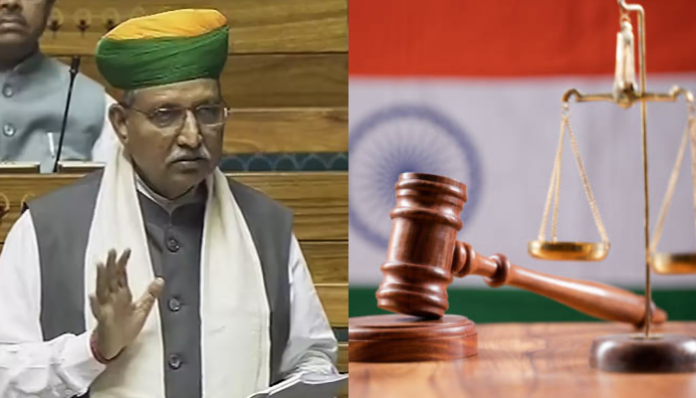
The Modi government plans to introduce “evening courts” to tackle the backlog of cases. The pilot project will first be rolled out in Delhi, Bihar and Andhra Pradesh before being launched in other parts of the country in cooperation with the relevant High Courts.
Union Minister of State (Independent Charge) for Law and Justice, Arjun Ram Meghwal, highlighted the pivotal development in a conversation with The New Indian Express, adding, “We also intend to engage retired judges to support this initiative. Under the proposed arrangement, courts that function during regular daytime hours will sit for a few additional hours in the evening to hear cases and expedite their disposal.”
He mentioned that extending the initiative to more states will be taken into consideration after evaluating its performance. Additionally, the government is concentrating on using Lok Adalats to settle and resolve problems.
According to Meghwal, the centre has also prioritised Alternative Dispute Resolution, in which a neutral third party assists the opposing sides in communicating, negotiating, and reaching a compromise. “This mechanism can reduce the burden on courts. We are also focusing on pre-mediation, which can help resolve disputes before they lead to prolonged litigation,” he expressed.
The minister also informed the media house that early signs are optimistic in relation to the new criminal laws, Bharatiya Nyaya Sanhita (BNS), Bharatiya Nagarik Suraksha Sanhita (BNSS) and Bharatiya Sakshya Adhiniyam (BSA), implemented in 2023, which have been able to reduce cases and expedite the justice delivery system. He emphasised that they are facilitating prompt case resolution and enhancing the administration of justice without placing an undue burden on the legal system.
He stated, “They introduce mechanisms for time-bound proceedings. We have developed five e-platforms under the new laws, initially launched on a pilot basis in Chandigarh, Gujarat and Delhi. These platforms enable electronic sharing of court orders and judgments with prison authorities, ensuring prompt access and action.”
