

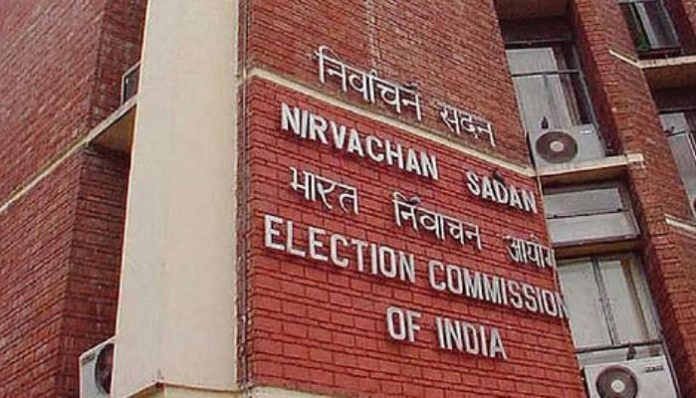
The Election Commission of India (ECI) is holding a meeting with the Chief Electoral Officers (CEOs) of all States and Union Territories on Wednesday (22nd October) to review preparations for the Special Intensive Revision (SIR) of electoral rolls. After this meeting, the EC is expected to decide when to officially launch the exercise. Along with the SIR preparations, a few other administrative matters are also likely to come up for discussion.
The meeting will take place at the EC’s India International Institute of Democracy and Election Management (IIIDEM) in Dwarka on Wednesday afternoon (22nd October). This is the second such meeting in a little over a month.
Earlier, on 10th September, Chief Election Commissioner Gyanesh Kumar and Election Commissioners Sukhbir Singh Sandhu and Vivek Joshi had met the CEOs to review how ready the states were for the SIR.
Before that, on 24th June, the ECI had issued an order introducing the SIR process across the country, starting with Bihar since assembly elections were due there soon. The Commission had said that it would announce dates for other states and Union Territories later.
The Special Intensive Revision is different from the annual or pre-election Special Summary Revision (SSR) that the EC usually carries out. Instead of making small updates, the SIR involves preparing new electoral rolls from scratch. In Bihar, all 7.89 crore registered voters were asked to fill out new enumeration forms by 25th July so that a draft list could be published on 1st August.
The EC also asked people who were added to the rolls after 2003, the year of the last intensive revision in the state, to provide documents proving their date and place of birth. This was meant to confirm each person’s eligibility as a voter. Moreover, anyone born after 1st July, 1987, had to submit documents of their parents as well, in line with the provisions of the Citizenship Act, 1955.
The EC gave a list of 11 documents that could be used for proof, such as a passport, birth certificate, or caste certificate. Interestingly, common IDs like Aadhaar, voter ID cards, and ration cards were not part of the list at first. During the process in Bihar, around 65 lakh names were removed from the draft rolls and another 3.66 lakh were deleted from the final list.
The EC’s 24th June order was soon challenged in the Supreme Court. Critics compared it to an attempt to create a National Register of Citizens (NRC) indirectly. Following this, the Supreme Court directed the EC to allow Aadhaar as the 12th valid document and to make the list of deleted names public, along with the reasons for their removal.
The Election Commission of India had on September 30 published the final voter list for the Bihar Assembly elections, marking the completion of a Special Intensive Revision (SIR) conducted after more than two decades. The roll is serving as the basis for polling, with the current Assembly’s term ending on November 22.
At its last meeting with the CEOs, the EC had also advised state officials to cross-check the current voter lists with the ones from the last intensive revision. This would help reduce the number of voters who need to submit documents again.
