

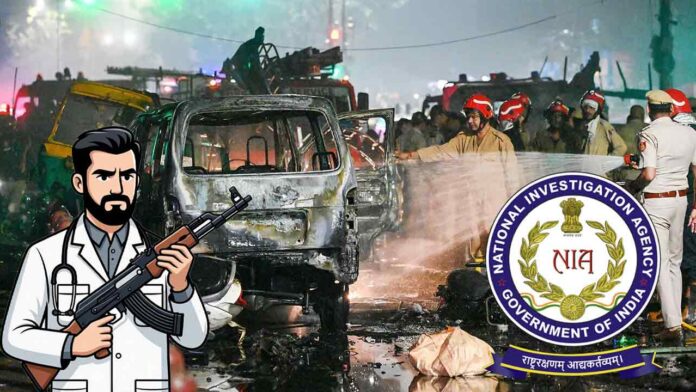
The National Investigation Agency (NIA) has filed a supplementary chargesheet naming three more accused, including an absconder, in the November 2025 car bomb blast near the iconic Red Fort in Delhi that killed 11 people.
This development takes the total number of persons charged in the case to 13, including the prime accused Dr Umer Un Nabi, who died in the blast. In the supplementary chargesheet filed before the NIA Special Court at Patiala House Courts, the agency has named three individuals, Zameer Ahmad Ahanger, Tufail Ahmad Bhat and Muzafar Ahmad alias Faraz alias Zafar, all residents of Jammu and Kashmir.
Zameer Ahmad Ahanger has been identified as an Overground Worker (OGW) of Ansar Ghazwat-ul-Hind Interim, an alleged offshoot of Al-Qaeda. He allegedly maintained contact with handlers and acted as a courier, ferrying arms, ammunition and cash for the terror module. He has been arrested and charged under Sections 13, 18, 20, 23, 38 and 39 of the Unlawful Activities (Prevention) Act (UAPA) along with Sections 61(2), 147, 148 and 152 of the Bharatiya Nyaya Sanhita (BNS).
The National Investigation has chargesheeted three more accused, including an absconder, in connection with the November 2025 car bomb explosion that killed 11 persons near the Red Fort in the national capital of Delhi in November 2025.
— ANI (@ANI) June 27, 2026
In its supplementary chargesheet, NIA has… pic.twitter.com/l3MYe8eOaj
Tufail Ahmad Bhat has been described as a former OGW of the banned Lashkar-e-Taiba (LeT). He allegedly functioned as the module’s arms supplier. According to the NIA, he procured an AK-47 rifle, a Krinkov rifle, a pistol, magazines and live ammunition through dead drops arranged by a handler and delivered them to the deceased prime accused Dr Umer Un Nabi for Rs 3 lakh. He has also been arrested and faces the same UAPA and BNS charges as Zameer Ahmad Ahanger.
The third accused Muzafar Ahmad alias Faraz alias Zafar is a paediatrician holding MBBS and MD degrees, and the elder brother of co-accused Dr Adeel Ahmed Rather. He is a founding member of AGuH Interim and remains absconding. A non-bailable warrant has been issued against him, and efforts are on to trace and arrest him. He is alleged to have been a key conspirator along with Dr Umer Un Nabi, Dr Muzammil Shakeel and others in planning the Vehicle-Borne Improvised Explosive Device (VBIED) blast.
Muzafar allegedly attended a secret meeting at Eidgah in Srinagar in June 2022 to form the AGuH Interim module and played a role in the manufacturing, testing and storing of TATP-based improvised explosive devices at a clandestine facility operated by Dr Umer Un Nabi and Dr Muzammil at Al-Falah University in Faridabad. He faces additional charges under Sections 61(2), 103(1), 109(1), 118(1) and 118(2) of the BNS, Sections 3, 4 and 5 of the Explosive Substances Act, and Sections 3 and 4 of the Prevention of Damage to Public Property (PDPP) Act.
11 persons were killed, and several were injured on November 10, 2025, when a high-intensity blast in a car rocked the area near the Red Fort in the national capital, while causing extensive damage to property.
The NIA, which took over the investigation, had earlier, on May 14, 2026, filed a voluminous 7,500-page chargesheet against 10 accused persons before the special court. All the accused were linked to the organisation Ansar Ghazwat-ul-Hind (AGuH), a designated offshoot of Al-Qaeda in the Indian Subcontinent (AQIS). The investigation has unravelled a major Jihadi conspiracy through scientific and forensic means, geo-location mapping, financial trail analysis and other multidisciplinary techniques. The probe is still ongoing.
The prime accused in the case is Dr Umar Un Nabi, a doctor by profession who worked as an assistant professor at Al-Falah University in Faridabad, Haryana. He carried out the suicide attack and died in the explosion. His identity was established through DNA fingerprinting.
Several other key accused named in the main chargesheet are also medical professionals or linked to the medical field, forming what investigators have described as a “white-collar terror module” or “doctors terror module”. These include Dr Muzamil Shakeel (Ganai), Dr Adeel Ahmed Rather, Dr Shaheen Saeed, Mufti Irfan Ahmad Wagay and others.
A significant aspect of the conspiracy revolves around Al-Falah University in Faridabad, where Dr Umer Un Nabi and some other accused worked or were associated. Investigators have alleged that a clandestine facility for manufacturing and storing explosives, including TATP-based IEDs, was operated from within the university premises, reportedly in a room in the boys’ hostel building. The module allegedly used the university setup for planning and preparation.
The university came under scrutiny after the blast, with reports indicating that several doctors linked to the module were employed there without obtaining mandatory inter-state No Objection Certificates (NOCs) from their respective state medical councils or proper police verification. Post-blast, a number of doctors associated with the university reportedly went underground. The Enforcement Directorate (ED) has also examined aspects related to appointments and financial trails in connection with the case.
The NIA’s investigation has highlighted the radicalisation of educated professionals, their alleged links to Pakistan-based and transnational handlers, and the use of modern tools such as online platforms for sourcing materials and learning bomb-making techniques.
