

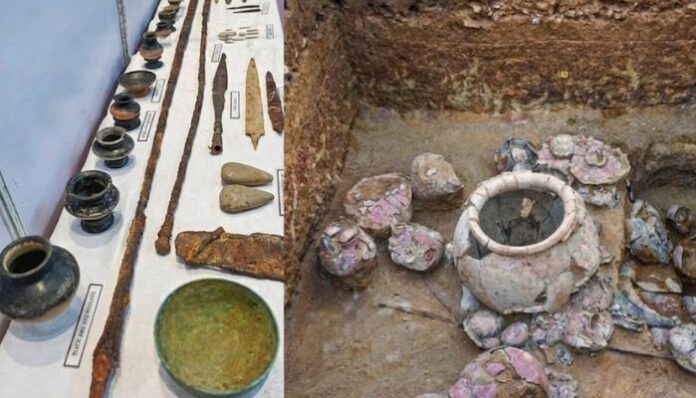
Archaeologists in Tamil Nadu have reportedly made a remarkable discovery with the unearthing of an eight-foot-long iron spear dating back to around 3,345 BCE. The weapon found at an Iron Age burial site in Thirumalapuram near Tuticorin is now considered the longest Iron Age iron spear ever discovered in India.
India’s longest Iron Age spear, 8 ft long, discovered in Tamil Nadu burial site: Reporthttps://t.co/S7tBN8gcNZ
— Hindustan Times (@htTweets) January 27, 2026
According to researchers, this discovery significantly expands our scholarly understanding of prehistoric metalworking techniques and the social hierarchies of the region.
The spear was found in unusually good condition. The archaeologists have linked it with the dry soil of Tamil Nadu, which helped preserve the metal over thousands of years. Alongside the main spear, a second spear measuring about 6.5 feet was also discovered, along with an urn that contained gold objects. The size and state of preservation immediately drew national attention to the site.
Ritual placement and possible purpose
What has especially attracted researchers is the way the weapons were placed. The two spears were found arranged in an X-shaped formation, which shows it was not a simple burial.
Archaeologists believe the spears may have served more than one role. They could have been used by Iron Age communities to protect cattle and stored wealth, which were vital assets at the time.
Advanced metallurgy of the Iron Age
Historians say producing such a large iron weapon would have required advanced technical knowledge. Iron typically needs temperatures between 1,200 and 1,500 degrees Celsius to melt, indicating that Iron Age communities in the region had well-developed furnace technology and skilled metalworkers.
To study the find in greater detail, the Tamil Nadu State Department of Archaeology has partnered with the metallurgy department of IIT Gandhinagar. The joint research project will examine Iron Age sites across the state and is expected to continue until 2028.
Earlier Idol discoveries in Bihar
Such archaeological discoveries are not limited to southern India. In recent years, several ancient idols of Hindu deities have also been found at different locations in Bihar.
These include Buddha statues dating back 1,200 to 2,000 years from Nalanda, Gaya and Vaishali, a 1,500-year-old Ganesha idol from the Nagarjuni Hills in Jamui, and Vishnu and Surya idols from the Pala period found in districts like Lakhisarai and Madhubani.
Jain Tirthankara statues over a thousand years old have also been discovered in Nawada and Gaya, underlining Bihar’s rich and layered cultural past.
These findings continue to shed light on India’s ancient technological skills, religious traditions and social structures, offering fresh insight into life thousands of years ago.
