

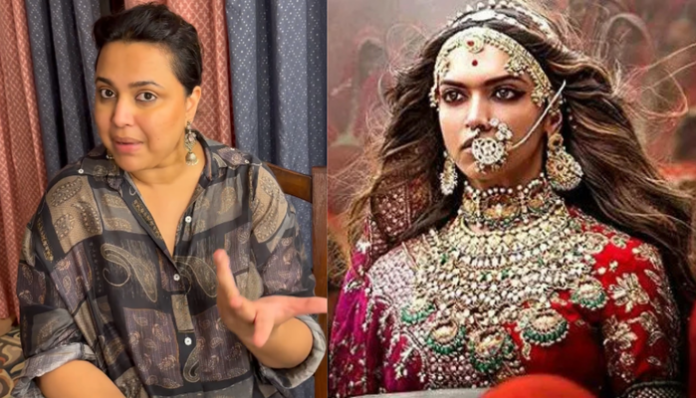
After facing backlash for repeating her distasteful remarks over the practice of Jauhar at a recent public event, Swara Bhasker has issued a clarification. Bhaskar posted a video on X on 1st September, in which she defended her remarks and blamed people for failing to understand her English.
She claimed that people’s reaction to her remarks resulted from their lack of understanding of English and ‘mistranslating’ her words. “When you don’t understand the language, ask someone or check it with someone instead of making up and spreading lies and provoking people,” Bhaskar said in the video. She went to translate her remarks and ended up repeating the same remarks that triggered the backlash.
Bhasker clarified that she did not refer to Rani Padmaavati and other women who committed Jauhar, as depicted in the movie Padmaavat (2018), as cowards for choosing to self-immolate to avoid being made sex slaves at the hands of the Islamic invader Alauddin Khilji. However, she did not like the inclusion of the Jauhar scene in the movie as, according to her, it would make rape survivors feel bad for being alive even after being raped and would encourage them to kill themselves.
While justifying her distorted understanding of Jauhar and medieval history, Bhaskar went on to label the entire Indian society as suffering from a “rape epidemic” and having a “thriving rape culture”. She added that rape survivors should not be made to feel like they do not deserve to live.
मेरा एक वीडियो क्लिप वायरल है- जिसे ग़लत रूप से झूठे ढंग से अनुवादित किया जा रहा है! मैंने कतई नहीं कहा कि रानी पद्मावती या कोई भी सती कायर थी । शर्मनाक है कि @ndtvindia और अन्य मीडिया चैनल और लोग बार बार झूठा इल्ज़ाम लगाकर लोगों को उत्तेजित कर रहे हैं ।
— Swara Bhasker (@ReallySwara) September 1, 2026
गाली देनी है तो दो- पर… pic.twitter.com/TR8sy5gRCr
The clarification relates to the recent remarks made by her at the left-leaning India International Centre event in Delhi on 31st August. Speaking at the event, Bhasker explained why, in 2018, she wrote an open letter to Sanjay Leela Bhansali, the director of the movie Padmaavat. She said that she opposed the inclusion of the Jauhar scene in the movie, as in her opinion, the scene would push rape survivors to commit suicide.
Bhaskar said, “I was watching this…all these women committing Jauhar…I was like, you know, if, god forbid, been a rape survivor, what would this film tell me? I would feel like a coward. That I didn’t kill myself to save my honour. Is that what you want to tell in a society like ours, where I feel like, anyway, there’s a rape epidemic? Is this what you want to tell our survivors? That you don’t deserve to live. That if you were actually honourable before rape, you would have killed yourself”.
Padmaavat delivered no message or prescription to present-day rape survivors that they should commit Jauhar or end their lives.
Since 2018 till now, the Bollywood entertainer has not been able to grasp that the backlash is not a result of people not understanding her remarks, but because they understood exactly what she stated both in her 2018 open letter and at the recent IIC event.
The movie Padmaavat depicted a gory reality of medieval times when repeated Islamic invasions inflicted unimaginable horrors, including religious persecution, violence, plunder, and slavery on the people of India. In those atrocious times, when justice was not protected by the rule of law as it is now, people made desperate choices to protect their lives and dignity.
Jauhar was one such choice made by Hindu Rajput women, necessitated by an imminent reality in which they would have been stripped of basic human dignity and pushed into lifelong sex-slavery. So, they chose while they still could and chose a willful death over a life of unending slavery.
Swara Bhasker’s problem is that she conflates a reality of medieval times, where might was right, with the present times, when a State and its institutions exist to protect those subjected to abuse. She imagines a message for rape survivors, where there is none, in the depiction of a historical reality in a movie, and blames the entire society for the imaginary message.
Bhasker also failed to provide any data confirming that since the release of the film Padmaavat in 2018, the practice of Jauhar has returned or that rape survivors committed self-immolation after taking inspiration from the film’s Jauhar climax.
