

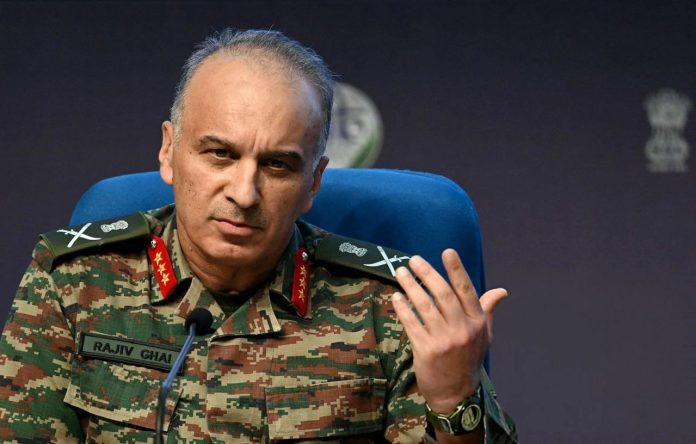
In a striking revelation at the United Nations Troop Contributing Countries’ (UNTCC) Chiefs’ Conclave, India’s Director General of Military Operations (DGMO) Lt General Rajiv Ghai disclosed that Pakistan pleaded for a ceasefire within just 88 hours of India’s decisive military retaliation, Operation Sindoor.
#WATCH | Delhi | Director General Military Operations Lt Gen Rajiv Ghai says, "88 hours is what it took for the enemy to come and ask for a cessation of hostilities. You're well aware of that. For that call to be made by my counterpart, then. We achieved our political and… pic.twitter.com/iBciGUvFxQ
— ANI (@ANI) October 14, 2025
Lt Gen Ghai said Pakistan’s hasty capitulation validated India’s political and military objectives. “Further conflict would have been catastrophic for them,” he warned, underscoring how India’s calibrated response left Islamabad with no strategic options.
Doctrinal shift under PM Modi: ‘No distinction between terrorists and their sponsors’
The DGMO emphasised that Operation Sindoor represented not merely a military strike but a strategic transformation in India’s counter-terrorism doctrine, a vision articulated by PM Modi himself.
“There has been a doctrinal shift in our strategy against terror. Our Prime Minister has spoken about it. He said three things clearly, terror attacks are acts of war; India will retaliate decisively; and we will not succumb to nuclear blackmail. There is no distinction between terrorists and their sponsors,” Lt Gen Ghai stated, as quoted by ANI.
#WATCH | Delhi | Director General Military Operations Lt Gen Rajiv Ghai says, "On the 22nd of April, terror came calling (in Pahalgam). Sponsored terrorists from across the LoC killed 26 innocent tourists, singled them out, identified them, asked for the community that they came… pic.twitter.com/zmOwZPZkDF
— ANI (@ANI) October 14, 2025
The operation was launched in retaliation to the Pahalgam terror attack of April 22, in which Pakistan-backed terrorists crossed the Line of Control (LoC) and brutally murdered 26 unarmed tourists, targeting them based on community identity. Though a proxy outfit initially claimed responsibility, Ghai noted that “they soon realised things had spiralled beyond their control and immediately withdrew.”
He added that while India’s response was expected, it was deliberate and calculated, preceded by key border deployments to deter escalation and safeguard civilian areas.
Tri-service precision strikes: Army, Air Force and Navy in synchronized action
Operation Sindoor was, in Ghai’s words, a “fusion of military precision and diplomatic agility” involving the Indian Army, Air Force, and Navy.
“We hit 11 of their air bases, eight major bases, three hangars and four radars were damaged. Pakistani air assets were destroyed on the ground, including a C-130 transport aircraft, an AEW system, and several fighter jets,” Ghai detailed.
The Navy, too, played a silent but decisive role. “The Indian Navy had already moved into the Arabian Sea. Had Pakistan taken it further, the consequences would have been disastrous for them, from the sea and beyond,” he remarked.
‘We did not let them rest’: Hunt for Pahalgam attackers
The DGMO revealed that India’s forces pursued the three main perpetrators of the Pahalgam attack for nearly 96 days.
“We did not let them rest. When we finally found them, they appeared exhausted and malnourished, worn out from running,” Ghai said, confirming that all were neutralised.
He also shared visuals of precision strikes on high-value terror hubs, including Lashkar-e-Taiba’s headquarters in Muridke and camps in Bahawalpur, in the early hours of May 7. Over 100 terrorists were eliminated in those strikes.
Indus Water Treaty suspended: Diplomatic and economic levers in play
Lt Gen Ghai highlighted that India’s response extended well beyond the battlefield. “The suspension of the Indus Water Treaty of 1960 immediately after the Pahalgam attack was part of the same strategy to signal that the old playbook of terror and talks cannot coexist,” he stated.
This, he said, showcased India’s ability to combine military might with diplomatic and economic instruments, reinforcing deterrence across multiple domains.
Pakistan’s casualties ‘far higher than admitted’
Ghai also pointed to an inadvertent admission by Pakistan itself. “They possibly let out their awards list on August 14. The number of posthumous awards they gave away revealed the real picture; their LoC casualties were in excess of 100,” he said.
The long shadow of Pakistan-sponsored terrorism
Reflecting on decades of cross-border terror, Lt Gen Ghai reminded the global community of the human cost borne by India: “Since the late 1980s, Jammu and Kashmir alone has witnessed over 28,000 terror incidents. More than 60,000 minority families, over one lakh individuals, were forced to flee their homes. 15,000 civilians and 3,000 security personnel have been killed. The source of this bloodshed is no secret.”
