

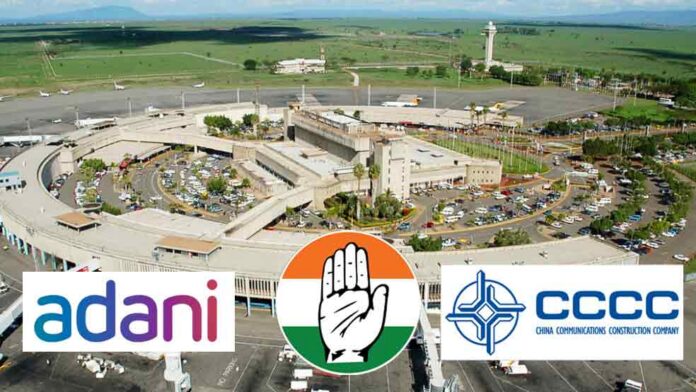
The Jomo Kenyatta International Airport (JKIA) in Nairobi, Kenya’s busiest gateway, is set for a major overhaul. As per reports, the Kenya government has awarded a $2.9 billion engineering, procurement, and construction (EPC) contract to China Communications Construction Co. (CCCC), a Chinese state-owned enterprise, for terminal expansion, a new 4.5 km runway, and capacity upgrades to handle up to 12 million passengers annually by 2045.
This comes nearly two years after Kenya cancelled a proposed $2 billion public-private partnership (PPP) concession with India’s Adani Group for modernisation and long-term operation of the same airport. The Chinese contract is approximately 50% more expensive, an extra $900 million. Shifting the burden more directly onto Kenyan taxpayers compared to the private investment-led Adani model.
Between 2022 and 2024, Kenya engaged Adani Group for JKIA upgrades under a PPP model. Adani offered competitive private financing with no immediate burden on the Kenyan exchequer, aiming for terminal modernisation, runway improvements, and operational efficiency. The deal positioned an Indian private player in a key East African infrastructure hub.
The project unravelled in November 2024 amid intense domestic pressure in Kenya. A sustained social media campaign, led prominently by France-based Kenyan whistleblower and influencer Nelson Amenya, highlighted alleged irregularities like a lack of public tender, bypassed stakeholder consultations required by Kenyan law, tax exemptions favouring the concessionaire, and concerns over gradual airport fee hikes. Amenya leaked documents and alleged that the project lacked transparency and threatened national interests.
Kenya Aviation Workers Union organised protests and strike threats over job security and privatisation of a strategic national asset. President William Ruto cited public pressure and global allegations, including US Department of Justice (DOJ) actions against Adani Group in a separate matter, when cancelling the procurement process. Adani denied all wrongdoing and the applicability of US allegations to the Kenya deal.
Congress had amplified the campaign
The most important angle in the episode is that the Congress party had openly opposed the airport contract given to the Adani group. The opposition party had amplified the narrative internationally. On 3 September 2024, Congress leader Jairam Ramesh posted on X highlighting the Kenyan protests and warning that they could “easily convert into anger against India and the Indian Government.”
He linked it to Prime Minister Modi’s “special friendship” with Gautam Adani, using the term “non-biological PM”, compared it to controversies around Adani projects in Sri Lanka and Bangladesh, and argued that such ties undermined India’s soft power and foreign policy.
The Adani Group’s proposed takeover of the airport in Nairobi, Kenya, has led to widespread protests in the country, with the Kenya Aviation Workers Union calling for a strike to demonstrate its opposition. This is a matter of grave concern for India, because the non-biological…
— Jairam Ramesh (@Jairam_Ramesh) September 3, 2024
After cancellation, Congress questioned the Indian government, with Ramesh stating the outcome was “expected” and that foreign policy should not be subordinated to one conglomerate’s interests. It was interesting to note that Adani Group had defeated several Chinese firms for the project, and it was alleged that Congress was targeting the Adani Group for that reason.
A fake press release purporting to be from Adani, threatening to expose alleged bribe recipients in Kenya, circulated in September 2024 and was widely shared to damage the company. Adani officially denounced it as fraudulent, stating no such release was issued.
China steps in at a premium
Now, Kenya has awarded the project to CCCC on an EPC basis. Unlike the cancelled Adani PPP (private investment and operation) project, this is a state-funded contract where Kenya pays a significantly higher price.
The around 50% cost increase has sparked debate in Kenya about value for money, transparency in the new award, and the trade-off between retaining sovereignty and accepting higher public debt. CCCC has a track record on major African projects, like Kenya’s Standard Gauge Railway, but the premium raises questions about who ultimately pays: Kenyan taxpayers funding via loans and infrastructure funds versus private investment under a concession model.
US DOJ Case collapse and Chinese AI propaganda
In May 2026, the US Department of Justice closed its criminal fraud and related charges against Gautam Adani and associates, citing a lack of conclusive evidence or inability to sustain the case. Adani had denied the allegations throughout, which were linked to a separate Indian solar deal, not related to the USA or Kenya. This closure came two years after Kenya cancelled the deal, citing the case against the company in the US.
Therefore, a baseless case against the company in the US led to the company losing the deal in Kenya, and thereby, the US govt also contributed to the Chinese company getting the project.
And recently, France’s Viginum agency exposed a network of 13 counterfeit Chinese news websites linked to state broadcaster CGTN using AI tools to spread pro-China narratives across several languages. These sites were launched primarily in early 2025, overlapping with the period after the cancellation of the project. While not directly tied to the JKIA episode, the timing and nature have fuelled speculation about coordinated information operations in global infrastructure contests.
Anti-Adani campaign benefits China
After the Kenya govt’s decision, the Congress party and others who had opposed the Adani project have come under the spotlight for the role they played in the development. The sustained anti-Adani rhetoric from the Congress party and others helped make the Indian proposal politically toxic for the Kenyan govt. This created space for a Chinese state-backed firm to secure the project at a 50% premium, representing a setback for Indian private-sector infrastructure diplomacy in Africa and a gain for China’s state-driven model.
It is also important to note that American allegations against Adani, which contributed to the cancellation of the deal, were ultimately not substantiated in court. Congress party had amplified these allegations too.
Now the Kenyan govt’s decision has come under question because a cheaper private company-led upgrade has been replaced by a more expensive state-funded contract. Kenyan taxpayers will face higher costs, and the project is now delayed by several years.
This also marks a loss for India, as it is a loss of a foothold for private Indian infrastructure firms in Africa. The development raises questions about whether domestic political attacks on specific companies like Adani Group harm India’s global competitiveness against state-backed rivals like China.
Moreover, fake press releases targeting Adani, a non-resident Kenyan-led social media campaign, and recent revelations about Chinese AI propaganda networks further raise questions about manufactured outrage versus organic local concerns over vital infrastructure projects.
Therefore, the Congress party had directly benefited China by continuing to attack the Adani group for its perceived closeness with PM Narendra Modi, resulting in the cancellation of the vital project in Nairobi for the Indian company, which would have contributed to enhancing India’s soft power in the region.


