

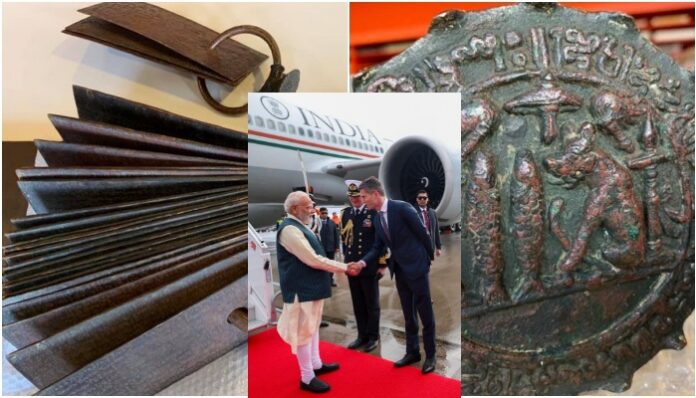
Making a major success for India’s efforts to restore ancient artefacts relating to the country’s heritage, the Netherlands on Friday (15th May) returned the 11th-century Anaimangalam copper plates to India. The plates, also known as the Leiden Plates, are among the most significant surviving records of the Chola dynasty. The gesture comes as Prime Minister Modi is in the Netherlands as part of his five-nation tour.
The development follows years of repatriation efforts between the Indian government, the Dutch government and Leiden University, where the artefacts were kept. The plates are 21 in number and weigh about 30 kg. They are held together by a bronze ring locked with the royal seal of Rajendra Chola I. The inscriptions on the copper plates date to the reign of Emperor Rajaraja Chola I (985–1014 CE) and his son Rajendra. The Sanskrit portion in the inscriptions traces the Chola genealogy, invoking divine legitimacy from Vishnu through a line of ancestors.
Anaimangalam Copper Plates, 11th-century Chola dynasty artefacts.
— Sidhant Sibal (@sidhant) May 16, 2026
India getting them back from Netherlands https://t.co/GKvPFZaIP7 pic.twitter.com/JN9Xa3wJwy
The copper plates offer a peek into the glorious Chola period
The Tamil section records Rajaraja’s grant of land revenues and taxes to the Chudamani Vihara, a Buddhist monastery in Nagapattinam. The monastery was built by Sri Mara Vijayotunga Varman, the ruler of the Srivijaya kingdom in present-day Indonesia. The land grants were originally issued by Rajaraja Chola I, but his son, Emperor Rajendra Chola I, later had the order engraved onto the copper plates to preserve it.
The inscriptions provide a rare insight into the maritime links, religious pluralism and cultural exchanges that existed between South India and Southeast Asia during the peak of the Chola period. The records reveal that Hindu rulers of the period patronised Buddhist institutions, underlining a long-standing Indian tradition of religious coexistence and support across faiths.
How the copper plates landed at Leiden University
The copper plates were acquired by Dutch missionary Florentius Camper around 1700 when the Dutch East India Company controlled Nagapattinam after shifting its Coromandel headquarters from Pulicat to there. Eventually, they landed at Leiden University in 1862 through the estate of Prof Hendrik Arent Hamaker and formed part of the university library’s Asian collections. At the varsity, the copper plates were preserved in secure vaults and were accessible only to researchers and scholars.
India had long been making efforts for the return of the copper plates by engaging with the Dutch government and Leiden University. In 2022, India’s repatriation efforts received a boost after the Netherlands finalised a restitution policy for colonial-era artefacts in 2022. This was followed by another breakthrough in 2023, when UNESCO’s Intergovernmental Committee validated India’s claim as the country of origin and urged bilateral talks.
