

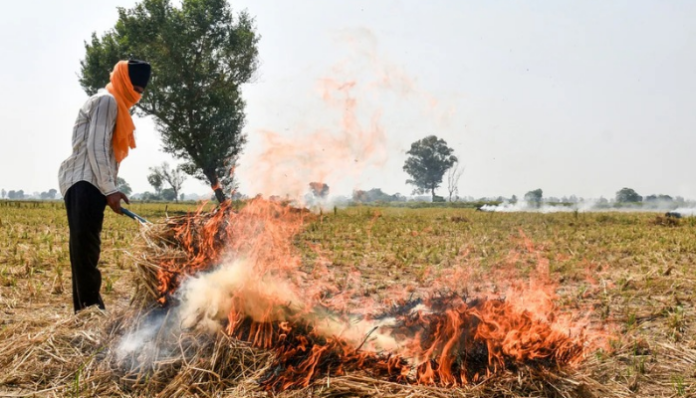
As North India braces for another winter of hazardous air quality, a stark discrepancy in farm fire data has emerged, challenging official narratives of progress in curbing stubble burning. A NASA-affiliated scientist’s satellite-based analysis, Dr Hiren Jethva, suggests that the actual number of farm fires in Punjab and Haryana this season could be nearly eight times higher than government records indicate.
According to Dr Hiren Jethva, an aerosol remote sensing scientist associated with Morgan State University and NASA’s Goddard Space Flight Centre, calculations show approximately 34,000 farm fires occurred in Punjab and Haryana between 1 October and 9 November this year. In contrast, the Commission for Air Quality Management (CAQM) reported only 4,459 incidents in Punjab alone up to 8 November.
The official figures have been presented as evidence of successful enforcement, with physical inspections conducted at 2,998 locations, fines levied in 1,228 cases, and 884 FIRs registered. However, Dr. Jethva’s research, shared on social media, indicates that satellites traditionally used by government agencies are missing a growing proportion of fires. The key reason, because farmers have gradually shifted the timing of burning to late afternoon, after polar-orbiting satellites have passed over the region.
1. Linear regression model using #MODIS NDVI-Fires correlation 📈 ranks 2026 Punjab-Haryana post-monsoon fire season 🔥 as one of the intense burning periods with ~14,000 expected stubble fires (1-km). https://t.co/DiHUszW7nl
— Hiren Jethva (@hjethva05) October 3, 2026
The satellite data reveals a telling pattern. NOAA-20 VIIRS (375 m resolution) detected 4,089 fires near 1:30 p.m. local time, while Aqua MODIS (1 km resolution) recorded 4,196 fires near 4 p.m. After empirical adjustment to the VIIRS fire-count baseline, Dr Jethva concluded that the total reaches ~34,000 fires, a conservative estimate, as he stated in his post.
At the Punjab district level, Tarn Taran recorded the most incidents (654), followed by Ferozepur (592), Sangrur (488), Bathinda (406), and Patiala (288). These official numbers differ sharply from Jethva’s satellite-based estimate: speaking on NDTV’s “Left, Right and Centre” on 5 November, he said his latest analysis using Aqua MODIS observations converted to the higher-resolution VIIRS fire dataset found 27,000 fires across Punjab between 1 October and 5 November.
While 🛰️INSAT 3DS data are quite important for tracking diurnal evolution of fires, the fire counts should/can not be compared those detected by MODIS/VIIRS simply because of significant differences in detection spatial resolution.
— Hiren Jethva (@hjethva05) November 3, 2026
This undercounting has significant implications for public health and environmental policy. Stubble burning is a major contributor to the severe air pollution that blankets Delhi and the Indo-Gangetic plains each winter, often accounting for a substantial share of particulate matter on peak days. If the actual number of fires is far higher than reported, official claims of a 90% reduction in farm fires since 2021 may present a misleading picture of air quality improvement.
The findings underscore a critical blind spot in monitoring infrastructure. While government agencies rely on satellite passes at fixed times, the shift in burning practices, with over 90% of large fires now occurring after 3 p.m. in Punjab, means that the very data used to measure compliance may be systematically flawed. As Dr Jethva’s analysis suggests, without accounting for this temporal evasion, policymakers and the public may continue to underestimate the scale of the stubble burning crisis and its contribution to North India’s toxic air.
