

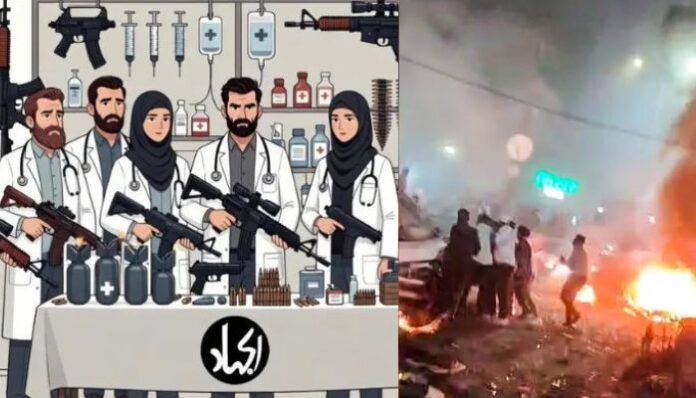
A breakthrough has been made in the investigation into the ISIS terror module, which was responsible for last year’s Red Fort blast. The module was first uncovered by the Jammu and Kashmir Police and is now being probed by the National Investigation Agency (NIA). Officials say the arrested individuals were radicalised as far back as 2016 and formed their own terror outfit named “Ansar Interim.”
Officials say that in April 2022, several key members met at Eidgah in downtown Srinagar. Present at the meeting were Muzammil Ganai, Umar-un Nabi (suicide bomber), Adeel Rather, his absconding brother Muzzafar Rather, Maulvi Irfan, Qari Aamir and Tufail Gazi. During this meeting, they decided to form a new organisation called “Ansar Interim.”
The 'white-collar' terror module recently busted by the Jammu and Kashmir Police indicates that the doctors arrested in the case had been radicalised since 2016 and formed a new terror organisation named "Ansar Interim" to carry out subversive activities in the Union Territory as… pic.twitter.com/ZTIDsa4E91
— Hindustan Times (@htTweets) February 15, 2026
Adeel was named the ‘Ameer’ or chief of the group, Maulvi Irfan became the deputy, and Ganai handled finances. Officials point out that the term “Ansar” is often linked with the globally banned terror outfit Al-Qaeda. The accused reportedly told investigators that they felt cut off from active terror groups and therefore chose to form their own outfit. Roles and secret codes were assigned during this meeting.
Radicalisation and explosive preparations
According to investigators, Umar-un Nabi was one of the most radicalised members. He had tried to join terror groups in 2016 and again in 2018 but failed. Over time, he became deeply involved in planning attacks. Along with Ganai, he managed funds and arranged materials.
In 2023, the group decided to procure fertiliser from Sohna and Nuh in Haryana. On Umer’s instructions, NPK, commonly associated in such cases with Potassium Nitrate, was purchased from a chemical shop in Faridabad. During questioning, the arrested doctors admitted that Umer began watching online videos to learn how to make Improvised Explosive Devices (IEDs). He eventually managed to prepare Triacetone Triperoxide (TATP), a highly dangerous explosive that has been used in several terror attacks worldwide.
Adeel Rather also began recruiting new members. One such recruit was Danish, also known as Jasir, from South Kashmir. Adeel took him to a rented room inside Al-Falah University in Faridabad, where Umer and Ganai were preparing explosive material. Umer even tried to convince Danish to carry out a suicide attack, but he reportedly backed out at the last moment, saying suicide was forbidden in Islam and citing his poor financial condition.
The plot and its collapse
Investigators believe Umer was planning a Vehicle-Borne Improvised Explosive Device (VBIED) attack at a crowded location, possibly in Delhi or at a religious site. The original plan, officials suspect, was to plant the explosive-laden vehicle and escape. However, the plan began to unravel when Srinagar Police intensified their investigation.
The breakthrough came after posters of Jaish-e-Mohammed appeared in Bunpora, Nowgam, on the outskirts of Srinagar on 19th October. Police registered a case and examined CCTV footage, which led to the arrest of three locals with prior stone-pelting cases. Their interrogation led to the arrest of Maulvi Irfan Ahmad, a former paramedic who had become an Imam in Shopian. He is accused of supplying the posters and playing a role in radicalising members of the group.
Soon after, Ganai was arrested, and explosives were seized. Officials believe this may have triggered panic within the network. As pressure mounted, Umer went ahead with the attack prematurely, resulting in the deadly blast outside the Red Fort.
The investigation has now revealed an interstate network that operated quietly for years under the guise of respectable professions. With the NIA continuing its probe, officials say more details about the funding, recruitment, and possible wider links of this “white-collar” terror module are likely to emerge in the coming weeks.
Red Fort blast and the white-collar terror module
A major car blast near the Red Fort in Delhi on 10th November, 2025, has resulted in the deaths of 13 people and injured over 2 dozen others. In the blast, a Hyundai i20 car filled with explosives was driven by a 28-year-old doctor-turned-terrorist named Umar-un Nabi, who hails from Pulwama. The Red Fort blast investigation and the “white-collar” module in Kashmir have exposed an interlinked jihadi network involving Adeel, an arrested staffer from GMC Anantnag, and Dr Muzammil Ganai, already in custody.
What initially appeared to be a standalone terror strike has now exposed a deeper and more organised network. Among those arrested are Dr Muzammil Shakeel Ganai of Pulwama, Dr Adeel Ahmed Rather of Anantnag, Dr Shaheen Saeed of Lucknow, and Mufti Irfan Ahmad Wagay of Shopian. Two doctors linked to Al-Falah University in Haryana were also arrested by the Delhi Police.
