

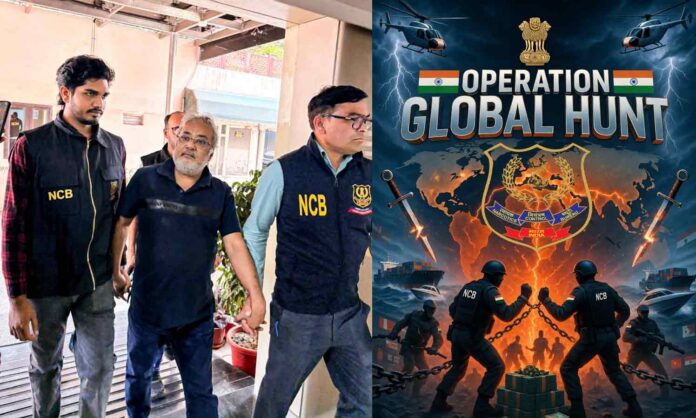
On 28th April (Tuesday), 59-year-old Mohammad Salim Dola, an international drug trafficker and close friend of gangster-turned-terrorist Dawood Ibrahim, was brought back from Turkey (Turkiye) by the Narcotics Control Bureau (NCB). The groundwork for the action was laid a few months ago when the agency proposed a three-year strategy to the Union Home Ministry for “Operation Global-Hunt.” The goal of the mission is to destroy 100 narcotics networks that Indian fugitives run overseas, notably in Dubai, Canada and Europe.
#WATCH | Delhi | The close aide of Dawood Ibrahim, Salim Dola, being taken away from the residence of the Duty Magistrate.
— ANI (@ANI) April 28, 2026
The court has reserved the order. He will pronounce the order shortly
He was taken into custody on his arrival at IGI Airport, New Delhi, early this… pic.twitter.com/yOAFSldkm4
Union minister Amit Shah also lauded the development, declaring “Zero tolerance against Narco syndicate.” He asserted, “Under Modi govt’s mission to ruthlessly smash drug cartels, our anti-narcotics agencies have extended their claws across borders through a robust network of global agencies. Now no matter where they hide, no place is safe for drug kingpins.”
Zero tolerance against Narco syndicate.
— Amit Shah (@AmitShah) April 28, 2026
The @narcoticsbureau today made a major breakthrough in securing the return of notorious drug trafficker Mohammad Salim Dola from Turkiye. Under Modi govt's mission to ruthlessly smash drug cartels, our anti-narcotics agencies have…
Dola was arrested in Turkey on Saturday (25th April) and arrived at the Indira Gandhi International airport in Delhi early on Tuesday, where he was apprehended by the NCB. The Istanbul Police Department’s Narcotics Crimes Division executed a targeted operation after he was traced to a home in the Beylikduzu neighbourhood of Istanbul in connection with a narcotics trafficking investigation.
While India does not have an extradition treaty with Turkiye, Indian agencies successfully worked with the UAE to convince them to hand over Dola. His use of a forged UAE passport facilitated the process. After diplomatic coordination involving the Turkish and UAE authorities, Dola was sent to India. He will now be handed over to the Mumbai Police and interrogated by several agencies.
Dola’s son, Taher Dola, was deported from the United Arab Emirates to India in 2025, and his interrogation provided vital inputs on Dola’s location. This subsequently led the authorities to Dola’s hideout in Istanbul’s Beylikduzu district.
Dola’s station proceedings had been finalised by the Istanbul Police Department. Meanwhile, nearly 126 kilograms of mephedrone and Rs 25,22,000 were found by authorities during raids in India. The action in Turkey occurred simultaneously with the probe in India, where the accused, who were arrested in the Kurla area of Mumbai, admitted to receiving orders from Dola.
The MHA released an official notice and informed, “Dola was the subject of an INTERPOL Red Notice issued at India’s request in March 2024 and was wanted for prosecution in multiple narcotics trafficking cases in India. He had been absconding from Indian law enforcement agencies.”
It further highlighted, “Over the years, Dola established a major transnational drug trafficking syndicate spanning several countries in the Middle East, Africa and Europe. His two-decade-long criminal record includes direct involvement in cases linked to multiple high-value seizures of heroin, charas, mephedrone, mandrax and methamphetamine in Maharashtra and Gujarat.”
Salim Dola’s role consistently emerged as that of a bulk supplier to downstream distribution networks in India. Besides, he is also wanted by ATS Gujarat and the Mumbai Police. Earlier, his son Tahil Salim Dola and other associates were arrested by Mumbai police after…
— ANI (@ANI) April 28, 2026
The statement mentioned that Dola has continually surfaced as a bulk provider to India’s downstream distribution channels. Moreover, the Mumbai Police and the Gujarat Anti-Terrorism Squad (ATS) are also looking for him. His son Tahil Salim Dola and several accomplices were previously captured by Mumbai Police following their extradition or deportation from the United Arab Emirates in 2025.
The press release declared, “This effort exemplifies close cooperation and coordinated action between the authorities in Turkiye, INTERPOL and Indian agencies.” In 1998, Dola was nabbed at the Mumbai airport with 40 kilograms of mandrax. After Salim Mirchi, investigators suspect that he handled drug operations for the D-Company. His name then appeared in other significant confiscations, including in a Directorate of Revenue Intelligence (DRI) gutka smuggling case and a fentanyl haul for Rs 1,000 crore.
Operation Global Hunt
Dola is the first target of “Operation Global-Hunt,” which is focused on the most-wanted list of traffickers connected to infiltrating the Indian streets with fentanyl, cocaine, heroin and synthetic substances. “These kingpins have evaded justice for too long, fueling addiction and violence across our cities. Under Operation Global-Hunt, Indian central agencies, through coordination, will hunt them down via Interpol red notices, while freezing their assets here,” The Indian Express quoted an official.
Operation Global-Hunt is a specialised operation conducted by the Narcotics Control Bureau (NCB) in coordination with international and Indian intelligence agencies to track down, detain, and repatriate Indian fugitives involved in major drug trafficking syndicates. The operation targets approximately 100 “most-wanted” fugitives over a planned three-year period, focusing on those heading syndicates that flood India with fentanyl, cocaine, and synthetic drugs.
Fugitives like Jaswinder Singh, also known as Jazz, a cartel leader from Punjab who is charged with smuggling 500 kilograms of heroin by sea, Sunny Kalra, who is the ringleader of MDMA shipments from the Netherlands and Pawan Thakur, a trafficker based in Dubai who laundered ₹500 crore through cryptocurrency channels, are reportedly at the forefront of the roster.
The NCB created its course of action in accordance with the MHA’s instructions. “We draw your attention to the alarming rise in substance abuse, extensively deliberated at the Narco Coordination Centre (NCORD) meeting held under the chairmanship of the Union Home Minister. The meeting emphasised that all ministries and departments must prepare a comprehensive roadmap up to 2029, backed by a strong, time-bound monitoring and review mechanism. It was decided that all stakeholder departments will jointly launch a three-year nationwide campaign against drug abuse,” the MHA conveyed in a message addressed to every state and the NCB.
It added, “Under this campaign, the operational framework for each pillar of the anti-drug strategy will be clearly defined, specific and measurable targets will be set, and regular reviews will be conducted to ensure accountability.”
By shifting the focus from local distributors to the “kingpins” based in foreign jurisdictions, the operation aims to dismantle the leadership structures of cartels responsible for the influx of narcotics into the country. The operational framework relies heavily on a robust network of international cooperation, utilising Interpol Red Notices and real-time intelligence sharing with foreign security agencies.
Because many targets reside in countries without direct extradition treaties with India, the NCB employs a combination of diplomatic outreach and multi-agency coordination to facilitate deportations. Beyond physical apprehension, the operation includes a significant financial component aimed at crippling the economic power of these syndicates. Authorities are actively identifying and freezing the domestic assets of these most-wanted traffickers, ensuring that their illegal enterprises cannot continue to function while they are in flight or custody.
