

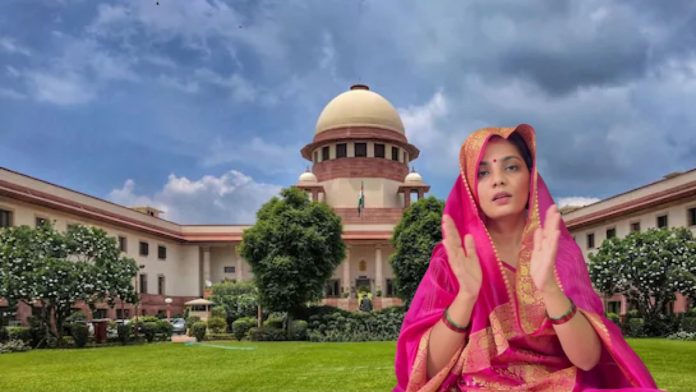
The Supreme Court on Monday refused to quash the FIR against Bhojpuri singer and activist Neha Singh Rathore, whose disparaging social media posts attacking PM Modi, the Bihar elections, and Hindu-Muslim politics after the Pahalgam terror attack landed her in legal trouble.
A Bench of Justices J.K. Maheshwari and Vijay Bishnoi made it clear that the top court was not inclined to interfere at this stage, effectively allowing the criminal proceedings to go on.
Appearing for Rathore, Senior Advocate Kapil Sibal argued passionately that slapping charges of mutiny and invoking provisions under Sections 159, 196(1), and 197(1)(b)(c)(d) of the Bharatiya Nyaya Sanhita was an absurd overreach. “How can I be tried for mutiny? I only seek quashing of certain sections,” Sibal shot back.
But the Bench was unmoved. “We are not expressing any opinion on merits,” Justice Maheshwari said, adding that Rathore could raise objections at the stage of framing of charges. The Court also declined to stay police action, meaning the FIR stands, and the investigation continues.
The case thus far
On September 19, the Allahabad High Court had already dismissed Rathore’s plea to quash the same FIR, holding that the complaint disclosed cognizable offences. The singer was told to appear before the investigating officer in Lucknow.
The FIR, filed on April 27, 2025, at Hazratganj Police Station, accuses Rathore under a slew of serious provisions: Sections 196, 197, 302, 152, and 353 of the BNS, along with Section 69A of the IT Act, 2008. Later, Sections 152 and 159 were added during the probe.
Investigators cited Rathore’s posts blaming the BJP for “politicising terror” and “sacrificing soldiers for votes,” alleging these remarks, which circulated widely, including in Pakistan, risked damaging India’s sovereignty and fanning communal tension.
“Political criticism, not sedition,” argues defence
Rathore’s counsel Kamal Kishore Sharma countered that her tweets were mere political dissent, fully protected under Article 19(1)(a).
“She neither incited violence nor spread falsehoods,” he said, citing the Imran Pratapgarhi vs State of Gujarat (2025)judgment where the Supreme Court upheld critical poetry as legitimate expression.
But the state’s advocate V.K. Singh hit back, arguing that Rathore’s comments went beyond criticism and into the realm of incitement. He invoked landmark rulings, Ramji Lal Modi (1957), Kedar Nath Singh (1962), and Bhajan Lal (1992), to stress that speech threatening public order or national unity can be curtailed.
Court’s stern message: Free speech has limits
The Bench sided with the state’s reasoning, holding that the FIR and case diary contained enough material to justify investigation. The court noted that, unlike in Pratapgarhi’s case, Rathore’s tweets explicitly named and attacked top constitutional authorities, invoking religion and national security in a “derogatory and inflammatory manner.”
“The fundamental right to free speech under Article 19(1)(a) is not absolute,” the court observed. “When speech risks inciting communal tension or undermining national unity, it loses its constitutional shield.”
With that, the writ petition was dismissed. The Supreme Court directed that the investigation be conducted fairly and strictly as per law, but made it clear that Rathore must appear before the investigating officer on September 26 at 11 a.m. and cooperate until the police file their report.
