

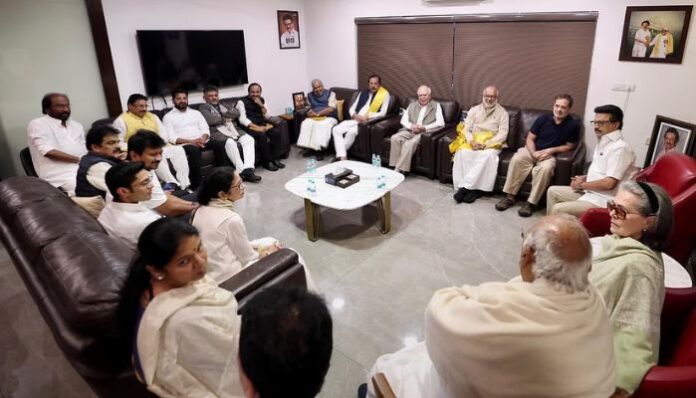
A high-profile delegation of the INDI bloc failed to persuade DMK chief MK Stalin to withdraw his party’s support for the Centre’s proposed delimitation bill. The delegation was led by Congress President Mallikarjun Kharge and included Sonia Gandhi and Rahul Gandhi. The meeting at Stalin’s Alwarpet residence on Sunday, 29 November, concluded with the DMK firmly reiterating its stand. They described the interaction as a “courtesy meeting” rather than a negotiation.
A mission that fell short
The Congress leadership’s last-ditch effort came a day after the DMK announced its backing for the revised delimitation proposals. It put the party at odds with its former ally. The delegation, which also included TMC supremo Mamata Banerjee and the Chief Ministers of Congress-ruled Karnataka, Kerala, and Telangana, sought to convince Stalin. According to them, the legislation could have far-reaching consequences for parliamentary representation and the balance of power between northern and southern states.
BREAKING on @NDTV: DMK refuses to budge after meeting with Gandhis-led delegation, signals it will support the Delimitation Bill. https://t.co/1IB5wJJ1u3
— Shiv Aroor (@ShivAroor) November 29, 2026
However, the atmosphere in Chennai was far from welcoming. Reports indicated that the meeting was delayed and that Congress leaders faced protests, with ‘Go Back Congress’ placards visible outside the venue. It exposed the deep resentment between the two parties.
Stalin’s unwavering stand
The DMK’s decision to support the Delimitation Bill is rooted in what MK Stalin has described as a victory for Tamil Nadu’s interests.
He stated that the Centre’s revised proposal incorporated the party’s two key demands: a guarantee that Tamil Nadu’s existing 7.18 per cent share of Lok Sabha seats would not be reduced, and the maintenance of parliamentary representation based on the 1971 Census.
The DMK has 22 Lok Sabha and eight Rajya Sabha MPs. They announced their support after receiving assurances that Tamil Nadu’s seats would rise from 39 to 59, with this arrangement frozen for 25 years.
In a direct response to Rahul Gandhi’s appeal on social media, Stalin invoked Tamil history to underscore his party’s resolve. Addressing the Congress leader as brother.
He said, “We will not compromise on this path, and I’m confident that history will judge us as Kattabommans and not Ettappans”. The reference was to Veerapandiya Kattabomman, an 18th-century chieftain celebrated for resisting British rule, contrasting him with Ettappan, a figure associated with betrayal in Tamil folklore.
The shadow of a broken alliance
The failure to sway Stalin is the culmination of a dramatic political falling-out. Less than seven months ago, the Congress and DMK were allies. However, after the April 2026 Tamil Nadu Assembly elections, the Congress walked out of the DMK-led alliance.
They supported the TVK government headed by Chief Minister C. Joseph Vijay. The DMK has since accused the Congress of a “U-turn” on delimitation, and the relationship has been marked by mutual criticism.
Rahul Gandhi had acknowledged the stakes.
He argued that expanding the Lok Sabha to 850 seats would “finish democracy in India” by giving the BJP-RSS “unlimited space to redraw India’s entire electoral map to their advantage”.
Despite this appeal, the DMK’s decision appears final. DMK MP Kanimozhi conveyed to the Congress leadership that the party’s stand, as announced by Stalin, would not change.
The failed Chennai meeting highlights the challenges facing the INDI bloc as it seeks to present a united front against the delimitation bill. It is scheduled to be taken up in the Lok Sabha on Monday.
The DMK and the NCP (SP) have announced their support for the legislation. The opposition alliance’s collective position has been thrown into question.
The Congress delegation is now expected to travel to Mumbai to meet NCP (SP) chief Sharad Pawar. The party scrambles to coordinate its allies ahead of a crucial parliamentary showdown. For now, however, the DMK’s bridge to the Congress appears well and truly burned.
