

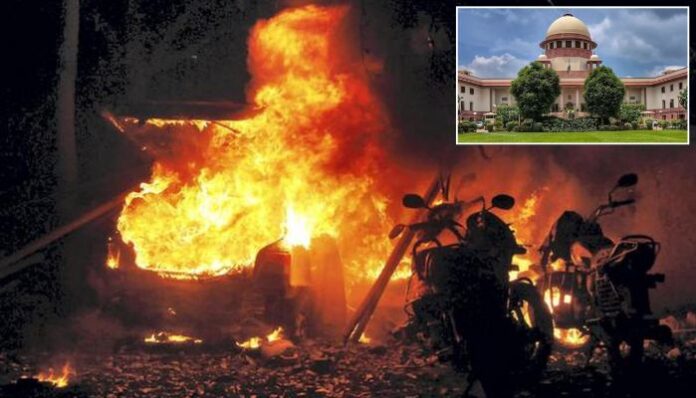
The Supreme Court has stayed the execution of Mohammad Tanvir, an Indian Mujahideen convict sentenced to death for his role in the 2008 Ahmedabad serial bomb blasts that killed 56 people and injured hundreds. The court has agreed to hear his challenge to the Gujarat High Court’s 7th July verdict, which upheld the death sentences of 38 convicts in the case.
According to the Press Trust of India (PTI), a bench of Justices Vikram Nath, Sandeep Mehta and Aparesh Kumar Singh passed the order on 9th October. “There shall be stay of execution of the death sentence awarded to the appellant (Tanvir),” the bench said.
The court has directed the Gujarat government to submit probation officers’ reports relating to Tanvir within eight weeks. It has also asked the concerned jail superintendent to provide details of Tanvir’s conduct and behaviour in prison, along with the work he has performed during his imprisonment.
Supreme Court seeks psychological evaluation and prison records
The bench also directed the prison authorities to arrange a psychological evaluation of Tanvir at a government medical hospital. The report must be submitted to the court within eight weeks, along with the other required documents.
“The superintendent of the prison of the concerned prison shall also get done the psychological evaluation of the appellant from the government medical hospital,” the court said.
The Supreme Court has also called for the original case records from the trial court and the Gujarat High Court. It has scheduled the next hearing after 12 weeks, allowing time for the required reports to be submitted.
Earlier, on 1st October, the Supreme Court had stayed the execution of another convict in the case, Ahmed Bawa, also known as Abbu Abubakar Barelvi.
Gujarat High Court had upheld 38 death sentences
On 7th July, the Gujarat High Court upheld the special court’s February 2022 verdict sentencing 38 convicts to death and 11 others to life imprisonment in the Ahmedabad serial blasts case. A Division Bench of Justices A.Y. Kogje and Samir Dave dismissed the appeals challenging the sentences.
The High Court said the scale of the attacks, the number of deaths, the extent of the conspiracy and the intention to spread terror justified the death sentences. It also noted that the trial court had considered both aggravating and mitigating circumstances before deciding the punishment.
The High Court upheld the life sentences of the other 11 convicts as well. Their roles included participating in terror training camps, arranging shelter for other accused and procuring scooters, plastic containers, and clocks used in the conspiracy.
2008 Ahmedabad serial Bomb blasts case
On 26th July, 2008, 20 serial bomb blasts struck Ahmedabad within a short period, killing 56 people and injuring more than 200. The attacks targeted several locations across the city and caused widespread panic. The blasts were followed by the discovery of unexploded bombs in Surat, which were defused by authorities.
Within three weeks of the attack, major arrests, in this case, had taken place owing to the coordinated efforts of the Gujarat police and the ATS. A big network of the Indian Mujahideen terrorists was exposed. These terrorists were also involved in the bomb blasts in other cities of the country. Then Gujarat CM Narendra Modi had extended every possible support to the investigating officers to ensure that a strong case was built against the terrorists.
The Gujarat police had revealed that these attacks were executed as an attempt to take revenge for the 2002 post-Godhra riots. Indian Mujahideen was a section of the banned organisation Students Islamic Movement of India that is SIMI. The terrorists had sent threat emails about these blasts to various news channels and media houses.
On 8th February, 2022, a special court convicted 49 out of 77 accused and acquitted others. Ten days later, on 18th February, it sentenced 38 convicts to death and the remaining 11 to life imprisonment. The verdict was notable because it marked the first time a court had sentenced 38 people to death in a single case.
The Supreme Court’s latest order pauses Tanvir’s execution while it examines the material required for his appeal.
