

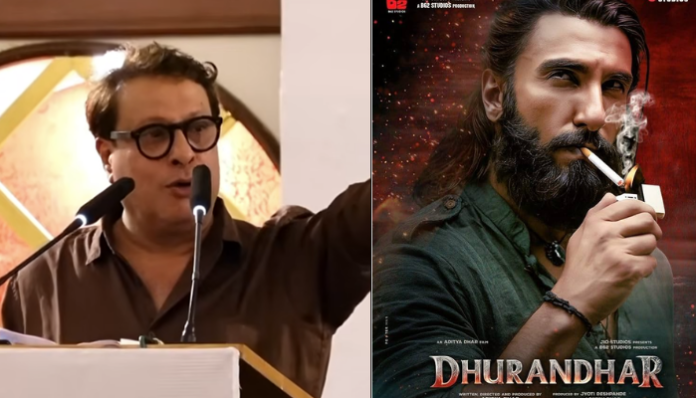
Filmmaker Tigmanshu Dhulia, speaking at the Editors Guild of India’s Rajendra Mathur Memorial Lecture 2026 in New Delhi on September 4, spoke at length about the changing nature of Bollywood, censorship, political pressure and the growing influence of corporate culture on cinema and journalism. During his address, Tigmanshu Dhulia described the blockbuster Dhurandhar films as devoid of any story.
Leftist-minded Tigmanshu Dhulia, who is quite a favourite of the Bollywood gang, is saying that Aditya Dhar’s Dhurandhar had no story at all.
— Amit Kumar Sindhi (@AMIT_GUJJU) September 7, 2026
And whatever story there was, according to him, was the worst possible because it showed Pakistan being destroyed by an Indian spy.
And… pic.twitter.com/9VPzlMkeym
While discussing the current state of Hindi cinema, Tigmanshu Dhulia took aim at the criticism surrounding Dhurandhar. He said the film was a well-made, engaging commercial entertainer, but questioned whether its critics were willing to apply the same standards to films that carry an ideological message from the opposite side.
Tigmanshu Dhulia, Dhurandhar and the debate over propaganda
Tigmanshu Dhulia said that if someone is asked to explain the story of Dhurandhar, it becomes difficult to describe it beyond its basic premise of an undercover Indian spy entering Pakistan and creating havoc there. He argued that the larger problem with mainstream cinema today is that “stories have disappeared” and filmmakers are increasingly working within a fixed template.
He praised Dhurandhar for its presentation, music and ability to keep audiences engaged. At the same time, the film has faced criticism from sections of the liberal ecosystem, with its depiction of Pakistan and themes involving terrorism being described as Islamophobic and politically motivated.
The wider debate, however, is not simply about whether a film is entertaining. Films have always carried political and social messages, Dhulia pointed out. He recalled how older Hindi films used historical characters, symbols and stories to communicate political ideas, sometimes without directly saying what they meant.
He also referred to films such as Pathaan, Main Hoon Naa and Rang De Basanti to underline what he sees as a double standard in judging political messaging in cinema.
Islamophobia debate and Bollywood
The controversy around Dhurandhar has also brought the long-running debate over Islamophobia in Bollywood back into focus. Dhulia argued that cinema should have enough creative space to tell stories involving religion, terrorism, politics and national security without filmmakers constantly fearing backlash.
He recalled the history of Hindi cinema, where Hindu-Muslim characters, Hindi-Urdu language and different cultural influences came together. According to him, Hindi cinema helped create a common Hindustani language understood across large parts of India.
Dhulia contrasted this earlier atmosphere with the current climate, where filmmakers can face pressure from political groups as well as censorship authorities.
Dhurandhar’s success rattled its critics
The success of Dhurandhar, according to this line of argument, made the criticism even sharper. The film became a major commercial success despite attacks over its political messaging and portrayal of Pakistan.
The debate exposed a wider divide in Bollywood: one side sees films such as Dhurandhar as nationalist entertainment and a legitimate way of presenting India’s security concerns, while critics see such portrayals as one-sided or Islamophobic.
Dhulia’s broader concern, however, is the shrinking space for filmmakers to take risks. He argued that cinema needs stories, individuality and freedom rather than a single commercially safe template.
In fact, invoking Dhurandhar indicates that the left-liberal ecosystem was not just rattled by the film showing Pakistan’s Islamic terrorist reality alone. They were angrier with India under the Modi government, ramping up its national security against Pakistani and Khalistani terrorists.
