

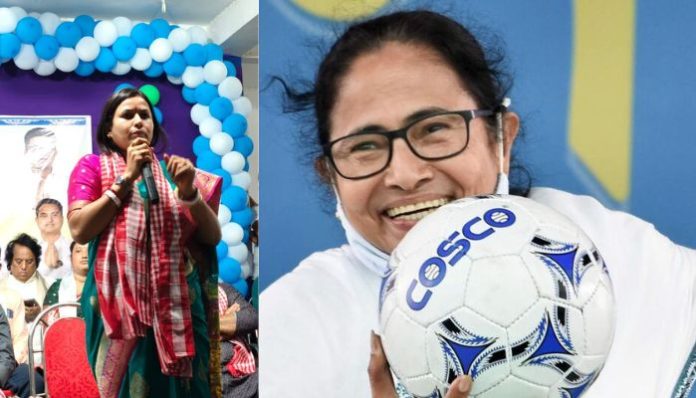
At a public event in Uttar Dinajpur of West Bengal, a Trinamool Congress (TMC) leader sparked controversy by warning political rivals (particularly the BJP) with a “terrifying game” or Bhayankar Khela, in the upcoming 2026 Assembly elections.
Chaitali Ghosh Saha, the president of the TMC’s Uttar Dinajpur Mahila Morcha, made the remarks during the TMC’s Bijaya Sammilani event.
Addressing the gathering, she said, “We will keep Mosarraf da in our hearts. We will keep Mosarraf da close to us. He is like Bhagwan of Hindus, and Allah of Muslims. Bhagwan and Allah have sent their human avatar in the form of Mosaraf Hossain. Under the leadership of Mosaraf Hossain, there will be Bhayankar Khela in the 2026 Vidhan Sabha election.”
At the TMC’s Bijaya Sammilani in the Itahar, TMC Uttar Dinajpur Mahila Morcha president, Chaitali Ghosh Saha, referred to MLA Mosaraf Hossain as "God of Hindu.”
— Tushar Kanti Ghosh (@TusharKantiBJP) October 11, 2025
She went further, warning that there would be a “terrifying Khela” in the 2026 Assembly elections! pic.twitter.com/n7RiWNClqV
The comments were delivered in the presence of local TMC workers and supporters and met with applause from the audience. The video, however, prompted quick criticism from opposition leaders, especially from the Bharatiya Janata Party (BJP), who claimed that the ruling party is glorifying violence.
BJP IT cell chief, Amit Malviya shared the video on his X account and said, “This is not politics, it’s blatant appeasement and arrogance.”
The origins of ‘Khela Hobe’: from political slogan to symbol of violence
The slogan ‘Khela Hobe’, or “the game is on” became the most potent of Bengal politics in the run-up to the 2021 Assembly polls. Debangshu Bhattacharya, a TMC leader, coined the slogan, which was made popular by Chief Minister Mamata Banerjee.
The slogan was first introduced as a light-hearted taunt for the BJP. But it soon became a battle cry that was accompanied by violence and political mayhem in the state.
After TMC’s victory in 2021 in the State, Mamata Banerjee even declared that the state would observe ‘Khela Hobe Diwas’ every year to celebrate the spirit of the campaign. “People have appreciated ‘Khela Hobe’, so we will have ‘Khela Hobe Diwas’,” she announced in the assembly.
Initially, the slogan appeared as a harmless jibe against the opposition but soon started to showcase its true colours. TMC workers were accused of using the phrase to intimidate opponents and justify acts of political violence.
At the very onset, TMC members made a wall painting in Bengal wherein Mamata Banerjee was seen hitting PM Modi’s head instead of a football. During her election rallies, the West Bengal Chief Minister continued to provoke her party workers to retaliate against the central armed forces and BJP workers. Several instances of violence were thus reported during the various stages of polling.
A slogan that turned bloody
Following the elections, West Bengal witnessed large-scale post-poll violence. Over two dozen BJP workers were killed, and many families were displaced from their homes.
Women in West Bengal have moved the Supreme Court narrating the details of the horrifying gang-rapes they were subjected to in the post-poll violence by the members of the ruling party. They had sought SIT probe into all the incidents as well as alleged inaction of the police.
A fact-finding report by the Group of Intellectuals and Academicians (GIA) later concluded that the violence was not “spontaneous” but “well-planned and targeted,” particularly against BJP supporters from marginalised Hindu communities.
Many supporters of a political party were forced to flee their homes due to a targeted attack. Houses were burnt and ransacked with the victims made to give in writing that they will not support a particular political party.
The members further revealed that the perpetrators also disrupted the water connection and destroyed the bridge that led to a village as the villagers supported one political party. Additionally, the victims were denied work and made to apologize for their support to the opponent party.
Even after the devastating aftermath of the 2021 elections, the TMC’s decision to celebrate ‘Khela Hobe Diwas’ was widely condemned. Critics argued that the ruling party was glorifying a slogan associated with bloodshed, intimidation, and political vengeance.
Now, as TMC leader Chaitali Ghosh Saha’s remarks about a “Bhayankar Khela” in 2026 Assembly elections gain traction online, the opposition has accused the ruling party of reviving the same culture of violence.
