

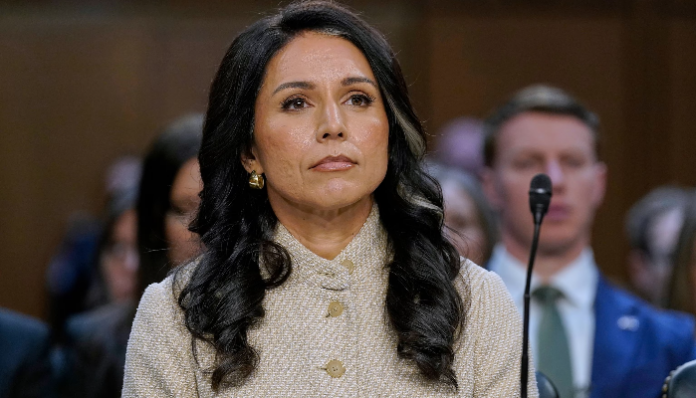
According to the United States Director of National Intelligence Tulsi Gabbard, Pakistan is one of the nations that pose the greatest nuclear threats to the country, along with North Korea, China and Russia. She made the revelation during a Senate panel hearing on Wednesday (18th March).
“The intelligence community assesses that Russia, China, North Korea, Iran, and Pakistan have been researching and developing an array of novel, advanced, or traditional missile delivery systems, with nuclear and conventional payloads, that put our homeland within range,” she warned during the briefing.
Tulsi Gabbard:
— Clash Report (@clashreport) March 18, 2026
The intelligence community assesses that Russia, China, North Korea, Iran, and Pakistan have been researching and developing an array of novel, advanced, or traditional missile delivery systems, with nuclear and conventional payloads, that put our homeland within… pic.twitter.com/X4g85J3DUh
According to Gabbard’s evaluation, the American intelligence agency projects that there are going to be more than 16,000 missiles capable of targeting the United States by 2035, surpassing the current estimate of about 3,000. She outlined that Pakistan has risen to the top of the nuclear watch list due to its developing arsenal and past instability.
Gabbard also discussed Iran, asserting that the June 2025 raids “obliterated” its nuclear enrichment program. The US authorities have noted that the action severely wrecked critical infrastructure which could take years to reconstruct.
“The threat landscape is changing. With Iran’s capabilities currently suppressed, the focus must shift to ensure that other nuclear-armed nations, particularly those with a history of state-sponsored militancy like Pakistan, do not fill the void or pose a direct risk to the homeland,” she submitted.
Gabbard did, however, stated that Iran and its regional affiliates persist as a grave threat because they remain capable of striking American military and allies throughout the Middle East. She emphasised that the Islamic regime is likely to embark on a protracted effort to redevelop its UAV drone and missile capabilities over the upcoming years if it stays in power.
She further highlighted changing geopolitical alignments, pointing out that North Korea is fortifying its alliances with China and Russia, which raises issues related to collaborative military strength among US rivals.
Moreover, Gabbard identified Al-Qaeda and Islamic State of Iraq and the Levant (ISIS or IS) as the biggest dangers to US interests abroad, especially in regions of Africa, the Middle East and South Asia, in a more comprehensive threat assessment.
The White House, meanwhile, reaffirmed its support for Gabbard, adding that Trump has “full confidence” in the intelligence head, according to press secretary Karoline Leavitt.
Notably, Pakistan’s Prime Minister Shehbaz Sharif lauded President Donald Trump regarding his ceasefire claims which are repeatedly refuted by India amid the Board of Peace summit in Washington, last month. He hailed the latter as a man of peace and the saviour of South Asia. New Delhi had refused Trump’s proposal to become a member of the board launched for rehabilitation, rebuilding and management of Gaza under his chairmanship.
