

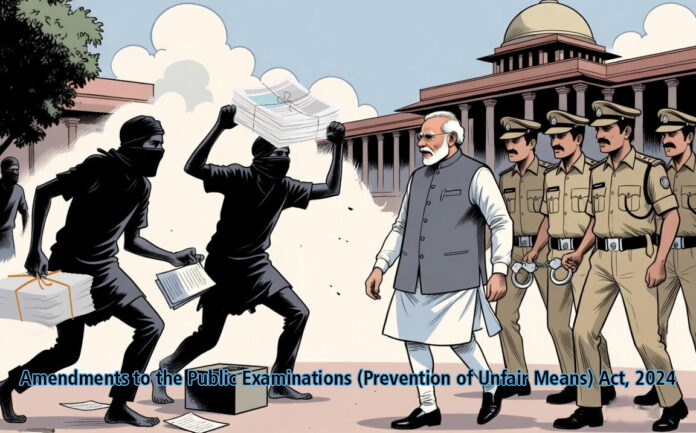
The Union Cabinet, chaired by Prime Minister Narendra Modi, on Friday approved a draft amendment bill aimed at significantly strengthening the legal framework against paper leaks and other unfair means in public examinations. The proposed changes seek to amend the Public Examinations (Prevention of Unfair Means) Act, 2024, by introducing harsher penalties, mandatory timelines for investigations and trials, and dedicated fast-track courts to ensure swift justice in such cases.
According to official sources, the amendments propose imprisonment of up to ten years and a fine of up to ₹10 crore for those found guilty of involvement in paper leaks, particularly in organised rackets. This marks a substantial escalation from the existing provisions under the 2024 Act, which currently prescribe three to five years’ imprisonment and a fine of up to ₹10 lakh for individuals, while organised crime attracts five to ten years in jail with a minimum fine of ₹1 crore. Service providers and institutions involved also face enhanced liability under the revised law.
A key feature of the approved draft is the provision for special fast-track courts to exclusively handle paper leak cases. The special courts may also be given additional powers to ensure swifter trials.
As per the bill, investigations and trials in these matters will be mandated to be completed within a strict three-month timeframe, addressing long-standing concerns over delayed justice that have allowed networks involved in exam malpractices to operate with relative impunity. The legislation covers public examinations conducted by bodies such as the National Testing Agency, Union Public Service Commission, Staff Selection Commission and other notified authorities, encompassing major entrance tests including NEET and JEE.
The Public Examinations (Prevention of Unfair Means) Act, 2024, already criminalises offences such as question paper leaks, unauthorised access to examination material and organised cheating. The proposed amendments are expected to bring in tougher penal provisions with time-bound investigations and trials in such offences.
Parliamentary affairs minister Kiren Rijiju said the government would soon introduce the legislation in Parliament, adding that the PM Modi had directed that there should be no delay in bringing the Bill. He said, “We are preparing to present the bill, but after you receive the briefing on our cabinet decision, we will inform you about our timing. The Prime Minister has said that there should be no delay in the bill we are bringing regarding students. The country also wants what the Prime Minister has said, so it would not be right to resort to any tactics to obstruct it.”
Talking about Congress party disrupting proceedings in the parliament, Rijiju said, “Congress will fall into this if they continue to disrupt the parliamentary proceedings. We are taking important steps for the future of the students. If the Congress party continues to create all kinds of hurdles to prevent parliamentary discussion, then they will have to face the brunt of the youth of this nation and, in fact, the entire nation.”
The Cabinet’s decision comes hours after the Prime Minister, in a late-night video message on Thursday, announced that the government would place a draft containing provisions for fast-track courts and stringent punishments before the Cabinet for discussion. He emphasised that paper leaks cause immense distress to lakhs of students and their families, noting that while the authorities had already arrested several culprits and ensured that examinations for over 22 lakh students were conducted without loss of an academic year, further decisive action was necessary. The Prime Minister stated that after incorporating suggestions from Cabinet colleagues, efforts would be made to introduce and pass the bill in Parliament at the earliest, with the second week of the Monsoon Session beginning on Monday.
The move is expected to give more teeth to the existing law, which already classifies offences related to leaking question papers, impersonation, tampering with answer sheets or computer systems, and organised cheating as cognisable, non-bailable and non-compoundable. The amendments are designed to dismantle organised paper-leak syndicates operating across states by combining deterrent punishments with accelerated legal processes.
The draft bill is likely to be introduced in the Lok Sabha early next week for consideration and passage. Once enacted, it is anticipated to send a strong message that the integrity of public examinations will be protected through robust and time-bound enforcement.
