

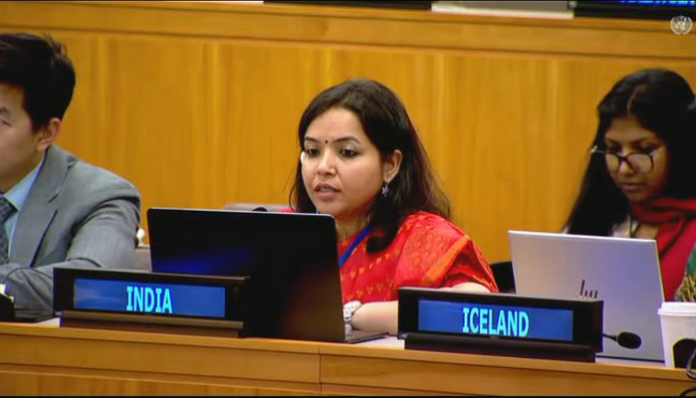
On 20th October (Tuesday), India hit out at attempts to exploit unfounded accusations and inadequate data to create a “negative characterisation of the largest democracy in the world” at a United Nations gathering. Deputy Secretary in the Ministry of External Affairs Barkha Tamrakar highlighted that human rights should not be used as a tool of political pressure or selective targeting of nations.
The development transpired during a discussion on the Working Group on Enforced Disappearances at the UN General Assembly’s Third Committee. India rejected attempts to treat claims as proven conclusions, but conveyed that it continued to be willing to provide clarification on particular and well-documented situations.
Tamrakar firmly stated, “India firmly opposes any attempt to convert unverified allegations, incomplete statistics or a report that contains no India country (specific) observation into a negative characterisation of the world’s largest democracy.” She added, “India remains prepared to clarify specific, properly documented cases through established channels.”
She further mentioned, “India engages with international human rights mechanisms, but such engagement must be based on dialogue, consultation, cooperation with non-selectivity and transparency as guiding principles.”
#IndiaAtUN @BarkhaTamrakar, Deputy Secretary @MEAIndia delivered 🇮🇳’s statement at UNGA Third Committee on the Agenda Item “Working Group on Enforced Disappearances” the following : ➡️ Reaffirmed that Article 21, habeas corpus, the NHRC and State Human Rights Commissions, independent media and civil society provide safeguards, transparency and avenues for redressal against enforced disappearances. ➡️ Called enforced disappearances grave human-rights violations and urged prevention, accountability and protection of civil society. ➡️ Noted that 🇮🇳 has signed the Convention on Enforced Disappearances and stressed that law enforcement is bound by law. ➡️ 🇮🇳 called for engagement based on dialogue, cooperation, non-selectivity and transparency. @PMOIndia @IndianDiplomacy @PIB_India @airnewsalerts @DDNewslive
— India at UN, NY (@IndiaUNNewYork) October 21, 2026
The Indian representative cautioned, “Human rights must not be used as an instrument of political pressure or selective country targeting. We call on delegations to cite the report faithfully, not to inflate a humanitarian communication into a verdict.”
A large number of UN rapporteurs, who are chosen by the Human Rights Council and operate independently, base part of their reporting on submissions from unidentified parties without verifying them. She reminded that New Delhi is a signatory to the International Convention for the Protection of All Persons from Enforced Disappearance.
She pointed out, “India is a vibrant democracy anchored in the rule of law, and Article 21 of its Constitution guarantees the right to life and personal liberty. Our independent judiciary is fully empowered to issue the writs of habeas corpus, thus providing a strong and readily accessible safeguard against any alleged disappearance.”
She emphasised that India has the Right to Information Act, which promotes transparency and accountability, and the National Human Rights Commission and State Human Rights Commissions provide forums for complaints. Additionally, vibrant civil society organisations and independent media offer an additional set of protections.
On Tuesday, over 20 UN experts in Geneva claimed to be concerned about the “repeatedly heavy-handed police response” to purportedly peaceful demonstrations conducted by the youth in the national capital. They demanded that the authorities ensure justice for alleged abuses of human rights during the demonstrations. India, however, has now responded decisively to refute the baseless remarks.
Notably, India earlier rejected the UN Special Rapporteur report attacking the country over retaliation against a “satirical political movement,” referring to the Cockroach Janta Party (CJP), as “hearsay.” The country stated, “This level of arbitrary report writing is precisely the reason that the United Nations and its institutions have lost credibility. A sweeping charge against the world’s largest youth population resting on anonymous and unverified claims is not evidence. It is hearsay, dressed up as a UN report, and my delegation rejects it outright.”
