

The United States has brazened out its hardline stance on enforcing its unilateral blockade in the Strait of Hormuz, with US Secretary of State Marco Rubio warning that Washington will not tolerate any violation of restrictions on maritime traffic through the strategic waterway.
The statement came on June 13 after Rubio spoke with India’s External Affairs Minister S Jaishankar amid growing tensions following a series of US attacks on commercial vessels operating near the Oman coast.
In a statement released after the conversation, the US Department of State said the two leaders discussed recent developments in the Strait of Hormuz.
“Secretary of State Marco Rubio spoke yesterday with Indian External Affairs Minister Subrahmanyam Jaishankar. The two officials discussed recent events in the Strait of Hormuz. The Secretary stressed that all commercial vessels should immediately comply with orders from US forces as they seek to uphold peace and security in the Strait. He underscored that violations of the US blockade and the illicit transport of Iranian oil will not be tolerated,” the statement said.
BREAKING: America refuses to apologise for U.S. Navy strikes that killed 3 Indian sailors
— Shashank Mattoo (@MattooShashank) June 13, 2026
“The Secretary stressed that all commercial vessels should immediately comply with orders from U.S. forces..Violations of the U.S. blockade and illicit transport of Iranian oil with not be… pic.twitter.com/pGJMLFjSRE
The remarks came despite strong objections from New Delhi over recent US military actions against commercial vessels carrying Indian crew members.
Following the call, Jaishankar revealed that he had conveyed India’s anger over the attacks, particularly those that resulted in the deaths of Indian sailors.
“Spoke to US Secretary of State Marco Rubio this evening. I reiterated India’s strong protest at the attacks by the US Navy in the Gulf that killed three Indian mariners. Such lethal actions against commercial shipping are not justified,” Jaishankar posted on X.
India’s sharp response follows a series of incidents involving oil tankers with Indian seafarers on board.
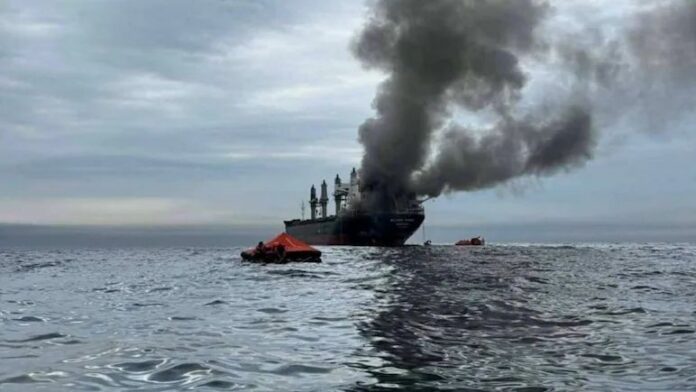
On June 8, US forces disabled the Palau-flagged tanker Marivex, which had 24 Indian crew members. All the sailors were rescued safely, and no injuries were reported.
However, the situation turned deadly on June 10 when US forces targeted another Palau-flagged tanker, MT Settebello. The strike killed three Indian sailors, deck cadet Aditya Sharma, engine fitter Shivanand Chaurasiya and chief engineer Patnala Suresh, among the vessel’s 24-member Indian crew.
In another incident, Jalveer, a Guinea-Bissau-flagged tanker carrying 20 Indian seafarers, was reportedly attacked on Thursday, further heightening concerns in New Delhi.
The deaths aboard MT Settebello prompted the Indian government to lodge a formal protest with Washington. New Delhi summoned the US Chargé d’Affaires and expressed deep concern over the use of lethal force against civilian shipping.
The Ministry of External Affairs stated that attacks on commercial vessels undermine the safety and security of international maritime trade and pose serious risks to civilian seafarers.
Earlier, MEA spokesperson Randhir Jaiswal had called for an immediate halt to attacks on merchant vessels carrying Indian nationals. He also urged all sides to pursue dialogue and diplomacy to restore peace and stability in the region.
The exchange highlights the widening divergence between Washington and New Delhi over the escalating situation in the Strait of Hormuz, one of the world’s most critical energy and shipping corridors, with the US defending its blockade measures even as India seeks accountability for the deaths of its citizens.
