

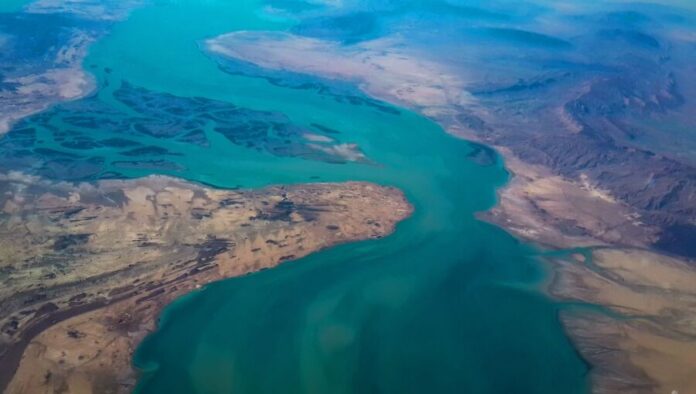
Iran reiterated on Saturday that it was closing the Strait of Hormuz to maritime traffic, blaming continued Israeli operations in southern Lebanon for violating a recently signed memorandum of understanding aimed at ending the broader conflict. The Iranian armed forces, through the Khatam al-Anbiya central headquarters, stated that the United States had shown “clear bad faith” by failing to restrain Israeli actions, describing the closure as the “first step” in response, with further measures to follow if violations persisted.
Iran’s Revolutionary Guards Corps navy had already asked all vessels not to approach the Strait of Hormuz earlier on Friday, declaring the strait closed to all vessels. “Since Israel’s withdrawal from Lebanon, the complete lifting of the naval blockade, and the withdrawal of American terrorist forces from the Persian Gulf and the region are among the main conditions of the agreement between Iran and the United States. The Strait of Hormuz will remain closed until these conditions are met. All ships are requested, for the sake of their security and safety, not to approach the Strait of Hormuz. Any vessel that defies this directive will be targeted,” the Islamic Revolutionary Guard Corps Navy (IRGC-N) had said.
The announcement came just three days after the waterway had reopened under the terms of the new MOU between US and Iran. Iranian officials linked the decision directly to what they called ongoing ceasefire breaches by Israel in Lebanon, where strikes have continued. Israel has asserted that the US-Iran does not include operations against Hezbollah, and they will not stop actions against the terror group. The move has again raised concerns about global oil supplies, as the strait handles a significant share of the world’s oil trade.
However, the United States has rejected Tehran’s claim of closing the strait. US Central Command (CENTCOM) said that traffic through the international waterway remained uninterrupted, with 55 merchant ships transiting on Saturday alone. These vessels carried large volumes of cargo and more than 17 million barrels of oil to global markets. CENTCOM spokesman Captain Tim Hawkins said, “Iran does not control the Strait of Hormuz. Traffic continues to flow, and US forces are monitoring the situation to ensure this remains the case.”
CENTCOM spokesman Capt. Tim Hawkins told me: "Iran does not control the Strait of Hormuz. Traffic continues to flow, and U.S. forces are monitoring the situation to ensure this remains the case." https://t.co/jV6Xk9rfBa
— Barak Ravid (@BarakRavid) June 20, 2026
The spokesperson further stated that US forces are closely monitoring the situation in the Strait of Hormuz to ensure the continued and uninterrupted flow of maritime traffic through the region. CENTCOM noted that no Iranian military movements indicative of an actual enforced closure had been observed. Before the recent conflict, around 130 ships typically passed through the strait each day, according to Congressional Research Service data. While Iranian state media and officials insisted on the closure, shipping data and US monitoring suggested normal operations were continuing, at least for now.
Amid these maritime tensions, diplomatic efforts between Washington and Tehran are moving forward in Switzerland. A new round of high-level US-Iran talks is scheduled to begin on Sunday in the Swiss resort area, including at Bürgenstock, following an earlier postponement of planned discussions. The cancellation had come amid fresh fighting in Lebanon, but preparations have now resumed, with Iranian delegations, including Parliament Speaker Mohammad Bagher Ghalibaf and Foreign Minister Abbas Araghchi, arriving in Switzerland. US envoys and special envoy Steve Witkoff are already on the ground, and US Vice-President JD Vance arrived in Switzerland early on Sunday morning.
Officials from the US and Iran will be joined at the talks by Pakistan’s Prime Minister Shehbaz Sharif and the head of the country’s armed forces, Field Marshal Asim Munir, the de facto ruler of Pakistan. Pakistan is acting as a mediator in the talks, and Sharif signed the MoU as a guarantor.
The Switzerland talks are seen as crucial for implementing the ceasefire framework, addressing nuclear issues, and securing lasting arrangements for the Strait of Hormuz and regional stability.
Oil markets reacted cautiously to the developments, with prices showing modest gains on fears of potential disruptions, though the continued flow of tankers has so far prevented any major spike.
