

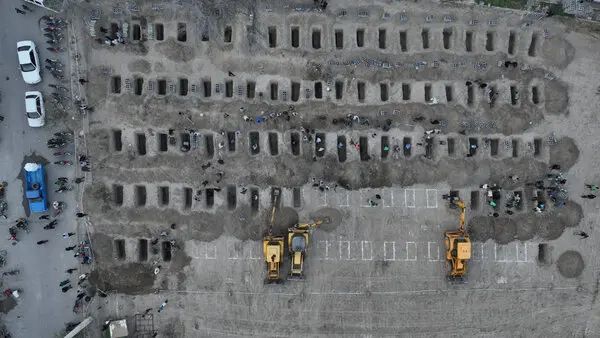
Fresh evidence emerging from the February 28 strike in Iran’s southern city of Minab has intensified scrutiny over who was responsible for one of the deadliest incidents since the outbreak of the US-Israel military campaign against Iran. Investigative analysts and open-source researchers now say the attack that killed more than 165 people, many of them children, likely involved a US-launched Tomahawk cruise missile.
The controversy centres on a strike that landed inside a military compound linked to Iran’s Islamic Revolutionary Guard Corps (IRGC), located next to the Shajarah Tayyebeh Elementary School. The explosion damaged the school building and resulted in heavy civilian casualties, drawing immediate condemnation from the United Nations and human rights organisations.
A detailed analysis posted on X by Bellingcat researcher Trevor Ball has brought renewed attention to the incident. In a thread published Sunday, Ball shared previously unseen video footage broadcast by Iran’s Mehr News Agency that appears to capture a missile striking a structure inside the IRGC compound.
New video footage shows a US Tomahawk missile hitting an IRGC facility in Minab, Iran, on Feb 28, showing for the first time that the US struck the area. The footage also shows smoke already rising from the vicinity of the girls’ school, where 175 people were reportedly killed. pic.twitter.com/4jBXrNcRJO
— Trevor Ball (@Easybakeovensz) March 8, 2026
According to Ball, the footage strongly suggests that the weapon used was a Tomahawk cruise missile, a type of long-range precision weapon operated by the United States.
Ball argued that the missile’s design and flight characteristics visible in the footage match those of the Tomahawk, adding that among the parties involved in the conflict, only the United States is known to deploy the weapon. Israel, he noted, is not known to possess Tomahawk missiles.
The video was geolocated using satellite imagery and terrain features, confirming it was filmed from a construction site overlooking the military compound. The footage shows the missile striking what analysts believe was a medical clinic inside the base. Moments later, the camera pans toward thick smoke already rising from the nearby elementary school, indicating that the school may have been hit shortly before the missile struck the IRGC facility.
Satellite imagery reviewed by researchers further indicates that only a small number of buildings within the compound were damaged. These include the clinic building seen in the footage and another structure believed to be an earth-covered bunker. The blast radius extends toward the school complex situated just outside the compound walls.
The February 28 strike occurred during the opening hours of a coordinated US-Israel offensive targeting Iranian military infrastructure across multiple cities. Hundreds of missiles and airstrikes were launched at facilities linked to the Iranian regime, including sites in Tehran and strategic installations near the Strait of Hormuz.
Minab, located along the southern coast close to that critical shipping route, was among the areas targeted during the first wave of strikes. US military officials later confirmed that American naval forces operating in the region had launched Tomahawk missiles during the early phase of the campaign.
However, responsibility for the school strike quickly became a matter of dispute.
Iranian authorities blamed both the United States and Israel for the blast that devastated the school. Israel has denied involvement. US officials have maintained that American forces do not deliberately target civilian infrastructure.
At a Pentagon briefing, US Defence Secretary Pete Hegseth said the incident was under investigation. “We never target civilian targets,” he said, adding that the circumstances of the strike were being examined.
US President Donald Trump has offered a different explanation. Speaking to reporters aboard Air Force One, he suggested the explosion may have been caused by Iranian munitions, claiming Tehran’s weapons are often inaccurate. “We think it was done by Iran,” Trump said.
Yet several independent analyses appear to contradict that claim. Investigations by weapons experts, satellite imagery reviews, and assessments by international media organisations all point toward the likelihood that the missile involved was American-made and launched during the broader strike campaign.
Under Pentagon procedures, a formal “civilian harm assessment” is typically initiated when there is a preliminary indication that US military operations may have caused civilian casualties. Reports indicate that such an assessment has been launched in connection with the Minab strike.
Legal experts say the case raises serious questions under international humanitarian law. Elise Baker, a senior lawyer at the Atlantic Council, noted that attacks affecting schools or other civilian sites can constitute violations of the laws of armed conflict if proper precautions are not taken to avoid civilian harm.
As investigations continue, the Minab strike is likely to remain a focal point in debates over accountability and the risks posed to civilians during high-intensity military operations. The emerging evidence from open-source analysis has added new pressure on Washington to clarify the circumstances surrounding one of the war’s most tragic incidents.
