

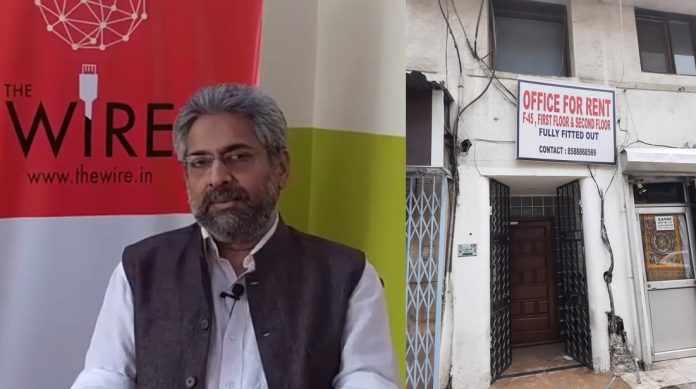
Siddharth Varadarajan, the founding editor of The Wire, revealed on Twitter that the office of the left-wing propaganda portal was visited by a policeman on Friday with specific inquiries. According to him, the police asked questions regarding actress Swara Bhasker and fellow propagandists Vinod Dua and Arfa Khanum Sherwani.
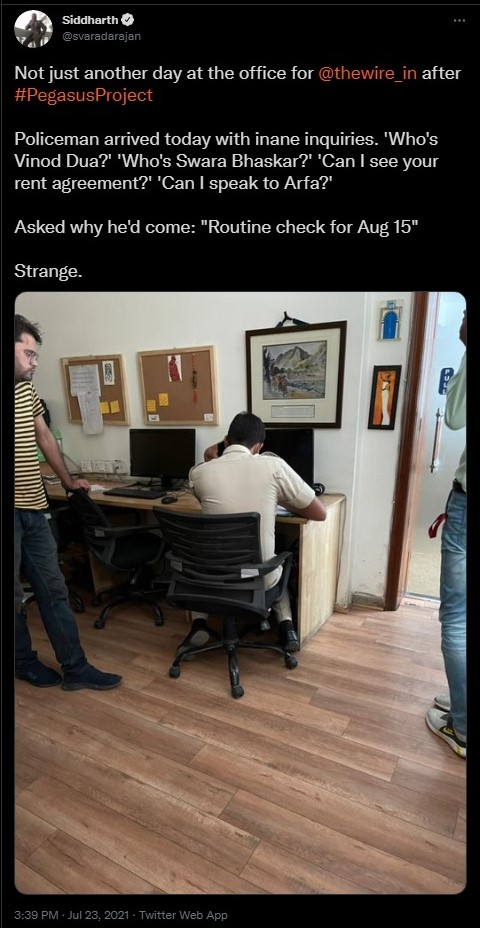
According to Siddharth Varadarajan, the policeman said that he had come for regular inquiries ahead of the 15th of August, the Independence Day. Earlier, The Wire had been served with a show-cause notice by Kashmir Police over fake news.
The Kashmir Police accused The Wire of indulging in “misrepresentation of facts, sensationalism, concocted mixing of facts with opinion of some unknown experts”. The portal was also accused of engaging in a media trial.
Vinod Dua, known peddler of fake news, had been helped by a Union Minister recently when he was suffering from Covid-19. Union Minister Hardeep Singh Puri had arranged medicines for him during distress. An FIR was registered against Dua in 2020 for peddling fake news and creating public nuisance.
Arfa Khanum Sherwani is a propagandist who often serves as an apologist for Radical Islam. She had once insinuated that the destruction of the Bamiyan Buddhas by the Taliban was inspired by the demolition of Babri Masjid.
Sherwani was also one of the liberal propagandists who had helped peddle the mythical narrative of a hate crime when a Muslim man was thrashed by other Muslim men over a personal matter. She had falsely claimed that the man was thrashed for refusing to chant Jai Shri Ram.
Police visited the Wire office because it has no signboard
After the tweet by Varadarajan, the official Twitter account of DCP New Delhi informed that the Wire office was checked as part of routine precaution ahead of Independence Day. The DCP also said that there is no signboard outside the building informing the building that it houses The Wire, and therefore they went to check what is inside the office. They also posted a photograph of the entrance of the office which says ‘Office for Rent’, and there is no mention of The Wire.
Delhi police said that ahead of Independence Day, security and anti-terrorist measures such as tenant verification, checking of guest houses etc are being taken throughout Delhi. As part of this exercise, a local beat officer had gone to verify an office that does not have any signboard at the entrance.


