

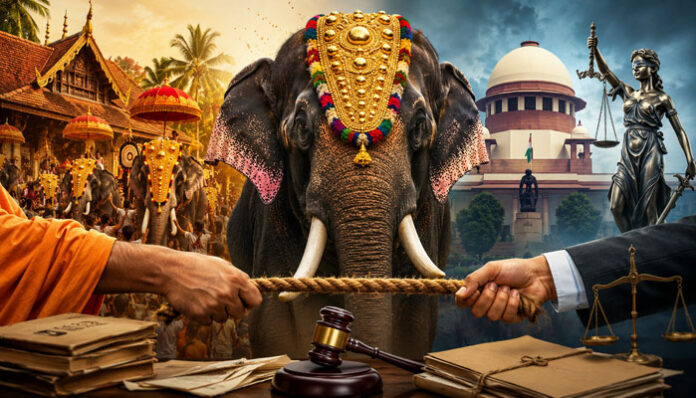
The Supreme Court of India took a decision on June 9, 2026, when it handed over the custody of a captive elephant from an individual in ownership to the Government of Kerala and found that person guilty of contempt of court for taking the animal to a temple festival in violation of a solemn commitment made before India’s top court.
In Kerala, where elephants are deeply integrated in temple life, Uttoly Raman, the elephant in question, is said to be the tallest captive elephant in the state. However, a complicated legal battle involving false documents, criminal accusations, violations of wildlife laws, and several years of institutional failure to protect an animal that cannot speak for itself lies behind the spectacle of Raman wearing a gold caparison at festival ceremonies.
A temple’s elephant, a caretaker’s claim
The case starts with a simple argument made by Jayakrishna Menon, the Contempt Petitioner, who filed the case on behalf of the Mata Amritanandamayi Mutt, the internationally renowned spiritual organisation founded by the Kollam, Kerala-based ‘Hugging Saint,’ Mata Amritanandamayi Devi.
Raman is the Mutt’s ownership; their stance is straightforward. The elephant was eventually given to a private person named Krishnankutty for maintenance and care. However, what was intended to be a temporary arrangement turned into a permanent ownership claim. Two gift deeds from February 18 and February 28, 2017, which allegedly gave Krishnankutty ownership of Raman, are the foundation of his counterclaim. The Mutt claims that these deeds are counterfeited and created. More importantly, even if these deeds were legitimate in nature, they would encounter a major legal obstacle. According to the Wildlife (Protection) Act, 1972, an elephant classified under Schedule I, which includes all Asian elephants, cannot be transferred between private owners under a gift deed. The Chief Wildlife Warden of the State must give prior written approval for such a transfer. There was no such approval received.
From trial court to supreme court
In 2023, things became even more serious. Krishnankutty was charged under Sections 406 (criminal breach of trust) and 420 (cheating) of the Indian Penal Code in Crime No. 1000 of 2023, which was filed before a Kerala court. These serious charges were related to the alleged unlawful custody and unjust treatment of Raman.
In order to obtain temporary custody of Raman, the Mutt simultaneously filed an application under Section 451 of the Code of Criminal Procedure, 1973, which permits courts to issue interim orders for the custody and disposal of property pending trial. After going through the Trial Court and the Kerala High Court (Criminal Misc. Case No. 7600 of 2023), the case was remanded back to the Trial Court for a fresh hearing in November 2023. The Mutt was granted interim custody by the Trial Court in December 2023, subject to a ₹25 lakh bond.
After that order was contested in the High Court, the Supreme Court heard the pending matter of interim custody in Criminal Appeal Nos. 4836-4837 of 2024. Raman remained with Krishnankutty while the more significant issue was being decided when the Supreme Court ordered in January 2024 that the custodial status quo be preserved.
The promise that was broken
The Mutt filed a plea before the Supreme Court in 2025 as problems over Raman’s welfare grew, claiming concerns about the elephant’s well-being and his regular participation in public processions and temple festivals despite the ongoing legal proceedings.
The Court ordered the Principal Chief Conservator of Forests or Kerala’s senior-most wildlife officer to examine Raman’s health on August 6, 2025. Crucially, Krishnankutty’s counsel specifically promised the court that the elephant would not be used for any religious or business activity while the inspection was in progress. This undertaking was noted in the Court’s order. On August 21, a month later, the inspection report stated that the elephant was in musth, a condition in which male elephants occasionally exhibit increased aggression, making a close inspection impossible. Following the conclusion of the musth period, the Court ordered a new inspection.
And then there was a breach of undertaking. According to the State’s own inspection report, which was handed over on February 3, 2026, Raman was taken out to Chavakkad for participation in the festival ceremony of a temple near Chavakkad. Put another way, Krishnankutty’s breach of his commitment was accidentally proven by the very document the State submitted to the Supreme Court for a status update.
Krishnankutty acknowledged the particular incident in his written arguments, stating that religious beliefs required an animal to be present at the ritual and that another previously scheduled elephant had fallen ill and tendered an apology.
The Court was not convinced and said, ‘We would be failing in our duty towards the voiceless, if we turn a blind eye towards such defiance,’ the bench said in unusually forthright terms.
What the wildlife law actually says
The foundation of India’s statutory framework for safeguarding wild animals kept in captivity is the Wildlife (Protection) Act, 1972. Asian elephants are classified as Schedule I animals, which is the highest level of protection under the Act and puts them on par with tigers and rhinoceroses. Without the Chief Wildlife Warden’s prior written permission, Section 40(2) of the Act clearly forbids anybody from obtaining, receiving, holding in custody, or transferring any Schedule I animal. An Ownership Certificate may only be granted to a person who is in legal possession, according to Section 42. Elephants cannot be traded commercially, according to Section 43(1).
This left Krishnankutty’s claim with a significant legal gap. Even if they are accepted at face value, the 2017 gift deeds were private arrangements made without official state approval. Such a transfer is null and void within the WPA’s framework, not just unusual. In its order, the Supreme Court stated that any such transfer ‘would ultimately be rendered void in the absence of requisite approval under the Wildlife (Protection) Act, 1972.’ Additionally, the WPA gives the State the authority to keep elephants in rescue and rehabilitation facilities and mandates that it assume custody and care of animals when needed. This is exactly what the Court finally ordered.
What the Supreme court decided
Respondent No. 1, Krishnankutty, was found guilty of contempt of court by the bench of Justices Dipankar Datta and Satish Chandra Sharma for knowingly breaking the undertaking. The Court Registry has levied a ₹2,000 fine, which must be paid within four weeks.
The fine is symbolic in every way. It shows that the Court acknowledges that the legal issue of eventual ownership is still up for debate and that it would be premature to penalise Krishnankutty too severely before the underlying appeals are resolved. The custody order, however, has the most serious consequences. The State of Kerala was ordered by the Court to take over possession of Raman and place him in an appropriate rescue or rehabilitation centre. Subject to the Court’s final judgment in the underlying criminal appeals, the arrangement is specifically temporary. Raman’s care expenditures may also be covered by the State, but it must do so while adhering to the WPA’s provisions.
The Court acknowledged that the musth time had really postponed the in-person examination, and as a result, the State officials, who had been listed as Respondents 2-9 for allegedly delaying the inspection, were discharged from contempt.
Conclusion
The primary criminal appeals are still pending before the Supreme Court, but the contempt petitions have been resolved. The basic question of who Raman truly belongs to remains unanswered. Until then, he would reside in a rehabilitation or rescue facility in Kerala under state custody, paid for by the government.
It’s questionable if the State of Kerala, which has had difficulty even performing a quick health examination of the elephant, will be able to give Raman the level of care he needs. The Court’s use of the phrase duty towards the voiceless is encouraging. However, Raman is more concerned with where he sleeps tonight than what the Court says.


