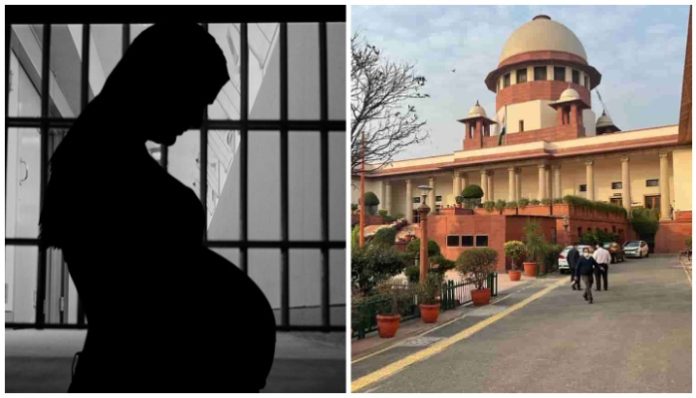
The Supreme Court on Monday, February 12, agreed to examine the matter of women inmates getting pregnant in correctional homes and jails across the state of West Bengal. A bench of Justices Sanjay Kumar and Ahsanuddin Amanullah has asked senior advocate Gaurav Agrawal to look into the matter and submit a report on the same.
Supreme Court to examine issue of prisoners getting pregnant in Bengal jails
— Law Today (@LawTodayLive) February 12, 2024
An estimated 196 babies were born in different correctional facilities across West Bengal, an advocate submitted at the Calcutta High Court.https://t.co/8mGPrRGaGA
The apex court had reportedly taken cognisance of the issue after it was brought up at the Calcutta High Court on Thursday, February 8 by lawyer Tapas Kumar Bhanja, who was appointed amicus curiae in a 2018 suo motu case on overcrowding in jails.
Bhanja had informed the Calcutta High Court about the fretting issue of women inmates getting pregnant while in custody. This prompted the court to express grave concerns about the condition of female inmates in West Bengal jails. An estimated 196 babies have reportedly been delivered in different jails throughout the state, according to the Amicus Curiae.
As a preventive approach to address the problem, the amicus curiae proposed a ban on male staff members entering enclosures housing female inmates.
Additionally, the amicus curiae offered other recommendations that were detailed in a note dated January 25 to enhance the circumstances and guarantee the well-being of prisoners housed in correctional facilities.
The amicus also recommended that all District Judges, who chair the Board of Visitors, be permitted to tour the correctional facilities under their respective purview to ascertain the number of women inmates who have gotten pregnant during their stay in correctional homes.
Additionally, to prevent sexual exploitation of women inmates, the Chief Judicial Magistrates of each district may be instructed to require all women convicts to undergo pregnancy tests before being sent to correctional facilities. To this end, all West Bengali police stations ought to conduct pregnancy testing.
The Calcutta High Court division bench, presided over by Chief Justice TS Sivagnanam and Justice Supratim Bhattacharya, took a serious view of the case and ordered a hearing before a division bench that specialised in criminal cases.