

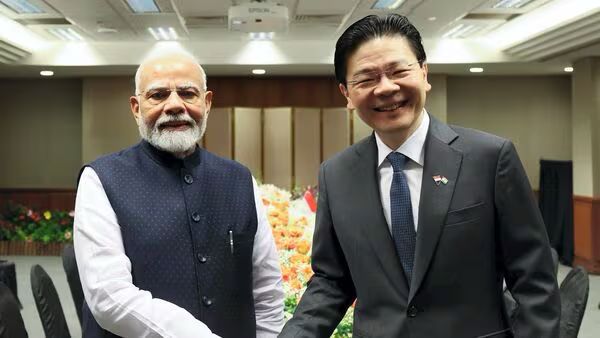
Prime Minister Narendra Modi on Thursday expressed deep gratitude to his Singaporean counterpart Lawrence Wong for extending solidarity with India in the wake of the Pahalgam terror attack. Addressing the media after bilateral talks in New Delhi, Modi underscored that both India and Singapore face shared concerns over terrorism and have a moral duty to confront it together.
“In the wake of the terrorist attack in Pahalgam, I express my gratitude to Prime Minister Wong and the Government of Singapore for their sympathy towards the people of India and for their support in our fight against terrorism. We believe that fighting terrorism with unity is the duty of all humanitarian countries,” Modi said.
The remarks came months after 26 people were killed in the Pahalgam terror attack in April, which prompted India to launch strikes on terror camps in Pakistan and Pakistan-occupied Kashmir under Operation Sindoor. Modi’s statement was not only a diplomatic acknowledgment but also a reaffirmation of India’s growing insistence that the global community must act collectively against terror networks.
Celebrating 60 Years Of India-Singapore relations
PM Modi highlighted that Wong’s visit holds special significance as both nations mark 60 years of diplomatic ties. “During my last visit to Singapore, we elevated our ties to a comprehensive strategic partnership. This relationship goes far beyond diplomacy—it is a partnership with purpose, rooted in shared values, guided by mutual interests, and driven by a common vision for peace, progress, and prosperity,” Modi observed.
Singapore Prime Minister Wong, who is on a three-day official trip to India, echoed the sentiment. Describing the India-Singapore bond as “more important than ever in a world of uncertainty and turbulence,” Wong stressed that trust and shared history form the backbone of the partnership. “Together we can strengthen resilience, seize new opportunities and contribute to stability and growth in our region and beyond. I look forward to working hand in hand with Prime Minister Modi to bring the Singapore-India partnership to even greater heights,” he said.
Modi said the cooperation will now extend into advanced areas such as manufacturing, green shipping, civil nuclear, urban water management, and cutting-edge technologies like AI, quantum, and digital connectivity. He highlighted Singapore’s role as India’s largest trading partner in Southeast Asia and a key pillar of the Act East policy, noting that bilateral trade, investment, defence ties, and people-to-people relations continue to deepen.
Modi also underlined the success of initiatives like the UPI-PayNow linkage, the Semiconductor Ecosystem Partnership, and space collaboration, while announcing the next India-Singapore Hackathon later this year to connect young innovators.
Expanding cooperation into new frontiers
Wong announced that India and Singapore are set to broaden cooperation in emerging sectors, particularly space. He noted that India has already launched over 20 Singapore-made satellites and that the new MoU on space collaboration would “push the boundaries of what we can achieve together.” He also underlined the importance of people-to-people ties as the “bedrock” of the bilateral relationship, with plans to enhance civil service cooperation and cultural exchanges.
The Singapore PM’s itinerary has been a packed one. On Tuesday, he met Finance Minister Nirmala Sitharaman to discuss boosting trade, investment, fintech, skill development, healthcare, sustainability, and connectivity. He also paid tributes at Rajghat alongside his wife, Loo Tze Lui, honoring Mahatma Gandhi’s universal ideals. On Wednesday, Wong met BJP national president and Union Health Minister JP Nadda, further deepening political linkages.
Earlier on Thursday, Wong met External Affairs Minister S. Jaishankar, who expressed confidence that the Singaporean leader’s visit would chart a roadmap for the next phase of the strategic partnership. “Appreciate his constant encouragement for strengthening India-Singapore ties,” Jaishankar posted on X.


