

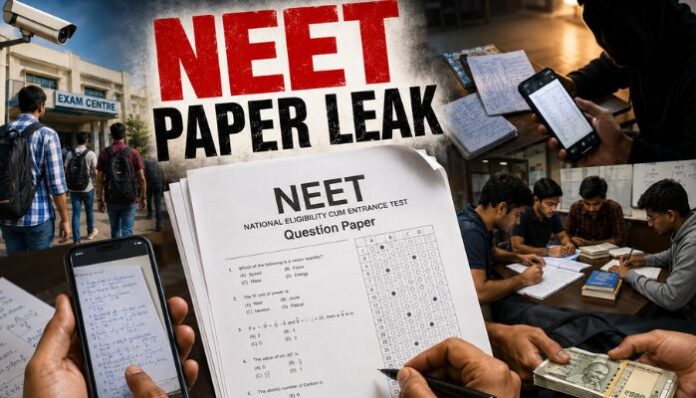
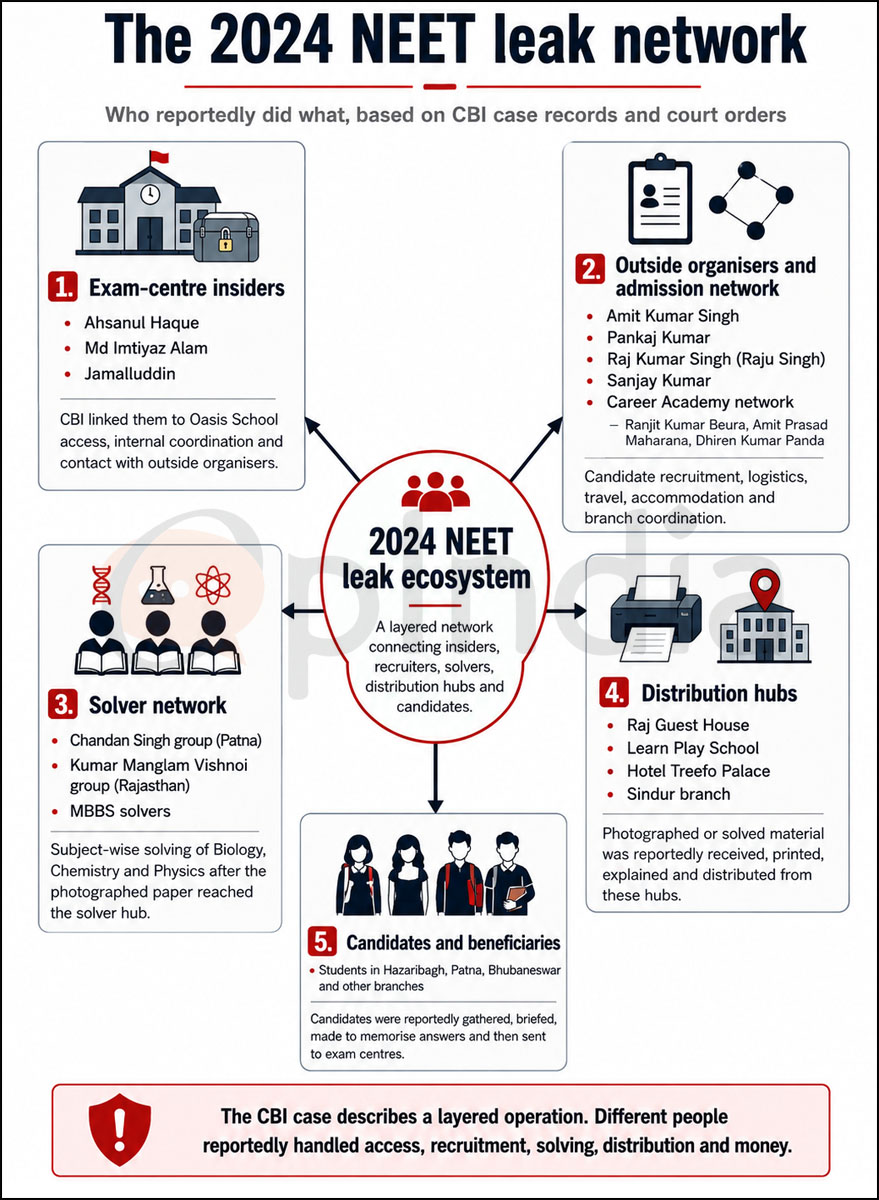
The NEET-UG paper leak of 2024 did not begin with one person breaking open a question-paper trunk. According to the Central Bureau of Investigation, it was the outcome of a network that connected admission consultants, career-counselling operators, examination-centre officials, candidate agents, MBBS students hired as solvers, guest-house operators, drivers, printers and financial intermediaries.
Two years later, the method reportedly changed but the commercial ecosystem survived. In the NEET-UG 2026 case, the CBI said people appointed as subject experts by the National Testing Agency (NTA) passed confidential questions through private coaching sessions and coaching-linked intermediaries. Chemistry lecturer PV Kulkarni was described as a key source. Questions dictated during special classes at his residence reportedly matched the examination held on 3rd May 2026.
The two cases show why paper leaks cannot be viewed only as failures in the movement of sealed boxes. The coaching mafia operates as a market. It finds families willing to pay, locates insiders with confidential access, recruits people capable of solving or teaching the material, arranges accommodation and transport, collects money and documents, then delivers the advantage before the examination begins.
While the term “coaching mafia” is used here, it does not suggest that every coaching centre, teacher or counsellor is involved in examination crime. The term is being used for organisations and individuals who, according to the CBI statements and court records, used education, counselling or admission-related operations to recruit candidates and facilitate cheating. OpIndia is not accusing the entire coaching centre network across the country of being involved in criminal activities.
The principal Patna-Hazaribagh case began when Shastri Nagar Police Station registered an FIR. The case was handed over to the Central Bureau of Investigation on 23rd June 2024 and a fresh FIR was registered. Later, multiple chargesheets were filed against 45 individuals by the investigating agency. For this report, OpIndia has relied heavily on court orders and FIRs. All the documents are linked in a single ZIP file towards the end of the article.
The network reportedly existed before the 2024 examination
The chronology of the 2024 NEET paper leak started with the plan created by two persons who had known each other since 2015-16. According to the CBI, Amit Kumar Singh, one of the main accused, had known Raj Kumar Singh alias Raju Singh since 2015-16. Both reportedly worked in consultancy or agency services that facilitated admissions to professional courses. Pankaj Kumar alias Aditya alias Sahil worked in the same field and came into contact with Amit during 2021-22.
The agency also referred to an older association between Amit and Ranjit Kumar Beura alias Pintu. During Beura’s bail proceedings, the prosecution said they had known each other since 2019 and had been arrested that year in an Odisha University of Agriculture and Technology examination malpractice case. While the older case was not linked to the NEET paper leak, it was relevant because the CBI presented the 2024 operation as an extension of relationships already built around admissions and competitive examinations.
Career Academy Education Trust became one of the principal candidate-recruitment channels. It was registered in Odisha on 3rd August 2023. Beura told the court that it was an NGO created to provide educational facilities and consultation to poor students. The CBI said it was used to identify NEET aspirants, secure commitments from families and collect original educational certificates and cheques as guarantees.
Beura was described as the organisation’s managing director. Amit Prasad Maharana and Dhiren Kumar Panda were identified as office-bearers. The agency said Amit Kumar Singh worked with them and Sanjay Kumar to arrange candidates from Odisha, Bihar, West Bengal, Rajasthan and Madhya Pradesh. Seventeen candidates were reportedly sent to Hazaribagh and accommodated at Raj Guest House or a house at Sindur. Others remained in Bhubaneswar or Patna.
The CBI cited statements from candidates, employees and drivers. One candidate reportedly handed over educational certificates to Career Academy. Another said Maharana shared the solved NEET paper. A candidate in Bhubaneswar said she received a printed copy at a hotel and identified Panda. The agency said Maharana transported candidates in a Scorpio, arranged a printer at Hotel Treefo Palace and distributed solved papers. It cited Rs 2 lakh received in his personal account and Rs 12 lakh received by Chiranjeevi Multiventure Private Limited, where he was a director. Panda was described as Career Academy’s treasurer and was also linked to transport, distribution at Hotel Treefo Palace and the Rs 12 lakh payment.
The CBI said original certificates and cheques were taken as guarantees. This would have given the organisers considerable leverage over the candidates and their families.
The next link was inside the examination system. Jamaluddin alias Jamal was a Hazaribagh journalist associated with Prabhat Khabar who regularly covered programmes organised by Oasis School. Notably, Oasis School was the examination centre from which the question paper was stolen. The CBI said this brought him close to the principal, Dr Ahsanul Haque, and the vice-principal, Md Imtiyaz Alam. The agency cited 814 calls between Haque and Jamaluddin from 3rd June 2023 to 18th June 2024. While call frequency alone was not enough to prove the conspiracy, the CBI used it to establish a continuing association.
According to the agency, Jamaluddin introduced Amit Kumar Singh to Haque and Imtiyaz. Amit later introduced Pankaj Kumar. The CBI also referred to meetings involving Amit, Haque, Imtiyaz, Jamaluddin, Pankaj, Raju Singh and Aman Kumar Singh. The prosecution’s broader theory was clear: Jamaluddin connected the outside admissions network to the officials controlling the secure centre, while Amit brought Pankaj into that circle.
Solvers and candidates were assembled before the paper was stolen
A raw question paper had little commercial value unless it could be solved quickly and delivered to paying candidates. The CBI said at least three solver groups were brought to Hazaribagh. Many members were MBBS students.
Sanjay Kumar was described as the person who arranged solvers, beneficiaries, transport and logistics. The prosecution said he asked AIIMS Patna student Chandan Singh to recruit academically strong medical students. The Patna group included Chandan Singh, Kumar Shanu, Rahul Anand, Karan Jain, Surbhi Kumari, Raunak Raj and Amit Kumar. Amit brought his college mate Sanoj Kumar Yadav, although the CBI said Sanoj did not enter Raj Guest House to solve the paper.
The students were first approached for impersonation. The CBI said Sanjay took Chandan, Kumar Shanu, Rahul Anand and Karan Jain to a photo studio near AIIMS Patna. Their photographs were taken for NEET applications. Raunak Raj and Amit Kumar sent photographs and signatures through WhatsApp. The dummy-candidate plan was later dropped, but the same recruits were reportedly reassigned as solvers.
The Rajasthan group was linked to Amit Kumar Singh. The CBI said he travelled to Bharatpur in February 2024 and met Kumar Manglam Vishnoi, Deependra Sharma and other medical students. Kumar Manglam, an MBBS student at Shri Jagannath Pahadia Government Medical College, reportedly arranged a group that included Deependra Sharma, Sandeep Kumar, Suresh Kumar and Ishita. They too were initially approached as possible dummy candidates. Kumar Manglam later arranged train tickets and brought members of the group to Hazaribagh.
The operation began moving people more than a week before the examination. On the night of 26th April, Sanjay Kumar, Chandan Singh, Kumar Shanu and Rahul Anand reportedly left Patna on the Ganga Damodar Express and travelled to Koderma. Surbhi Kumari arrived separately from Ranchi. The group stayed first at Ramson Hotel and then at Hotel Tara Tower. Bookings were reportedly made by Sanjay and Kumar Abhishek.
Amit Kumar travelled from Chennai to Ranchi on 2nd May and reached Koderma the following day. Raunak Raj came from Mumbai. Karan Jain travelled from Patna on a ticket booked by Kumar Abhishek. On 3rd May, the Patna group shifted to Hotel Sri Vinayak in Hazaribagh. Their early arrival supported the CBI’s case that they had been positioned in anticipation of confidential material.
The prosecution said preparations were also taking place inside Oasis School. Its counter-affidavit in Imtiyaz Alam’s bail proceedings said a toolkit bag was placed in the control room on 3rd May. The tools were later reportedly used to manipulate the rear hinges of an NTA trunk, open the packaging and restore it after the paper was photographed. According to the CBI counter-affidavit reproduced in Imtiyaz Alam’s bail order, Alam placed the toolkit bag in the control room on 3rd May. The agency said Pankaj later used those tools to open and restore the trunk.
Candidates began converging on Hazaribagh on 3rd and 4th May. Beura reportedly arrived in an MG Hector with Career Academy employee Debashish Panigrahi and driver Ranjan Sethi alias Manas. The vehicle was used to move candidates. Beura stayed at AK International Hotel. Candidates from Odisha were sent to Raj Guest House and Sindur.
Raju Singh reportedly managed Raj Guest House. The CBI said the premises were deliberately kept available. Food was arranged and vehicles were used to move candidates and solvers. Raju maintained that he had merely rented rooms and did not know the purpose. The Patna High Court initially refused bail after referring to the prosecution’s case that the guest house had knowingly been provided for preparing candidates.
In Patna, Sikandar Yadvendu coordinated with Akhilesh Kumar, Avadhesh Kumar, Shivnandan Kumar and candidate Anurag Yadav. The CBI said they were told to bring candidates near St Karen’s High School at around 10:30 pm on 4th May. By that night, the different branches were reportedly in position: insiders at the school, solvers in nearby hotels, candidates in guest houses and private premises, and vehicles, printers and accommodation ready.
How the paper was removed and distributed on 5th May
At around 5:30 am, Chandan Singh, Rahul Anand, Surbhi Kumari and Karan Jain reportedly left Hotel Sri Vinayak in a black Hyundai Creta and reached Raj Guest House. Kumar Shanu, Amit Kumar and Raunak Raj followed. The CBI said every member of the Patna solver group except Sanoj Kumar Yadav was inside the guest house before the stolen paper arrived. Deependra Sharma and Sandeep Kumar from the Rajasthan group were also placed there through mobile locations, travel records and witness identifications.
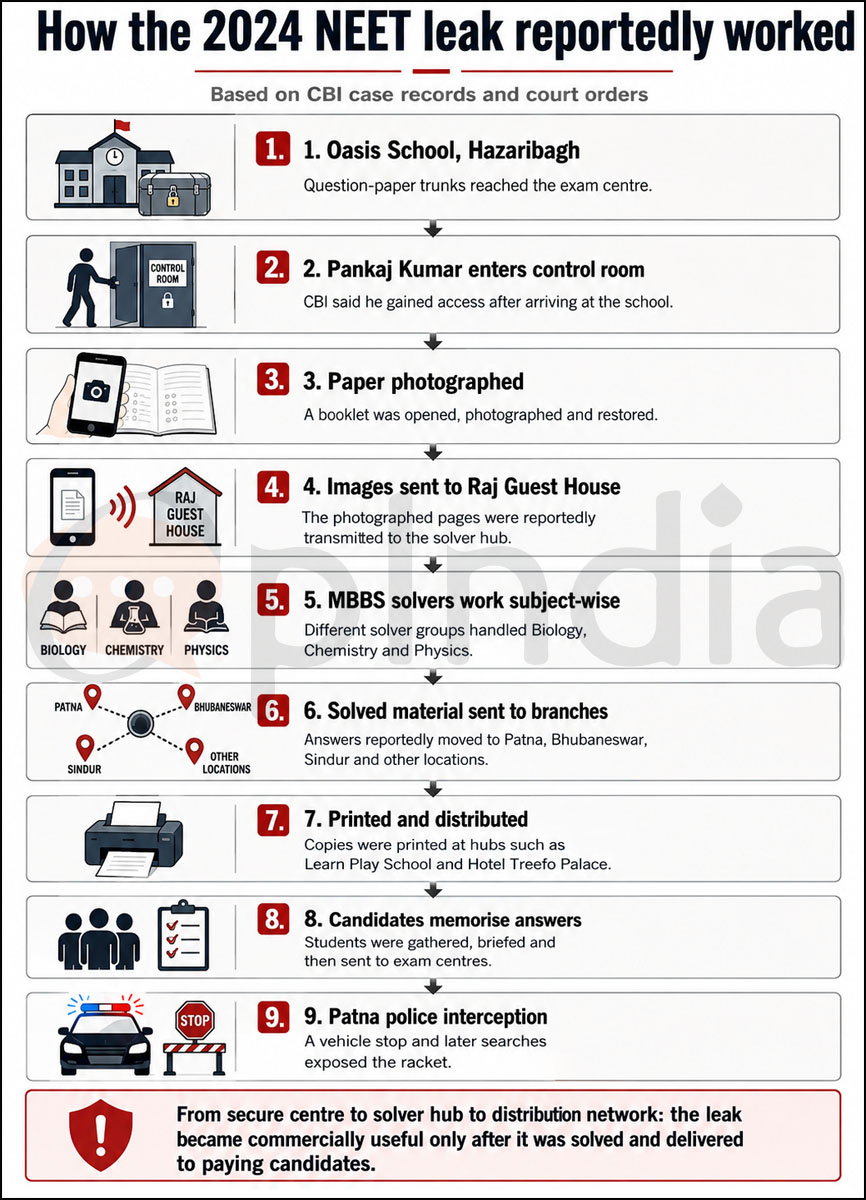
At around 7:40 am, Oasis School principal Ahsanul Haque collected two trunks containing NEET papers from an SBI vault in Hazaribagh. Haque was also the NTA city coordinator. The trunks were handed to vice-principal Imtiyaz Alam, the centre superintendent, who reached the school at about 7:53 am and placed them in the control room.
The CBI traced the stolen booklet through the packaging chain. Trunk 13093 contained bunches 13560 to 13563. Bunch 13560 contained packets 38988, 38989 and 38990. Packet 38990 contained 24 booklets numbered 6136465 to 6136488. Booklet 6136488 was identified as the source copied inside the school.
Pankaj Kumar reached Oasis School and reportedly told the guard, Rohit Ram, that he represented “Innovative View” and had come to meet Imtiyaz Alam. Rohit called out to Alam, who was standing near the principal’s office. The CBI said Alam signalled that Pankaj should be allowed inside. Pankaj then sat in the staff room. Notably, Innovative View was the official security and biometric verification agency deployed at examination centres. It is unclear whether Pankaj genuinely represented the company or merely used its name to enter the school.
School employees Mohd Shakeb Khan and Sadul Hassan noticed that the outsider had remained there for a long time. Shakeb reportedly informed Alam and later Haque. Sadul also raised the issue. According to statements cited by the CBI, Alam became irritated and told the employees to leave the matter to him. Shakeb and Sadul later gave statements before a magistrate. Shakeb also identified Pankaj in a test identification parade.
At 8:02:11 am, Pankaj reportedly entered the control room through its second door. The CBI said he used the toolkit to manipulate the rear hinges of trunk 13093, removed bunch 13560 and opened packet 38990. He selected booklet 6136488, cut its plastic wrapping and opened the paper seal with a pencil.
The agency said Pankaj photographed every page except the first and last sheets with an iPhone 13 that the CBI said was used in the operation. He had also reportedly obtained a SIM card using another person’s identity. He returned the booklet to the packet, restored the bunch and tried to reseal the trunk. Plastic strips removed during the process were placed inside the toolkit bag, which was concealed near an almirah. The CBI said the disturbed tablecloth could be seen in the school’s CCTV footage. The tools were later seized and Pankaj reportedly re-enacted the process in CBI custody.
Pankaj left the control room at around 9:23 am and the school premises at about 9:24 am. The examination was scheduled to begin at 2 pm. The network had less than five hours to transmit the photographs, solve the paper, prepare readable copies and move candidates to their centres.
The photographed pages were sent to Raj Guest House. The solvers were divided by subject. Kumar Shanu, Deependra Sharma and Sandeep Kumar were reportedly assigned Biology. Surbhi Kumari and Raunak Raj handled Chemistry. Chandan Singh, Rahul Anand and Amit Kumar handled Physics. Karan Jain was assigned difficult or time-consuming questions. Chandan was described as the leader of the Patna group and Kumar Manglam as the leader of the Rajasthan group.
Once the answers were prepared, Chandan and Surbhi were reportedly taken downstairs to explain them to candidates and clear doubts. Other solvers joined them. The CBI said physical solved copies were ordered to be destroyed after memorisation. The solvers returned to Hotel Sri Vinayak, where Sanjay Kumar and Sanoj Kumar Yadav were waiting. The agency relied on statements attributed to Sanoj about conversations in which group members said they had solved the paper.
Pankaj reportedly created PDFs of the solved material and transmitted them to handlers at Sindur, AK International Hotel, Bokaro, Bhubaneswar and Patna. Shashikant Paswan handled the Sindur branch. A copy was sent to a WhatsApp number used by Aman Kumar Singh, the brother of Amit Kumar Singh. In Bhubaneswar, handlers connected with Pankaj’s brother Ghanshyam reportedly worked with two electricians, Gautam and Vikas. Career Academy emerged in the CBI’s case as one of the most extensively documented candidate-recruitment and logistics channels in the 2024 leak.
The Patna branch received the solved subjects separately. According to the CBI chargesheet reviewed by The Indian Express, Baldev Kumar alias Chintu received the solved Biology paper on WhatsApp at 10:50 am. Chemistry arrived at 11:05 am and Physics at 11:40 am. The sequence indicates that each section was transmitted as soon as the relevant solver group completed it.
Baldev and Nitish Kumar reportedly printed 15 sets at Learn Play School in Khemnichak. Nitish brought a Brother printer and a Dell laptop. Around 30 to 32 candidates were assembled in groups of two or three. The chargesheet account placed Baldev, Pintu Kumar, Nitish Kumar, Abhimanyu Patel, Ashutosh Kumar and Manish Prakash at the premises during printing and distribution. Learn Play School was a key distribution and memorisation site for the Patna branch of the leaked-paper network.
Nitish also took solved Biology copies to his residence in Pratibha Colony, where seven women candidates were reportedly kept. Ashutosh Kumar, son of Krishnandan, was described as a candidate agent who took Rashi Singh there. CCTV footage reportedly showed Nitish giving her sets of solved papers.
Investigators said one page from the leaked paper was found on Nitish’s phone with a timestamp of 11:23 am, well before the examination began. At around 12:30 pm, candidates at Learn Play School and Nitish’s residence were told to leave for their centres. They were reportedly frisked so that no printed copy travelled with them.
The police interception that exposed the racket
At around 2:05 pm, Inspector Amar Kumar, then SHO of Shastri Nagar Police Station, received information that an organised gang had breached the NEET question-paper chain of custody. He was also told that members of the network were moving in a white Renault Duster bearing registration number JH01BW0019.
Police intercepted the Duster near Rajvanshi Nagar Mor and detained Sikandar Yadvendu, Akhilesh Kumar and Bittu Kumar. Four photocopied admit cards were found near the front seat. They belonged to Abhishek Kumar, Shivnandan Kumar, Ayush Raj and Anurag Yadav. Two phones were recovered from Sikandar.
The FIR records that Sikandar referred to “Sanjeev Singh”, Rocky, Nitish and Amit Anand in connection with candidate arrangements. Police used the recovered admit cards to identify examination centres and waited until the test ended before detaining the candidates.
Ayush Raj was appearing at DAV Public School in BSEB Colony. According to the FIR, he said he and around 20 to 25 students had been taken to Learn Boys Hostel and Learn Play School, provided solved questions and told to memorise them. He also said the questions in the examination matched the material supplied. Police seized his admit card, test booklet and identity documents.
Investigators then searched Learn Play School and recovered half-burnt and wet pieces of the NEET paper from the roof. The CBI later said the fragments enabled it to trace the leak to the booklet assigned to Oasis School. This physical recovery connected the Patna distribution centre with the Hazaribagh paper.
After finishing their work, Chandan Singh, Kumar Shanu, Rahul Anand, Amit Kumar and Karan Jain were reportedly taken to Hazaribagh Town railway station by Kumar Abhishek and Tinku Kumar. They boarded the Vande Bharat Express and reached Patna at around 10 pm. Within one day, the solvers had entered Raj Guest House before sunrise, the paper had been copied after 8 am, subject-wise answers had reached Patna by 11:40 am and candidates had left for their centres by 12:30 pm.
The key organisers and their reported roles
The CBI did not identify one person as the controller of every branch. Its case describes a layered operation in which different people handled access, candidate recruitment, solving, distribution and money.
Amit Kumar Singh emerges as the figure who reportedly linked the largest number of branches. The CBI said he knew Raju Singh from the admissions business, brought Pankaj into contact with the Oasis officials, worked with candidate suppliers and connected both the Patna and Rajasthan solver groups. Kumar Manglam and Deependra Sharma were reportedly accommodated at an Amit-linked flat in Ranchi. The agency also said Kumar Manglam received Rs 2.4 lakh from an account belonging to Ratna Khan that Amit operated. Amit disputed the flat, payment and meeting claims. Searches of his house reportedly yielded no incriminating material.
Pankaj Kumar was described as the operational link between the secure centre and the outside network. The CBI accused him of buying the tools and iPhone, entering Oasis School under a false description, opening the trunk, photographing the paper and transmitting the solved PDFs. It also linked him with candidate locations in Hazaribagh, Bokaro, Patna and Bhubaneswar, as well as payments routed through his brother Ghanshyam’s account. Pankaj denied the allegations. The High Court granted him bail in May 2025 after considering his custody period and parity with other accused. The order did not clear him of the charges.
Rakesh Ranjan alias Rocky was described as one of the kingpins of the Patna distribution operation. His branch reportedly managed Learn Play School, candidate assembly, printers, laptops and local delivery. Baldev received the subject-wise files. Nitish supplied equipment and moved papers to his residence. Rocky denied involvement and was later granted bail.
Raju Singh reportedly made Raj Guest House available and arranged food and transport. He said he was merely renting rooms. His first bail request was rejected, but he received bail in February 2026 after spending more than a year and a half in custody. The High Court noted that charges had not been framed and that the prosecution proposed 589 witnesses.
Jamaluddin was described as the intermediary who introduced the admissions network to Haque and Imtiyaz. Haque and Imtiyaz were the officials responsible for the secure centre. The CBI said Pankaj’s entry was facilitated, his presence was tolerated despite staff objections and access to the control room was enabled. Both denied involvement and questioned the prosecution chronology.
Career Academy supplied a structured candidate network. Beura, Maharana and Panda reportedly recruited aspirants, collected certificates or cheques, arranged travel, accommodation and vehicles, and distributed papers in Hazaribagh and Bhubaneswar. Sanjay Kumar arranged candidates and solvers. Chandan Singh was described as the head of the Patna solver group. Sikandar Yadvendu connected parents and candidates with the Patna handlers.
The separate Godhra network targeted the OMR sheets
The Godhra case involved a different method. It did not depend on stealing the paper and making candidates memorise answers. The CBI said a coaching-linked network attempted to control an examination centre so that correct responses could be filled on selected OMR sheets after the candidates had left.
The case named Tushar Rajnikant Bhatt, Parashuram Bindnath Roy, Arif Noor Mohammad Vora, Vibhor Umeshwar Prasad Singh Anand, Purshottam Sharma and Dixit Kantibhai Patel. Tushar Bhatt worked at Gyan Mandir Career Institute, a private coaching operation. The CBI said he was projected as a teacher and supervisor at Jay Jalaram School so that he could be appointed Deputy Centre Superintendent. Purshottam Sharma, principal of the school and NTA city coordinator, reportedly facilitated the appointment.
Dixit Patel was the chairman of Jay Jalaram Education Trust, which ran the schools used as examination centres. The prosecution said he participated in arranging the centres and officials. His lawyers said those appointments were made by the NTA and denied his involvement.
The CBI said agents instructed candidates to enter present addresses in Panchmahal or Vadodara, select Godhra as their examination city and choose Gujarati as the medium. The purpose was to increase the likelihood that they would be allotted to centres influenced by the network. Candidates were reportedly told to answer only questions they knew and leave the rest blank. The correct options would then be filled in on their OMR sheets. Families were asked to pay between Rs 20 lakh and Rs 25 lakh.
The Gujarat High Court order accessed by OpIndia also recorded statements concerning NEET-UG 2023. A witness named Vishnu Sharma reportedly said he approached the network for three relatives. Dixit Patel asked for Rs 10 lakh in advance for each candidate, according to the statement. Sharma said he paid Rs 20 lakh to Tushar Bhatt on the day of the examination. Bhatt later demanded another Rs 25 lakh and claimed that the work had been completed.
The witness also said he had been appointed as an invigilator in 2023 after sending his photograph to Bhatt. The prosecution relied on the statement to argue that coaching and school networks had already developed methods to influence examination staffing. Dixit Patel challenged the material and said it did not connect him with the 2024 crime. The High Court refused to discharge him in April 2026, holding that the material created grave suspicion that required a trial.
Sanjeev Mukhiya was suspected, but the CBI did not file a chargesheet against him
Sanjeev Kumar Singh alias Sanjeev Mukhiya became one of the most publicised names during the early investigation. Bihar’s Economic Offences Unit described him as the suspected kingpin of an interstate solver gang. Reports said investigators believed he had contacts in examination-leak networks across several states. He remained unavailable for nearly 11 months before the EOU arrested him near Saguna More in Patna on 25th April 2025. The Bihar government had announced a Rs 3 lakh reward for information leading to his arrest.
The CBI took him into custody because he had been named during the Bihar investigation. Initial reports said he was questioned about interstate contacts and logistics.
Mukhiya received default bail in the NEET case in August 2025 because the CBI did not file a chargesheet against him within 90 days. He remained in custody in other Bihar Police cases. On 23rd July 2026, the CBI clarified that it had found no evidence connecting him with either theft or onward distribution of the NEET-UG 2024 paper. The agency said it had identified the people involved and filed chargesheets against 45 accused. Mukhiya was not among them.
Bihar investigators initially suspected Sanjeev Mukhiya of heading the 2024 leak, but the CBI later said it found no evidence of his role in the theft or distribution and did not file a chargesheet against him.
How the 2024 case became a national crisis
The Patna case began with one vehicle, four admit cards and candidates linked to Learn Play School. It became a national controversy after the results were declared on 4th June 2024.
Sixty-seven candidates initially received a perfect score of 720. Questions were raised over scores of 718 and 719, which appeared unusual under the normal marking scheme. The NTA said compensatory marks had been awarded to 1,563 candidates who lost examination time at certain centres. The grace-mark dispute and the Patna-Hazaribagh paper theft had different factual foundations, but they became part of the same public crisis.
On 13th June, the Centre informed the Supreme Court that the compensatory scores would be withdrawn. The 1,563 candidates could accept their marks without grace marks or appear in a fresh test on 23rd June. That addressed the grace-mark question, not the geographical extent of the paper leak.
Student protests spread across the country. Political parties, including the Congress and organisations linked to the ABVP, demanded accountability and a wider investigation. The government brought the Public Examinations (Prevention of Unfair Means) Act, 2024 into force on 21st June. The law provides for punishment for organised cheating, paper leaks, impersonation and unauthorised access to examination material.
On 22nd June, the Ministry of Education constituted a committee headed by former ISRO chairman K Radhakrishnan to recommend reforms in the examination process, data security and the functioning of the NTA. The same weekend, NTA Director General Subodh Kumar Singh was removed from the position. The Centre asked the CBI to conduct a comprehensive investigation, including the wider conspiracy and the role of public servants.
The Supreme Court repeatedly asked when the breach occurred, how widely it travelled and whether tainted candidates could be separated from the rest. The CBI’s initial assessment identified around 155 suspected beneficiaries. The agency later said the leak was centred on Hazaribagh and Patna with interstate distribution to selected candidates.
On 23rd July 2024, the Supreme Court refused to cancel the entire examination. It held that the material then available did not establish a systemic breach that had destroyed the integrity of the test nationwide. It noted the absence of evidence showing that the leaked paper had spread through social media or reached an unmanageable number of candidates. The Court said a re-test for more than 23 lakh candidates could not be ordered without a stronger factual foundation.
The Court nevertheless identified serious failures in the NTA system. Its final judgment called for a stronger standard operating procedure covering paper preparation, storage, transport, centre security, identity verification and handling of irregularities. The number of perfect scores later fell from 67 to 17 after the grace-mark decision and resolution of a disputed Physics answer.
The CBI filed five chargesheets against 45 people in the Patna-Hazaribagh branch. The court orders became the main public source for understanding the investigation. The trial, however, moved slowly. By February 2026, charges had still not been framed in the Patna case and the prosecution had proposed 589 witnesses.
The government began implementing the Radhakrishnan committee’s recommendations. Measures included greater use of government institutions as examination centres, stronger coordination with state administrations, permanent NTA staffing, improved centre allocation, digital monitoring and a steering committee for reform. The Central Consumer Protection Authority also issued guidelines against misleading coaching advertisements. It prohibited false success claims, concealed information and guarantees of selection. By November 2024, the CCPA said it had initiated action against 45 coaching centres and imposed Rs 54.6 lakh in penalties on 18 institutions.
These measures strengthened examination security and addressed deceptive advertisements. They did not create a complete framework for admission consultants and small counselling networks. Career Academy reportedly operated through counselling and candidate handling rather than a conventional classroom. The 2024 network used guest houses, hotels, private homes, original certificates, blank cheques and third-party accounts. The 2026 leak, however, exposed an even greater vulnerability, namely confidential access at the subject-expert level.
The 2026 leak was hidden inside a ‘guess paper’
The NEET-UG 2026 breach was not discovered after police stopped a vehicle. It surfaced after a teacher in Sikar received a 150-page handwritten “guess paper” on the evening of the examination held on 3rd May. The document had travelled through his landlord’s son, who was studying in Kerala. The teacher compared it with the real paper and approached the authorities after finding extensive matches.
On 7th May, he sent information to the NTA, the Ministry of Home Affairs and the CBI. NTA officials contacted him the next day and obtained the PDF. The 150-page material reportedly contained around 410 questions. Approximately 120 of them appeared in the Chemistry paper used on 3rd May. Parts of Biology were also suspected to have circulated.
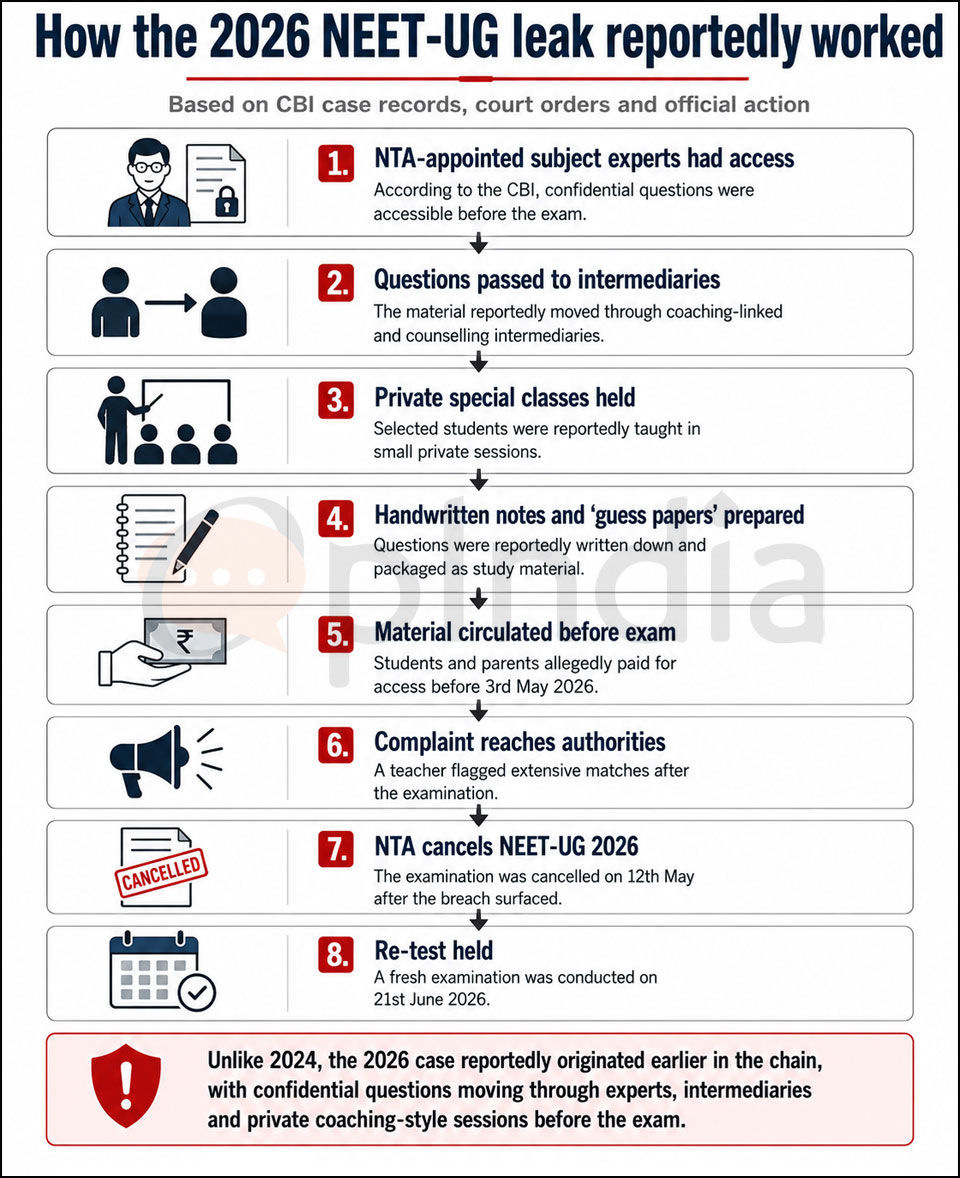
Calling it a “guess paper” provided deniability. Confidential questions could be sold as expert predictions or a high-probability revision set. Rajasthan’s Special Operations Group traced the file through contacts in Dehradun, Kerala and Rajasthan. It also examined paid digital groups through which material was sold. The inquiry did not establish that every coaching institute in Sikar was involved. It showed that a confidential document had reached a major coaching hub and entered a wider resale market.
The NTA referred the material to central agencies on 8th May. On 12th May, it cancelled the examination and referred the matter to the CBI. Existing registrations and centre preferences were carried forward for the re-test. Candidates did not have to register again or pay another fee.
The decision differed from 2024. The Supreme Court had allowed that examination to stand because the evidence did not show an unmanageable nationwide breach. In 2026, the NTA concluded within nine days that the compromised test could not be preserved.
The CBI traced the 2026 leak to NTA-appointed experts
The CBI registered its case on 12th May and searched locations in several states. It examined phones, messaging applications, bank records and NTA documents. The agency’s case moved closer to the source than the 2024 investigation. Pankaj Kumar had reportedly copied a printed booklet on the morning of the test. In 2026, the CBI said subject experts accessed confidential questions weeks earlier and passed them to coaching and counselling networks.
The first five people arrested on 13th May were Shubham Khairnar of Nashik, Mangilal Biwal, Vikas Biwal and Dinesh Biwal of Jaipur, and Yash Yadav of Gurugram. Khairnar reportedly ran SR Education Consultancy, which offered medical-admission guidance. The CBI told a Delhi court that he helped Yadav obtain the paper for distribution. Yadav had reportedly received Physics, Chemistry and Biology PDFs through Telegram on 29th April. Mangilal Biwal was said to have approached the network for his younger son. The price discussed was between Rs 10 lakh and Rs 12 lakh.
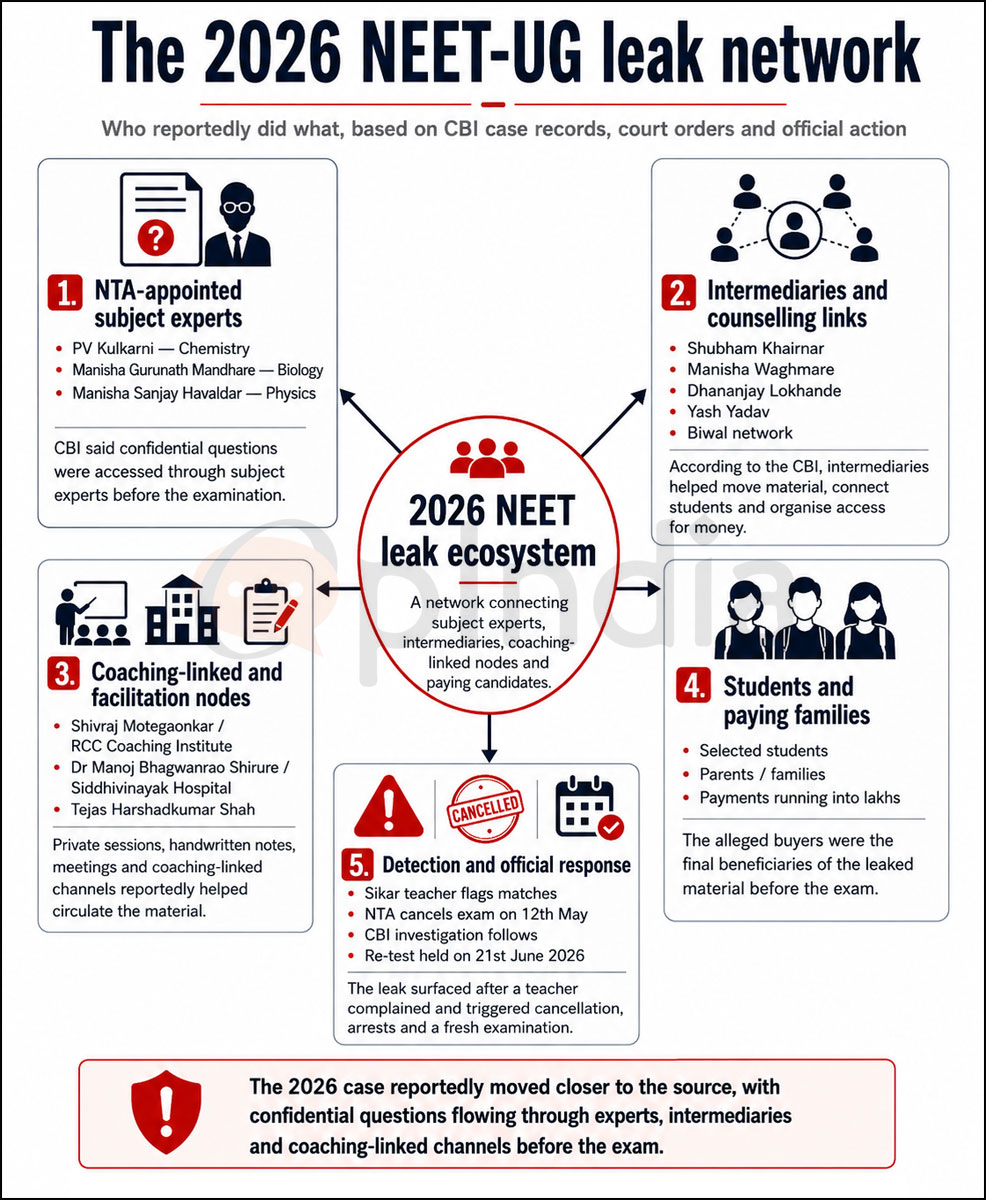
Manisha Waghmare of Pune and Dhananjay Lokhande of Ahilyanagar were arrested next. The CBI said Lokhande obtained material from Waghmare and passed it to Khairnar, who facilitated its transfer to Yadav. Waghmare was linked with medical counselling and candidate mobilisation. The agency later said she brought students to special classes held by NTA-appointed Chemistry and Biology experts.
On 15th May, the CBI arrested Chemistry lecturer PV Kulkarni and described him as the kingpin of the Chemistry branch. Kulkarni had been involved in the examination process on behalf of the NTA and had access to confidential questions. During the final week of April, he reportedly held special sessions at his Pune residence for students mobilised through Waghmare.
The CBI said Kulkarni dictated questions, answer options and correct responses. Students wrote them in notebooks. The material reportedly matched the 3rd May paper. Students paid several lakhs to attend. The method converted confidential access into a private coaching product without handing every buyer an identifiable NTA document.
On 16th May, the agency arrested senior Botany teacher Manisha Gurunath Mandhare. The CBI said she had been appointed as an NTA expert and had complete access to the Botany and Zoology papers. She reportedly conducted special classes at her Pune residence. Waghmare mobilised candidates. Students wrote questions in notebooks and marked relevant portions of textbooks. A majority of those questions reportedly appeared in the examination.
The private-residence model avoided a visible coaching-centre transaction. A recruiter used personal contacts, the expert taught a small paid group and students recorded the leak as ordinary notes.
The strongest direct institutional link emerged on 18th May when the CBI arrested Shivraj Motegaonkar, the owner of RCC Coaching Institute in Latur. The agency said RCC operated nine branches and trained NEET candidates. Motegaonkar was described as close to Kulkarni. Searches of the institute and his residence reportedly produced a Chemistry question bank containing questions from the 3rd May examination.
The CBI later told a Delhi court that Motegaonkar’s son Aditya attended Kulkarni’s sessions and prepared handwritten notes. Investigators recovered 36 images from a phone used by Motegaonkar. Five were duplicates. The remaining images contained 132 handwritten Chemistry questions and around 111 matched the NTA master sets. The images were reportedly captured on 23rd April, ten days before the test.
The agency said the transfer took place at Siddhivinayak Hospital in Latur, run by paediatrician Dr Manoj Bhagwanrao Shirure. He was arrested on 26th May. A Rouse Avenue District Court order dated 24th July records the CBI’s claim that Shirure arranged for Aditya Motegaonkar to meet Kulkarni in a deluxe room at the hospital during the third week of April. The agency cited the statement of a hospital employee whom Shirure reportedly tasked with making the arrangements. It said the meeting allowed Aditya to obtain Chemistry questions before the examination.
The CBI said Shirure received Rs 5 lakh from Shivraj Motegaonkar’s wife for facilitating access. The amount was recovered from Shirure’s sister’s house on 21st May. According to the order, she told investigators that Shirure had given it to her the previous night. The agency also said Shirure referred two doctors to Kulkarni. Their children received Chemistry questions after paying Rs 3 lakh each and Shirure reportedly received half of those payments. Statements of the relevant witnesses were recorded before a magistrate under Section 183 of the BNSS. The court order says the witnesses identified 42 questions supplied by Kulkarni that appeared in the NEET-UG paper. Shirure’s lawyers said no leaked questions were recovered from him, his devices, his house or his hospital and disputed the link between him and the Rs 5 lakh.
The Physics branch led to NTA-appointed expert Manisha Sanjay Havaldar. The CBI said she had complete access to the Physics paper and passed handwritten questions to Mandhare. She also reportedly dictated Physics questions to Tejas Harshadkumar Shah, a faculty member at Dr Abhang Prabhu Medical Academy in Pune. Shah was accused of passing the material to students connected with the academy. The available material attributes the act to Shah but does not establish that the academy’s management authorised it. That distinction matters because a faculty member’s reported participation cannot automatically become a finding against the entire institution.
By the end of May, the CBI had arrested 13 people including Khairnar, Mangilal Biwal, Vikas Biwal, Dinesh Biwal, Yash Yadav, Lokhande, Waghmare, Kulkarni, Mandhare, Motegaonkar, Havaldar, Shirure and Shah. The publicly available material supports three subject-level sources: Kulkarni for Chemistry, Mandhare for Biology and Havaldar for Physics. It shows overlapping intermediaries, but does not yet establish that one person controlled all three branches.
On 24th July, the special CBI court rejected Shirure’s bail application. It said the investigation remained at a crucial stage and that the possibility of influencing witnesses could not be ruled out. The order records that all 13 arrested accused were then in judicial custody. The finding was limited to bail and did not decide guilt.
The 2026 network therefore operated closer to the source and with more time. It could organise private classes, handwritten notes, “guess papers” and Telegram sales. There was less need for a large group of solvers racing against a five-hour deadline.
The re-examination, the Supreme Court and the government response
The NTA reconducted NEET-UG 2026 on 21st June with a fresh paper and new subject experts. The cancellation forced more than 22 lakh affected candidates to prepare for another examination. According to the NTA, close to 20 lakh candidates actually appeared in the re-test conducted on 21st June. Candidates from the cancelled test were eligible without fresh registration or an extra fee. Results were released on 16th July.
During Shirure’s bail hearing, the CBI prosecutor said the cancellation and re-examination caused a loss of more than Rs 600 crore to the government exchequer. The prosecutor also said fresh question papers had to be transported to examination centres by helicopter. The order records these as prosecution submissions and not as quantified findings independently reached by the court.
The case reached the Supreme Court before the re-examination. Petitioners questioned the cancellation, the protection of candidates and the ability of the NTA to prevent repetition. The Court asked why reforms after 2024 had not created sufficient institutional memory. It wanted the agency to demonstrate the physical and intellectual capacity needed to prevent another breach.
The concern went beyond locks and CCTV. The 2024 case exposed weaknesses after printed papers reached an examination centre. The 2026 case showed that the expert-selection and confidentiality system remained vulnerable. A permanent risk system should record who had access, what control failed, whether an expert had coaching links and how similar warning signs should be handled in future.
During the 29th May hearing, Solicitor General Tushar Mehta reportedly told the Court that Prime Minister Narendra Modi was personally supervising the response and the re-examination process.
Protests followed the cancellation and later became a wider agitation over paper leaks, the NTA and ministerial accountability. The controversy disrupted Parliament during the Monsoon Session. Opposition MPs demanded the resignation of Education Minister Dharmendra Pradhan, while the government said it was ready for a debate but rejected resignation as a precondition.
On 23rd July, PM Modi announced that fast-track courts would be established for paper-leak cases. He said those who harmed the future of students would face strict punishment. The announcement addressed a real weakness. The 2024 CBI case had produced five chargesheets, but its trial had not reached the framing of charges by February 2026.
More strict actions against paper leaks to come in tomorrow’s Cabinet! pic.twitter.com/NRysBukk5U
— Narendra Modi (@narendramodi) July 23, 2026
Administrative changes also followed. Higher Education Secretary Vineet Joshi was transferred and Naresh Pal Gangwar was appointed in his place. The government promised additional measures. Reports said NEET-UG would move towards a fully computer-based format from 2027. On 24th July, NTA terminated 47 officials.
Nothing is more important than the welfare and future of our youth!
— Narendra Modi (@narendramodi) July 23, 2026
We have decided to set up fast-track courts to ensure swift and stringent punishment for those involved in paper leaks. Have directed the concerned authorities and officials to take all necessary steps in this…
Computer-based testing may reduce risks linked with printed papers, transport and OMR sheets. It cannot by itself stop an expert who has advance access to confidential questions and passes them to a coaching network. The central weakness in 2026 was not the printed booklet. It was the relationship between insiders, coaching operators and candidate intermediaries.
What must change to break the coaching mafia
The first reform must create a strict firewall between confidential examination work and the coaching industry. An NTA subject expert should not be allowed to provide private tuition, conduct paid special classes, receive referral payments, act as a consultant, share revenue with a coaching business or work through an institute controlled by a close relative during the relevant confidentiality period. A declaration on paper is not enough. The NTA must verify company records, professional profiles, payment trails and disclosed associations.
No expert should have access to an entire subject paper unless the task requires it. Question drafting, review, translation, moderation and final selection should be divided. The system should record who accessed each question, when it was accessed, the device used, whether it was printed or downloaded, who approved the answer and when it entered a master set. Unusual access must trigger an automatic alert.
Compulsory registration must cover both coaching centres and admission consultancies. The 2024 case shows why a definition based only on large classrooms is inadequate. A business that prepares candidates, offers medical counselling, collects documents, claims it can arrange seats or acts as an intermediary between families and colleges should fall within the regulatory system even if it teaches fewer than 50 students.
Ownership and finances must be transparent. Regulators should know the promoters, directors, trustees, related companies, authorised signatories and beneficial owners. The same information should be linked across states so that a promoter barred in one jurisdiction cannot reopen through another company or a relative.
Promises of “guaranteed selection”, “confirmed MBBS admission” or “100 per cent success” should trigger more than a consumer-advertising notice. Such claims can indicate impersonation, paper access, OMR manipulation or illegal seat arrangements. A common platform operated by consumer authorities, the NTA and state police should flag unusually high fees, demands for original certificates, blank cheques, instructions to change examination cities, payments linked with marks, private sessions promising exact questions and offers to arrange dummy candidates.
The Godhra case shows how application data can be used to manipulate centre allocation. A cluster of candidates changing their present address to one district, selecting the same city and choosing an unusual language combination should be reviewed before centres are allotted. This need not presume guilt. It should trigger human verification.
Coaching institutions must face liability when the evidence reaches the institution itself. Cancellation of registration, attachment of proceeds and long-term debarment should be available where an owner or director participates, institutional accounts receive money, premises are knowingly used, confidential questions are distributed through the organisation or management ignores credible warnings.
Liability must still follow evidence. RCC stands on a stronger reported footing because its owner was arrested and material was reportedly recovered from devices and premises linked with him. The reported act of Tejas Shah cannot automatically prove that the management of Dr Abhang Prabhu Medical Academy knew about the Physics transfer.
Candidate data also requires protection. Coaching centres and counsellors hold examination scores, family income, preferred colleges, phone numbers, addresses, identity documents and information about a family’s ability to pay. That database allows corrupt agents to identify desperate or financially secure targets. Student information should not be sold or shared with admission agents without explicit consent. Regulators should audit how original certificates and identity documents are collected and stored.
A protected whistleblower system is equally important. The 2026 case surfaced because a teacher examined the “guess paper” and approached the authorities. Teachers, coaching employees, students and examination personnel should be able to submit suspected papers, screenshots and payment demands through a secure portal. It should timestamp the material, preserve the original file, protect identities and alert both the NTA and an independent investigative unit. Protection against retaliation is essential. A financial reward may be justified where credible information prevents a nationwide examination from being compromised.
Financial investigation must begin with the first arrest. In 2024, the CBI traced payments through parents, middlemen, employees, relatives, companies and third-party accounts. Investigators should freeze suspicious funds, examine payment apps and company records, and identify property purchased from the proceeds. Attachment of profits can damage the business model more effectively than arresting a replaceable local handler.
Fast-track courts must complete trials rather than merely process remand and bail applications faster. A designated court should receive a consolidated digital chargesheet, a clear role chart, verified chronology, financial-flow diagram, device-ownership record and a limited list of essential witnesses. A case should not require hundreds of repetitive witnesses to describe the same FIR. Periodic public case-status information would also allow affected students to know whether charges have been framed and the recording of evidence has begun.
The method changed, but the market survived
The 2024 and 2026 cases used different methods. In 2024, the paper was reportedly removed from a sealed trunk after reaching Oasis School. MBBS students were waiting at Raj Guest House to solve it. Admission agents had already assembled candidates across cities. The operation depended on speed, transport, printers and local handlers.
In 2026, the CBI said the questions came from subject experts before the examination. Private classes, handwritten notes, “guess papers”, Telegram files and coaching networks replaced the rushed morning operation. The leak could be disguised as teaching and incorporated into an ordinary revision schedule.
The method evolved because the market remained. Parents were still willing to pay. Consultants could still identify them. Coaching operators had access to large candidate pools. Insiders could still sell confidential material.
Securing examination centres can close one route. Computer-based testing can close another. Arresting individual teachers can temporarily break a chain. None of these steps will be sufficient unless the commercial network connecting insiders, coaching operators, counsellors and candidates is dismantled.
A question paper does not move from a confidential system to paying candidates on its own. In 2024, the operation reportedly required school officials, a person capable of opening the trunk, MBBS solvers, guest-house operators, candidate recruiters, printers, transporters and money handlers. In 2026, it reportedly required NTA-linked experts, private coaching sessions, counselling intermediaries, coaching faculty and digital resellers.
The person who steals or discloses the paper is only the first supplier. The coaching mafia gives that paper commercial value. It knows where to find candidates and which families will pay. It can arrange centres, documents, travel and special classes. It can present stolen questions as predictions and route payments through consultancies, trusts and private accounts.
The government has introduced a dedicated law, restructured examination processes, ordered CBI investigations and announced fast-track courts. These measures are necessary. The next step must target the education businesses that convert confidential access into a marketable product.
Coaching centres and admission consultancies must be registered. Their ownership and finances must be disclosed. NTA experts must be kept away from private coaching relationships. Access to questions must be divided and digitally traceable. Institutions that knowingly participate must lose the right to operate.
Otherwise, the examination authority will continue fighting the previous leak while the coaching mafia prepares the next method.
Court documents and FIRs on which this report is based on can be accessed from this link.


