

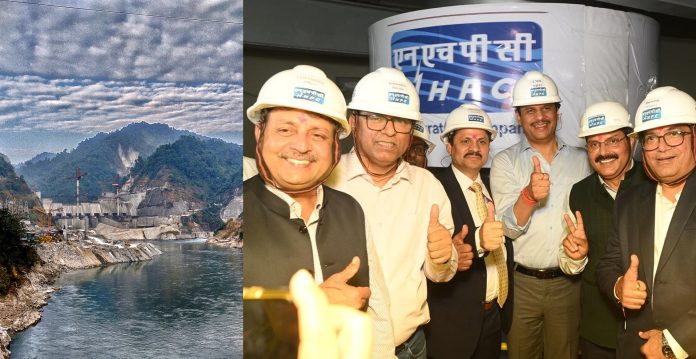
In a major achievement towards India’s renewable energy ambitions, the Subansiri Lower Hydroelectric Project (HEP), the nation’s most ambitious hydropower venture, has initiated the wet commissioning of its first 250 MW unit. This milestone, achieved on 24th October, marks the of trial power generation for the 2,000 MW project for the first time, fulfilling the goal of providing clean, sustainable power to the country.
Located at Gerukamukh along the Subansiri River on the Arunachal Pradesh-Assam border, the project developed by NHPC Limited represents a cornerstone of India’s push for self-reliant green energy. Wet commissioning of a hydel project refers to the critical phase where water first surges through the turbine to rigorously test mechanical and electrical systems under operational conditions to ensure a flawless mechanical run of the turbine. This step paves the way for grid synchronization and the inaugural flow of electricity, transitioning the project’s status from construction to power production.
The ceremony marking the first test run of the project was attended by several officials including NHPC Chairman and Managing Director Bhupender Gupta, Executive Director and Project Head Rajendra Prasad, Directors Sanjay Kumar Singh (Projects), Suprakash Adhikari (Technical), and Mahesh Kumar Sharma (Finance), along with Independent Director Uday Sakharam Nirgudkar and Chief Vigilance Officer Santosh Kumar. Other senior officials from NHPC’s corporate and site teams also joined the event.
Gupta lauded the achievement as “a shining testament to NHPC’s engineering excellence and India’s growing strength in world-class infrastructure.” He added, “This is more than a project milestone—it is a symbol of India’s unstoppable march toward a cleaner, greener, and self-reliant energy future.”
Gupta extended heartfelt gratitude to the Ministry of Power, the governments of Arunachal Pradesh and Assam, past NHPC leaders, the dedicated Subansiri team, and key executing partners like BGS-SGS-SOMA JV, TREL, Patel Engineering Ltd., and GE Vernova.
He said that this achievement is more than a project milestone, it is a symbol of India’s unstoppable march towards a cleaner, greener and self-reliant energy future. Together, we flow forward, with the power of nature, innovation and national pride.
With Unit-1 now successful in wet trials and producing 250 MW units of electricity, NHPC plans swift grid integration. The Corporation plans to commission three additional 250 MW units before the year ends. This phased rollout will inject a robust 1,000 MW of green energy into the national grid.
In a landmark moment for India’s Hydropower landscape, Wet Commissioning of Unit–I (250 MW) of #NHPC’s 2000 MW Subansiri Lower Hydroelectric Project (HEP) commenced on 24.10.2025 with successful Mechanical run of machine , marking the beginning of commissioning of the first unit… pic.twitter.com/oyrDHS0lOr
— NHPC Limited (@nhpcltd) October 24, 2025
After the completion of the entire project, eight 250 MW units will generate a total of 2000 MW electricity, making the Subansiri Lower HEP India’s premier hydroelectric powerhouse. The project will generate clean energy equivalent to powering over 1.5 million households annually and slash India’s carbon emissions significantly.
Apart from enhancing the national grid, this project will provide much-needed power to the northeastern region of India, which has historically faced challenges in energy availability. Arunachal Pradesh and Assam will be main beneficiaries of the project.
Like several infrastructure projects in the country, this clean energy project also faced significant hurdles, delaying it by a decade. The Subansiri Lower HEP was envisioned in January 2005, but it endured an excruciating eight-year limbo from 2011 to 2019, stalled by fierce protests in Assam over fears of downstream flooding, ecological disruption, and displacement. Local communities, environmentalists, and activists rallied against perceived risks to the region from the big dam built for the project. This led to stoppages for work for long durations and legal battles in courts and the National Green Tribunal. Apart from stopping work, activists in Assam also stopped transport of vital equipment like turbines.
The situation improved in October 2019 when construction recommenced after clearance from the NGT which came after comprehensive environmental safeguards, impact studies, and stakeholder consultations. The construction gained momentum under the BJP came to power at the Centre and in Assam with promise of accelerated infrastructure development.
