

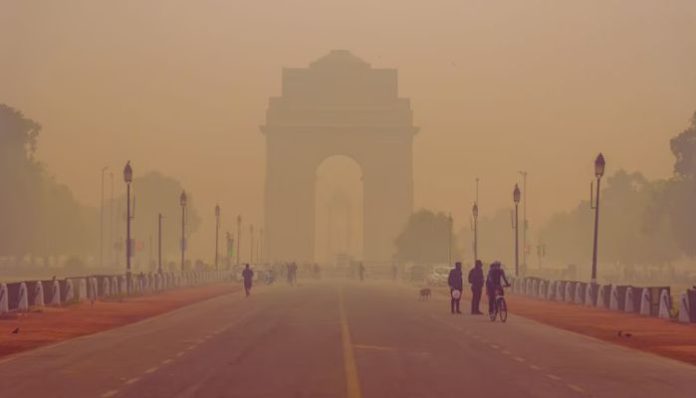
The Prime Minister’s Office (PMO) has requested that India’s top pollution-monitoring bodies expedite work on a new emissions inventory and source-apportionment study for the Delhi-NCR region. This direction came even before the National Green Tribunal (NGT) was informed last week that ongoing action plans against air pollution were still based on old emissions data. According to the media reports, the PMO wants updated, scientific data to guide Delhi’s clean-air strategy.
High-level meeting flags urgent need for new pollution study
These directions were issued at a high-level task force meeting on 23rd October, chaired by P.K. Mishra, Principal Secretary to the Prime Minister. Senior officials from multiple departments, environment, power, housing, agriculture and others, were present, along with the Chief Secretaries of Delhi, Haryana, Punjab, Rajasthan and Uttar Pradesh.
During the meeting, both the Commission for Air Quality Management (CAQM) and the Central Pollution Control Board (CPCB) were told to speed up work on the new emission inventory. This study will help authorities understand exactly which sources are contributing how much to air pollution, whether it’s dust, vehicles, industries, waste burning or stubble burning.
Officials said the new inventory and source-apportionment results will allow agencies to update their action plans, something that has not happened despite a 2023 real-time study being conducted. Last Wednesday, NGT’s amicus curiae Sanjay Upadhyay told the tribunal that the old action plan was still being used.
Dust pollution and poor roads under scanner
One of the biggest takeaways from the meeting was the huge role of dust in Delhi’s pollution. With thousands of kilometres of roads across industrial and urban areas in poor condition, dust becomes a major source of PM10 and PM2.5, especially during the winter months.
Because of this, the PMO has directed pollution authorities to prepare a time-bound plan to redevelop major roads. This includes complete paving, repairing broken stretches, and greening road shoulders so that dust does not fly back into the air. Adequate funding has also been promised for this work.
Dust from construction and demolition waste was highlighted as another major problem. Delhi-NCR generates nearly 8,000 tonnes of such waste every day, but the system does not have enough capacity to process all of it, the meeting noted.
Old vehicles and traffic load add to the crisis
The 23rd October meeting also took note of the massive number of vehicles in Delhi. Officials pointed out that Delhi alone has more than half of all the vehicles in the entire NCR. This includes lakhs of old vehicles, with around 37% still falling under outdated BS I to BS III emission norms. These older vehicles release far more toxic emissions compared to newer models.
Industrial pollution was another important issue discussed. NCR has nearly 50,000 industries, out of which about 11,000 fall in the polluting category, officials said. While many have shifted to piped natural gas, several are still working to install proper emission-control devices and continuous monitoring systems.
IIT Kanpur is currently preparing stricter emission norms for selected industrial sectors. These will apply especially to industries that continue to release high levels of pollutants.
Along with industries, the government is also monitoring 11 thermal power plants within 300 km of Delhi. Out of 35 units in this radius, only 14 have so far installed flue-gas desulphurisation (FGD) systems, which help cut sulphur dioxide emissions. The Ministry of Power, CPCB and state pollution boards have been told to ensure that all remaining units comply with emission standards quickly.
New pollution study work already in progress
Government sources said work on the new emission inventory has already started. The CPCB has been coordinating with IITs and other scientific institutions to study 7–8 major pollution sectors such as vehicles, waste, industries, and transboundary pollution coming from neighbouring states.
Officials said the updated study will help create a more accurate and effective clean-air action plan for Delhi-NCR, which has been battling severe pollution every winter.
