

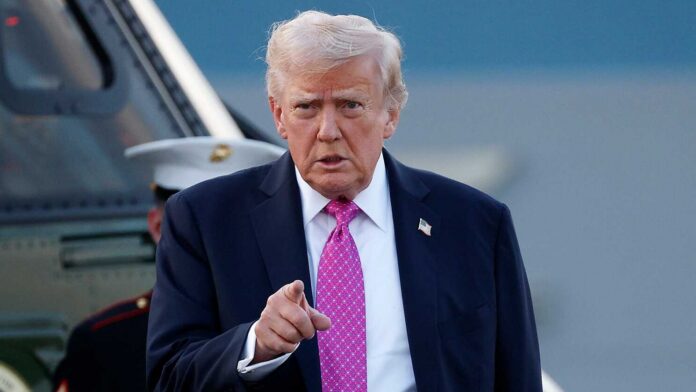
President Donald Trump has again thrust the Arctic territory of Greenland into the global spotlight, doubling down on statements suggesting that the United States may seize control of the autonomous Danish territory if Denmark will not agree to a deal. His remarks at a White House gathering this week, framed around broader discussions of U.S. strategy in Venezuela and global rivalries, have quickly reverberated across Europe and the North Atlantic.
Trump characterised Greenland as a critical national security asset, citing increased Russian and Chinese military activity in the Arctic and asserting that the United States cannot allow either power to gain influence there. “We’re going to do something with Greenland, either the nice way or the hard way,” he said, indicating that diplomatic negotiations are preferable but that more forceful measures remain on the table.
The president’s repeated emphasis on control of Greenland, which he described as vital to prevent adversaries from “occupying” the territory, revives a controversial concept first raised during his earlier presidency. Despite its unnerving tone, White House officials have subsequently stated that the administration’s current goal is to negotiate a transaction, potentially through purchase or other political arrangement, rather than immediate military action.
European and Greenlandic leaders push back
Denmark, a longstanding U.S. NATO ally, has reacted sharply. Danish Prime Minister Mette Frederiksen condemned the notion of forceful acquisition, warning that any attempt by the United States to violate Denmark’s sovereignty over Greenland could unravel decades of transatlantic security cooperation and threaten the very framework of NATO.
Likewise, Greenlandic officials have stressed the territory’s autonomous status and their own right to self-determination, with the Greenland government dismissing fears of an imminent annexation and affirming a desire for stronger bilateral ties on equitable terms.
European capitals have also rallied in support of Denmark and Greenland, underscoring that Greenland’s future must be decided by its people and their government, not imposed by external powers. Leaders from nations including France, Germany, Italy, Canada and others have issued statements emphasising respect for international law and the inviolability of sovereign territory.
Strategic stakes and wider implications
Greenland’s geopolitical importance stems from its location at the heart of the Arctic, a region experiencing intensified interest from major powers for both military reach and untapped natural resources. The island’s vast mineral deposits, critical for high-tech and defence industries, alongside existing U.S. access via Pituffik Space Base under long-standing defence agreements, amplify its strategic relevance.
However, experts and allied officials argue that a military takeover, beyond being diplomatically explosive, would be unnecessary, as the U.S. already maintains a significant presence and partnership in the region. They stress that collective Arctic security should be pursued through NATO and existing alliances, not unilateral action.
To address the diplomatic strain, U.S. Secretary of State Marco Rubio is scheduled to meet next week with Danish and Greenland representatives. This engagement aims to clarify U.S. intentions and explore avenues for cooperation that respect Denmark’s jurisdiction while acknowledging shared security concerns.
The controversy over Greenland underscores a rare rupture between the United States and close allies, particularly on questions of sovereignty and international norms. As Trump continues to link the territory’s future to larger concerns about competition with Russia and China, diplomatic efforts in the coming days will be critical in determining whether the dispute remains rhetorical or evolves into a broader geopolitical confrontation.
