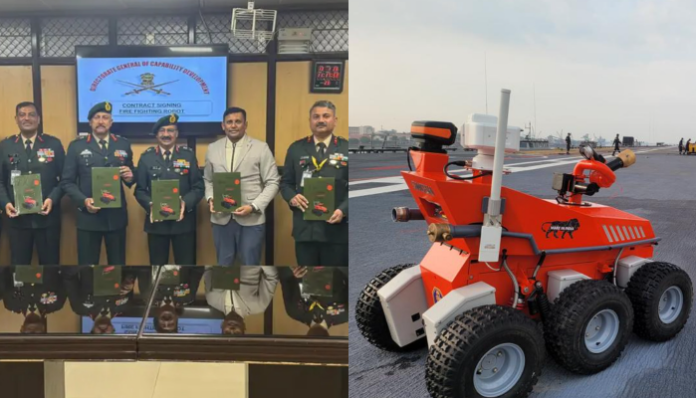
The Indian Army has taken a landmark step towards enhancing safety at the most critical locations and signed a contract to procure 18 indigenously developed firefighting robots (FF BOT) to improve safety at ammunition depots and other high-risk military facilities. On 13th January (Tuesday), the Army’s Directorate of Capability Development and Gujarat’s Ahmedabad-based startup Swadeshi Empresa Private Limited inked the ₹62 crore agreement.
The company has developed the system under the Innovations for Defence Excellence (iDEX) program. During the Vijay Diwas celebrations in December of last year, the bot was on exhibit at Army House. The first week of April is expected to mark its induction, and it is scheduled to be installed in several cantonments of the country.
Fire fighting bot developed by Swadeshi Empresa being developed for #IndianNavy under @India_iDEX #SPRINT initiative handed over to @IN_R11Vikrant for user trials.
— SpokespersonNavy (@indiannavy) December 6, 2022
Detects seat of fire & extinguishes it using water/foam jet/spray, keeping humans away from danger.@DefenceMinIndia pic.twitter.com/BDsWXX6ggy
The robot was first created for the Indian Navy, but the Army has bought it for the first time owing to clauses that let services acquire iDEX products that have already undergone testing by another branch of the defence forces. It previously passed a Single Stage Composite Trial.
This cross-service strategy speeds up the adoption of tested local innovations and prevents duplication of development resources. The Design Bureau of the Army supported the project in line with its efforts to produce homegrown technology and support military businesses through the “Make in India” initiative.
A two-year warranty and five years of complete maintenance are provided by the supplier as part of the deal. There is also a seven-year guarantee for on-site service assistance.
What is the significance of FF BOT
The autonomous ground system is designed for greater protection when combating fires in areas where they can spread swiftly and endanger infrastructure and people. It is made to function in situations where human entry can often be dangerous, such as those involving explosions, poisonous fumes, intense heat and the possibility of building collapse.
It is intended for application in industrial facilities, oil refineries, fuel storage regions, ammunition depots and weaponry storage places. Firefighters are able to control the robot remotely from a safe distance. The system has thermal and optical cameras that allow live video feeds to be transmitted in order to better manage the situation.
Hotspots and hidden flames that are hard to notice through smoke can be identified via thermal imaging. This aids in enhancing situational awareness while combating fires. This enables firefighters to monitor the fire’s spread, evaluate the situation and make well-informed decisions in smoke-filled and low-visibility situations.
The FF BOT has already been deployed in civilian firefighting activities like the Visakhapatnam refinery. The officials highlighted that this proved its utility outside of military locations. Officials added that the robot can also be used in crisis response scenarios where access for human firefighters is restricted or risky including power plants, airports and fuel storage sites.
According to officials, the FF BOT is meant to assist firefighters rather than take their place. It lowers worker risk and facilitates a faster and more secure response during fires in areas of concern by allowing unmanned devices to enter the most susceptible venues first.
The system’s features and its functions
For mobility on challenging terrain, the system has a six-wheel drive with suspension. It has enough strength to draw fire hoses full of water. It is capable of towing up to five-ton vehicles and can spin completely on the spot as well as run at different speeds.
The robot has a self-cooling mechanism to endure extreme heat and is constructed from corrosion-resistant stainless steel. It is comprised of a winch, integrated lighting, optical and thermal cameras, along with other features. A basic control station with a large touchscreen and a joystick is employed for operators to handle the bot.
The Acceptance of Necessity (AoN) for the system, which is the first iDEX Sprint venture under DISC-7, was given in 2023. Sprint stands for Supporting Pole-Vaulting in Research & Development through iDEX, Naval Innovation and Indigenisation Organisation (NIIO), alongside Technology Development Acceleration Cell (TDAC). Through the involvement of start-ups and private companies, it seeks to create an ecosystem for innovation in military and aerospace.
The fresh move is part of a larger worldwide trend towards robotic firefighting systems, especially at military bases, oil refineries, nuclear power plants and industrial complexes where fires can advance promptly and jeopardise lives or vital infrastructure. A small fire in a munitions storage could cause broad damage and subsequent explosions, which could interfere with operations and logistics.