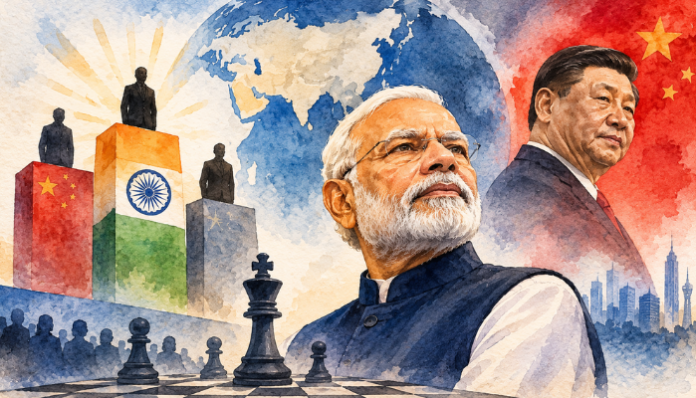
Lowy Institute, an Australia-based think tank, has released the 2026 edition of its Asia Power Index on 22 November. India ranks third among the 27 countries and territories assessed with a score of 40.5 points. The Key Findings Report, written by Dr Hunter Marston and Jack Sato, also names Prime Minister Narendra Modi the second most effective leader in the region. It finds that the power gap between India and China is the narrowest since the index was launched in 2018.
India is third and the only “major power” in the index
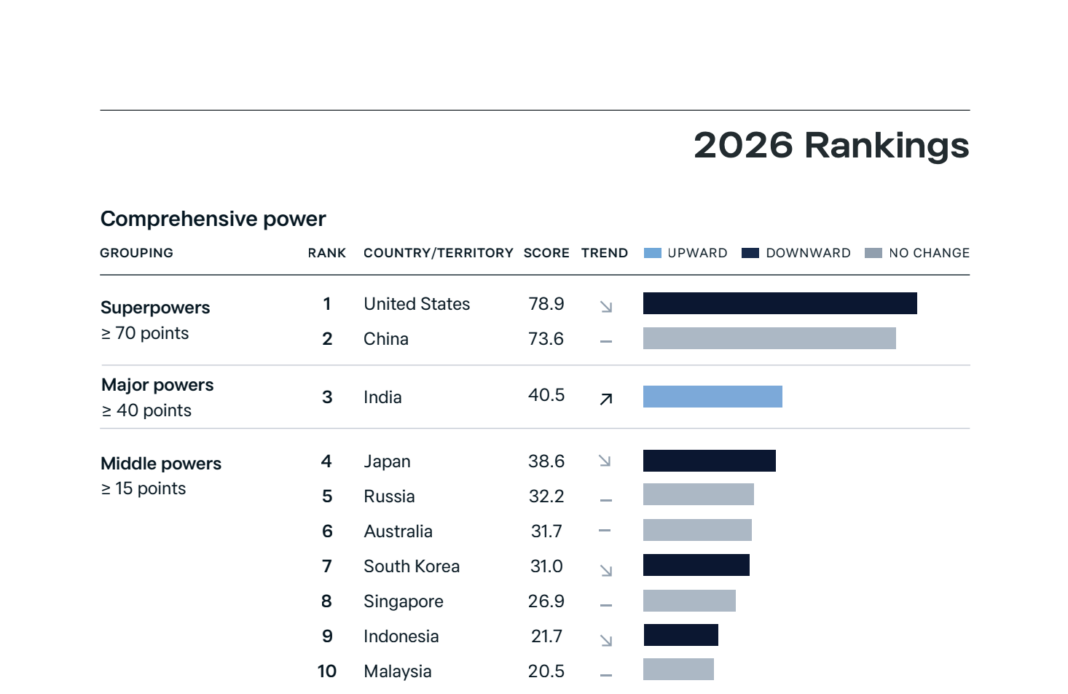
The rankings table on page 3 gives India a comprehensive power score of 40.5 with an upward trend arrow. That puts it in the “major power” category, defined as 40 points or more.
India’s lead is clear. Japan is fourth at 38.6, followed by Russia (32.2), Australia (31.7) and South Korea (31.0). Singapore, Indonesia, Malaysia, Thailand and Vietnam follow, all between roughly 20 and 27 points. India is the only country in the index placed in the “major power” tier.
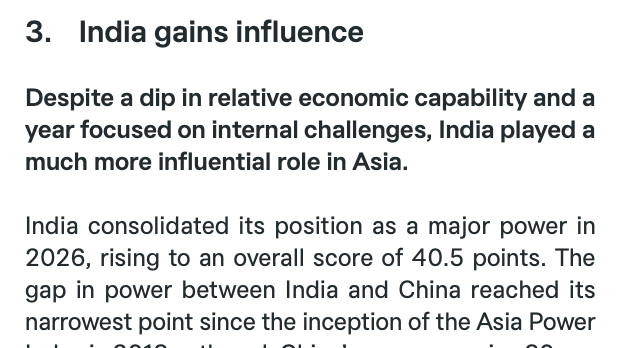
On page 9, the report says India “consolidated its position as a major power in 2026”. It credits this to a year in which India “played a much more influential role in Asia”, and it describes this as happening despite a year focused on internal challenges.
India was also one of the few countries to see its comprehensive score move up. The index’s list of greatest gains is led by Papua New Guinea and Taiwan, but India’s upward trend is one of only a handful recorded among the larger economies. Japan, Indonesia, South Korea and the United States all registered downward trends.
The gap with China is the narrowest on record
The report says the gap in power between India and China reached its narrowest point since the index began in 2018 (page 9). China scores 73.6 and India 40.5.
The report’s wider analysis of Asia’s balance of power also leaves room for India. It describes the region as “markedly bipolar” but within that structure, India is the clear third pole. Ahead of countries like Russia, Japan, South Korea and Vietnam.
3. India gains influence India rose to 40.5, consolidating its place as a major power. The gap with China is the narrowest since 2018, and Modi is now rated the second-most effective regional leader behind Xi, despite a dip in economic capability. 4/
— Hunter Marston (@hmarston4) November 22, 2026
Modi: the region’s second most effective leader
The report’s finding on leadership appears on page 10. Expert appraisals of Prime Minister Modi’s regional leadership “improved markedly”, lifting India three places on the relevant indicator. Modi is now judged to be the second most effective regional leader.
The appraisals come from the Asia Power Index’s expert survey on Diplomatic Influence. It asks respondents to rate how effectively leaders pursue their country’s diplomatic interests and how strategically ambitious they are.
Other leaders fared less well in the same survey. The report says President Donald Trump’s strategic ambition fell by more than that of any other leader surveyed except Taiwan’s President Lai Ching-te. Indonesian President Prabowo Subianto’s leadership ratings, at both global and regional levels, fell more steeply than any other leader’s.
Japan’s Prime Minister Sanae Takaichi was rated more effective globally than her predecessor but less highly for regional leadership. Japan’s score on that indicator fell nearly 9 points to 81. Australia’s Prime Minister Anthony Albanese saw his rating for advancing diplomatic interests in Asia fall 14 points to 76. South Korea’s President Lee Jae-myung was seen as less able to manage the US president, weakening perceptions of his regional leadership.
In that company, Modi’s improved standing stands out. The assessment reflects a year in which the index’s experts saw India’s regional leadership strengthen while that of several peer-country leaders weakened.
Diplomatic influence: India held steady as others slipped
Diplomatic Influence is India’s strongest measure. Its score is 70.3 points, in a year when the report says most countries faltered. The authors state that nearly every country in the index saw its Diplomatic Influence decline.
Diplomatic Influence ranking is mentioned on page 22. India sits ahead of South Korea (65.9), Australia (64.6), Indonesia (61.7), Vietnam (59.0), Russia (58.4) and Malaysia (56.3). It was one of the few countries in the top ten whose position did not fall.
The context matters. The United States saw the largest single-year loss in diplomatic influence on record, a fall of 6 points. Indonesia’s drop of 5.5 points was the region’s steepest. Japan, South Korea and Australia all lost ground, which the report says “calls into question their ability to shape the international system”. India’s ability to hold its position through that turbulence gives it a stronger relative standing than its raw score alone suggests.
Economic relationships: among only five countries not to fall
The report credits India with unusual stability in its regional economic links. Page 10 says relative stability in its regional trade relations and investment ties made it one of only five countries whose Economic Relationships score did not fall. That lifted it two places to seventh, with a score of 19.9 (page 20).
The Economic Relationships ranking shows how many of India’s peers went the other way. China, Japan, South Korea, Vietnam and Malaysia all registered downward trends. Japan’s score fell 15 per cent to a record low, and the report notes that for the first time in the index’s history, Japan is not the primary foreign investor in any other country in the index.
India also ranks third in the index on Economic Capability (page 16) ahead of Japan (25.6), South Korea (17.8), Singapore (15.4), Taiwan (14.3) and Russia (12.9).
Defence networks: BrahMos exports and deeper engagement
India’s defence partnerships also strengthened. The report says its Defence Networks score rose to 18.6 points as greater regional defence engagement. BrahMos missile sales to Southeast Asia lifted it two places to ninth. That measure assesses alliances, regional defence diplomacy and arms transfers (page 21).
The upward trend sits alongside India’s position in military strength. On Military Capability (page 17), India ranks fourth in Asia with a score of 48.5 and an upward trend. India is ahead of South Korea (32.5), North Korea (30.6), Japan (30.4), Singapore (25.8), Australia (25.7) and Pakistan (24.5).
On Resilience, which gauges the capacity to withstand external threats and covers internal stability, resource security, geoeconomic security, geopolitical security and nuclear deterrence, India is again fourth, at 55.4 (page 18). It sits ahead of Australia (42.6), North Korea (41.1), New Zealand (38.9), Japan (35.2) and South Korea (35.1).
Cultural influence rises on every front
India’s cultural influence rose to 43.8 points, placing it fourth in the region according to page 23. The report says the improvement was driven by gains across all three of the measure’s dimensions: cultural projection, information flows and people exchanges.
Those dimensions cover online search trends in the region, exports of cultural services, global brands, the regional appeal of national media outlets and universities, the number of inbound students from the region, the size of regional diasporas, and the attractiveness of countries as travel and emigration destinations. India ranks ahead of Malaysia (35.2), Australia (34.4), South Korea (30.5), Thailand (28.2), Singapore (27.9) and Indonesia (22.5).
The future: India third on Future Resources
India ranks third on Future Resources, with a score of 56.2. The report says India’s score rose on the back of an improved economic forecast, “highlighting the scale of the opportunities ahead for the country”.
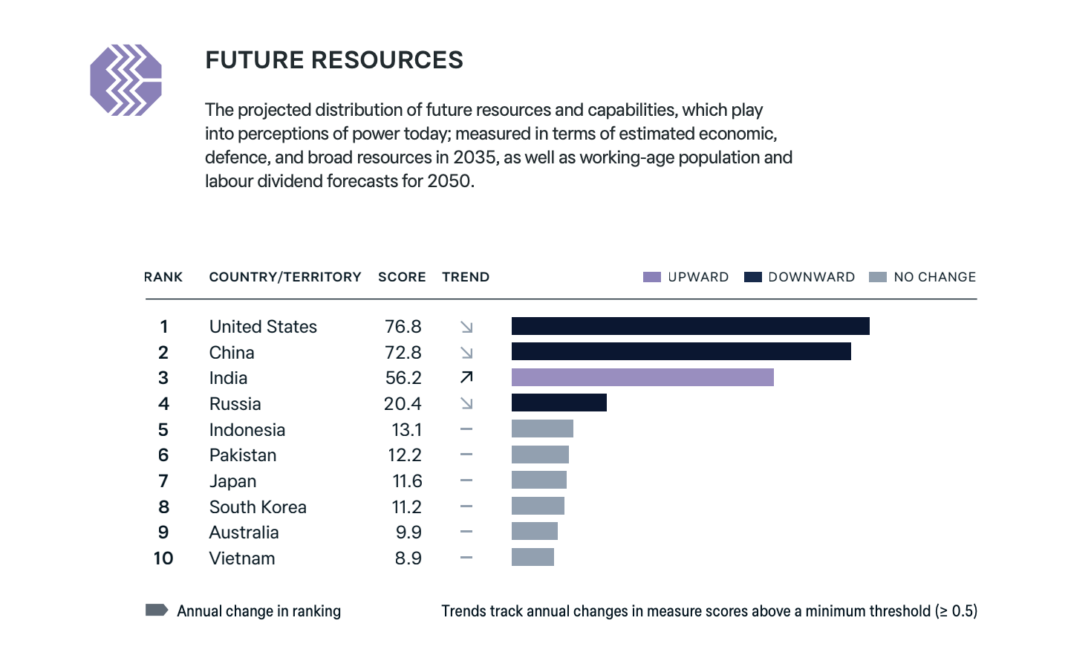
Future Resources combines forecasts of GDP at purchasing power parity in 2035, projected defence spending, estimated broad resources, and working-age population and labour dividend forecasts for 2050. India’s score is far above that of the fourth-ranked country, Russia (20.4), and the fifth, Indonesia (13.1). The gap between India and the countries below it is the widest anywhere in the top five of any ranking in the report.
A shifting regional balance
India’s rise comes as the report describes a “precarious balance” between the US and China. They point to the unresolved US war with Iran, which began in February 2026, as eroding US military capability and diplomatic standing. The US Defence Networks score fell 4.2 points to 77.3, its lowest since the index began.
The report says Southeast Asia rode out a rough year, with Indonesia’s diplomatic influence falling sharply. Middle powers had what the authors call a “middling moment”. Carney’s call for middle-power cooperation raised expectations, but the index shows a mixed picture. Japan, South Korea and Australia have all lost diplomatic ground.
Against that backdrop, India’s results look robust. It gained comprehensive power while the US declined, Japan dipped, and South Korea fell. It held steady in diplomacy while others slid, and it improved in defence networks, cultural influence and future resources.
What it means
For India, the picture this report paints is of a country consolidating its place as Asia’s third power, narrowing its distance from the second. India is led by a prime minister whom regional experts now rate second in Asia. The report’s own conclusion about India is that its rising future resources and narrowing power gap suggest it can sustain its growing influence.