

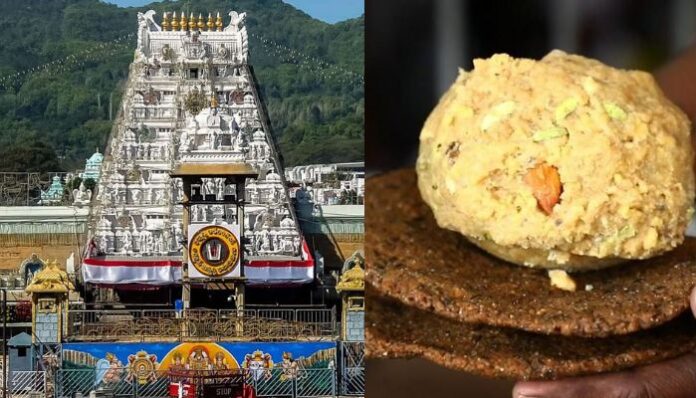
The Central Bureau of Investigation has filed its chargesheet in the Nellore ACB court in the Tirupati laddu case on Friday, 30th January stating clearly that the laddus were made using synthetic ghee and not milk-based cow ghee.
At the same time, the chargesheet makes no mention of the ghee supplied to the Tirumala Tirupati Devasthanams being mixed with animal fats like tallow or lard, putting an end to one of the biggest claims made earlier in the controversy.
Andhra Pradesh: CBI chargesheet confirms Tirumala laddu ghee was adulterated with vegetable oils and synthetic additives not animal fat. Probe flags procurement fraud and warns against unverified claims.@NewIndianXpress pic.twitter.com/jr5n8xWvit
— TNIE Andhra Pradesh (@xpressandhra) January 30, 2026
According to the CBI’s Special Investigation Team, laboratory tests of the ghee samples showed that the material used for preparing laddu prasadam was synthetic in nature and blended with vegetable oils.
The investigation found that the ghee was not derived from milk. Samples collected from tankers supplied by AR Dairy in July 2024 were examined and confirmed to be synthetic ghee. The chargesheet also described the ghee supplied by Bhole Baba Dairy and its related firms as fake ghee.
The case gained attention soon after Telugu Desam Party (TDP) chief and Andhra Pradesh Chief Minister N. Chandrababu Naidu made claims in September 2024 that ghee mixed with animal fats had been used in laddu prasadam during the previous YSR Congress government’s tenure from 2019 to 2024.
Following these claims, a special investigative team was formed under the Central Bureau of Investigation to examine whether tallow or lard had entered the ghee supply meant for the Tirumala Tirupati Devasthanams.
During the probe, the CBI asked the National Dairy Development Board to recheck the raw data and carry out fresh tests on the remaining ghee samples taken by TTD from four AR Dairy tankers on 6th and 12th July, 2024. NDDB completed the testing and submitted its detailed report on March 27 last year, which now forms a key part of the chargesheet.
The lab results showed that butyric acid levels were below measurable limits in all four samples, indicating extremely low milk fat content. Even with such low milk fat, the presence of lauric and myristic acids pointed to the use of coconut oil or palm kernel oil. Further fatty acid analysis confirmed the use of palm oil and palm stearin, while the chances of fish oil being present were found to be very low.
The report also revealed that in two samples, cholesterol was completely absent, confirming they were made only from vegetable oils. The absence of cholesterol meant that the possibility of tallow, lard, or fish oil was very low.
Based on the fatty acid profile and the presence of beta sitosterol, the chargesheet concluded that the ghee used was mainly a mixture of palm oil with palm kernel oil.
With the chargesheet now filed, the investigation has made it clear that while animal fat was not part of the laddu preparation, the use of synthetic material instead of milk-based ghee raises serious concerns about quality control and oversight in the supply chain of one of India’s most sacred temple offerings.
