

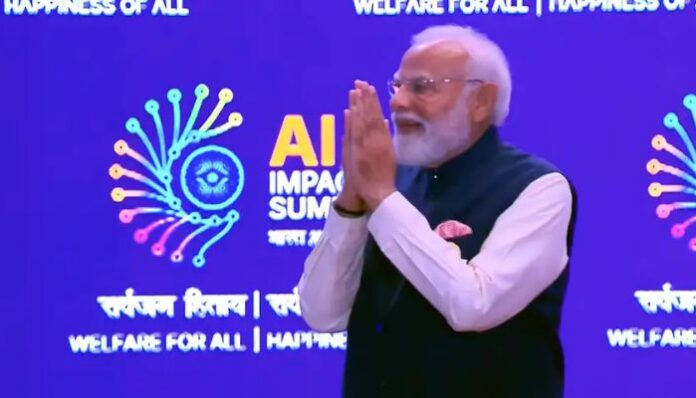
The fourth day of the India AI Impact Summit 2026 is underway in the national capital, marking one of the most significant moments of the six-day global gathering focused on artificial intelligence. The summit has brought together policymakers, global technology leaders, entrepreneurs and researchers to discuss how AI will shape economies and societies in the coming decades. The event is being held at Bharat Mandapam and has drawn participation from some of the biggest names in the tech world.
PM Modi outlines India’s AI vision
Prime Minister Narendra Modi addressed the opening ceremony of the summit on Thursday, 19th February, setting the tone for the discussions. In his keynote speech, he expressed confidence in India’s growing role in artificial intelligence.
“…India sees a strong future in AI. We have the talent, energy, capacity, and policy clarity. I am pleased to inform you all that at this summit, three Indian companies have launched their AI models and apps. These models showcase the talent of our youth…I invite you all to design and develop in India, deliver to the world, humanity,” the Prime Minister said.
#WATCH | Delhi: At the #IndiaAIImpactSummit2026, Prime Minister Narendra Modi says, "…India sees a strong future in AI. We have the talent, energy capacity, and policy clarity. I am pleased to inform you all that at this summit, three Indian companies have launched their AI… pic.twitter.com/GLwGz8249i
— ANI (@ANI) February 19, 2026
He also introduced what he called the MANAV Vision for AI. “Today at the New Delhi AI Impact Summit, I present the MANAV Vision for AI. MANAV means human, and MANAV Vision says M- moral and ethical systems: AI should be based on ethical guidance. A- accountable governance means transparent rules, robust oversight; N- national sovereignty means whose data, his right. A- accessible and inclusive means AI should be a multiplier, not a monopoly. V- valid and legitimate means AI should be lawful and verifiable. This MANAV vision of India will become an important link for the welfare of humanity in the AI-based world of the 21st century,” he said.
#WATCH | Delhi: At the #IndiaAIImpactSummit2026, Prime Minister Narendra Modi says, "Today at the New Delhi AI Impact Summit, I present the MANAV Vision for AI. MANAV means human, and MANAV Vision says M- moral and ethical systems: AI should be based on ethical guidance. A-… pic.twitter.com/KR3rz8pGet
— ANI (@ANI) February 19, 2026
Global technology leaders speaking at the summit praised India’s vision and its expanding role in AI.
Sundar Pichai: Don’t let the digital divide become an AI divide
Sundar Pichai, CEO of Google and Alphabet Inc., said that inclusivity must remain central to AI development. “We cannot allow the digital divide to become an AI divide. That means investing in compute infrastructure and connectivity… We’re also building a vast network of subsea fibre optic cables, including four new systems between the US and India as part of our America-India Connect initiative announced yesterday,” he said.
#WATCH | Delhi: At the #IndiaAIImpactSummit2026, CEO of Google and Alphabet, Sundar Pichai says, "We cannot allow the digital divide to become an AI divide. That means investing in compute infrastructure and connectivity… We're also building a vast network of subsea fibre optic… pic.twitter.com/c5x0aJCqU8
— ANI (@ANI) February 19, 2026
He also spoke about the economic shifts AI will bring. “AI will undeniably reshape the workforce, automating some roles, evolving others, and creating entirely new careers. 20 years ago, the concept of a professional YouTube creator didn’t exist. Today, there are millions around the world,” he added.
Anthropic CEO Dario Amodei: India has a crucial role in AI’s future
Dario Amodei, CEO of Anthropic, said India has a crucial role in shaping the future of AI. “India has an absolutely central role to play in these questions and challenges, both on the side of the opportunities and on the side of the risks,” he said, while also highlighting AI’s potential to cure diseases and lift billions out of poverty.
Amodei announced that Anthropic has opened an office in Bengaluru this week and appointed Irina Ghose as managing director for India. He added that the company has partnered with major Indian enterprises, including Infosys.
#WATCH | Delhi | At the #IndiaAIImpactSummit2026, CEO of Anthropic, Dario Amodei says, "As a sign of our commitment, we just this week opened an office in Bengaluru and hired Irina Ghose, who has spent three decades building businesses in India, as our managing director for… pic.twitter.com/tUUYS7275h
— ANI (@ANI) February 19, 2026
N Chandrasekaran: Building AI at scale with trust
Meanwhile, N. Chandrasekaran, Chairman of the Tata Group, said India has treated AI as a strategic national capability under the Prime Minister’s leadership. “We are building AI at scale with trust, resilience and long-term competitiveness,” he said, adding that Tata plans to develop AI-optimised, domain-specific chips, beginning with the automotive sector.
#WATCH | Delhi: At the #IndiaAIImpactSummit2026, Chairman of the Tata Group, N Chandrasekaran, says, "At the Tata Group, we are adopting AI across the stack, from silicon to systems to AI-ready data centers to applications and AI agents and we believe such a vision and such a… pic.twitter.com/paGs3kfI1s
— ANI (@ANI) February 19, 2026
He cited examples of rapid AI adoption, including rural participants learning and deploying AI tools within hours, to illustrate the technology’s lowering of barriers. He also positioned India as a nation of “AI optimists,” linking the country’s confidence to its track record in building large-scale digital public infrastructure, from digital identity systems to payments platforms.
As the summit enters its crucial middle phase, the strong endorsements from global tech leaders underline India’s growing influence in the global AI conversation.
